


EPD Consultants: When You Need Expert Support for Verified EPDs

An Environmental Product Declaration is not just a quick carbon estimate. It is a verified environmental report built from product data, facility data, LCA methodology, Product Category Rules, and third-party review.
That is why expert support matters. An EPD consultant can help companies collect the right data, avoid methodology mistakes, respond to verifier questions, and create EPDs that customers can actually use in bids, tenders, and submittals. Here are the key things to know before choosing an EPD consultant or building an EPD workflow.
Key Takeaways
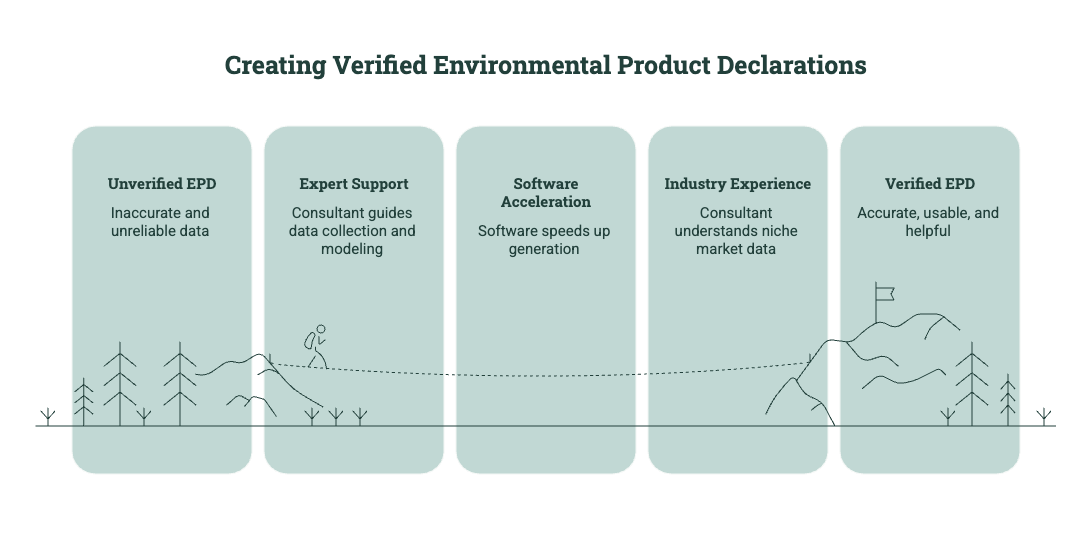
- An EPD consultant helps companies create verified Environmental Product Declarations. They support data collection, LCA modeling, PCR interpretation, EPD documentation, verification responses, and publication.
- EPD consultants are especially valuable when the process is new, complex, or high-stakes. If a customer, public tender, owner, contractor, or agency requires a verified Type III EPD, expert support can help avoid mistakes.
- Software can speed up EPD generation, but expert guidance still matters. Verified EPDs depend on accurate data, defensible assumptions, correct standards, and proper verification.
- Industry experience is important. In niche markets like ready-mix concrete and cement, an EPD consultant or support team should understand plant data, product data, mix designs, cement, SCMs, PCRs, GWP, and customer requirements.
- The best EPD partner is not just someone who creates a document. The best partner helps you create EPDs that are accurate, verified, usable, and helpful in real customer conversations.
What Is an EPD Consultant?
An EPD consultant is an expert who helps companies create Environmental Product Declarations. An EPD, or Environmental Product Declaration, is a standardized report that shows the environmental impacts of a product. It is usually based on a Life Cycle Assessment and follows specific standards, product category rules, and third-party verification requirements.
In simple terms, an EPD consultant helps turn product, facility, material, and supply chain data into a verified document customers can use. That might include collecting data, checking assumptions, interpreting the PCR, preparing the report, responding to verifier questions, and helping the final EPD get published.
For many companies, the first EPD request comes from a customer. A contractor may need it for a bid. An owner may need it for a low carbon procurement requirement. An architect may need it for a green building project. A public agency may require it for a tender. When that happens, the company quickly realizes an EPD is not just a PDF. It is a technical process.
An EPD is only as strong as the data, assumptions, and methodology behind it.
Who This Article Is For
This article focuses on EPD consultants and expert EPD support. If you are comparing platforms, automation, or calculator tools, read a separate guide on EPD software for concrete producers. This article is different. It focuses on when human expertise matters, what EPD consultants actually do, and why verified EPDs still require strong data, standards knowledge, and industry-specific review.
.png)
Why Companies Search for EPD Consultants
Most companies start searching for an EPD consultant because they have been asked for an EPD and do not know where to start. The request may come from a customer, contractor, architect, engineer, procurement team, public agency, or sustainability consultant.
This is especially common in construction products. EPDs are showing up in public tenders, Buy Clean programs, LEED projects, infrastructure work, data centers, universities, hospitals, commercial buildings, and large private developments. In Europe, product environmental data is also becoming more important because of EN 15804+A2, CPR, and Digital Product Passport expectations.
Companies often look for EPD consultants when they need to:
- Create their first verified EPD
- Respond to a customer EPD request
- Support a public tender or bid
- Meet green building documentation requirements
- Publish a product-specific EPD
- Understand GWP and embodied carbon results
- Prepare for verification
- Update an existing EPD
- Enter a market with different EPD standards
- Support sales teams with credible environmental product data
The urgency usually comes from the customer. The complexity comes from the data.
What Does an EPD Consultant Actually Do?
An EPD consultant’s work can vary depending on the product, industry, and project requirement. Some consultants handle the full EPD process. Others support specific parts, such as LCA modeling, data collection, verification response, or technical review. A strong EPD consultant usually helps with these core steps.
1. Define the EPD scope
Before anything is calculated, the consultant helps define what the EPD will cover. Is it one product, a product family, one plant, multiple plants, one mix, or multiple similar products? What declared unit or functional unit applies? Which geography and production period are being represented?
This step matters because the scope affects the data, the result, and whether the EPD will be useful for the customer’s requirement.
2. Identify the right standards and PCR
EPDs must follow standards and Product Category Rules, also called PCRs. The PCR is the rulebook for that product category. It defines how the LCA should be calculated, what data is required, what life cycle stages are included, and how results should be reported.
For construction products, common frameworks may include ISO 14025, ISO 14040, ISO 14044, ISO 21930, EN 15804+A2, and product-specific PCRs. A concrete EPD, cement EPD, steel EPD, insulation EPD, and glass EPD will not all follow the same exact rules.
3. Collect product and facility data
The consultant helps gather the data needed to create the EPD. This may include raw materials, supplier data, transportation distances, energy use, water use, production volumes, waste, packaging, emissions factors, and facility information.
This is often the hardest part. Many companies have the data, but it is spread across operations, procurement, QC, production, accounting, plant systems, and spreadsheets. An EPD consultant helps determine what is actually needed and whether the data is complete enough to use.
4. Build or review the LCA model
The consultant uses Life Cycle Assessment methodology to calculate environmental impacts. For many construction products, the most watched result is GWP, or Global Warming Potential. But EPDs usually include multiple environmental impact categories, not just carbon.
The consultant checks whether the model follows the correct PCR, uses reasonable assumptions, and reflects the actual product or process being reported.
5. Prepare the EPD report
Once the LCA is complete, the consultant helps prepare the EPD document. This includes the product description, declared unit, system boundary, life cycle stages, data quality, impact results, assumptions, limitations, and required program operator language.
A good EPD report should be technically correct, but it should also be usable. Customers, contractors, agencies, and project teams need to understand what the EPD covers and how to use it.
6. Support third-party verification
Verified EPDs require independent review. A third-party verifier checks the EPD and supporting LCA work against the applicable standards and PCR. The verifier may ask questions, request clarifications, or require corrections.
An EPD consultant helps respond to these questions and resolve issues. This is one of the biggest reasons expert support matters. Verification can expose weak assumptions, missing data, or unclear documentation.
7. Support publication and customer use
After verification, the EPD is published through a program operator or recognized EPD registry. Some consultants also help the company explain the EPD to customers, sales teams, procurement teams, or project stakeholders.
This matters because publishing the EPD is not the end of the process. The company may still need to use it in bids, submittals, customer requests, and product comparisons.
.png)
When Should You Hire an EPD Consultant?
You should consider hiring an EPD consultant when the EPD process is new, technical, time-sensitive, or tied to a customer requirement. Expert support is especially useful when the EPD needs to be verified, published, and accepted by a specific market. An EPD consultant makes sense when:
- You are creating your first EPD.
- A customer requires a verified Type III EPD.
- You are responding to a public tender or bid.
- The applicable PCR is complicated or recently updated.
- Your product has complex inputs or supply chains.
- Your internal data is not organized yet.
- You need a product-specific or plant-specific EPD.
- You need to update or renew an existing EPD.
- You need support during third-party verification.
- You are entering Europe and need EN 15804+A2 alignment.
- You are preparing for CPR or Digital Product Passport expectations.
- Your sales team needs help explaining the EPD to customers.
The more important the EPD is to winning work, the more important expert support becomes.
When You May Not Need a Full EPD Consultant
Not every company needs a fully manual consulting project every time. If your data is already organized, your product category is well understood, and you need many EPDs over time, a repeatable EPD generation workflow may make more sense. This is where EPD software and internal systems can help. Software can make it easier to manage product data, reduce repetitive manual work, update EPDs, and scale across multiple products, plants, or regions. But even then, expert support still matters.
The practical answer is often not “consultant or software.” It is: Use software to move faster. Use expert support to make sure the EPD is right. That is especially true when EPDs are used in bids, procurement, customer requests, or regulatory documentation.
EPD Consultant vs. EPD Software: The Clear Difference
An EPD consultant provides expertise. EPD software provides structure, speed, consistency, and data management. Both can be valuable, but they are not the same thing.

EPD Consultant vs. EPD Calculator
An EPD calculator is usually a tool that estimates environmental impacts based on product inputs. It may help calculate GWP, compare materials, or test early design changes. Some calculators are useful for planning, but not all calculators produce verified EPDs.
That difference is important. If a customer asks for “carbon data,” an estimate may help with early conversations. If a project requires a “third-party verified Type III EPD,” a basic calculator is usually not enough by itself. Think of it this way:
- EPD consultant: Helps guide the technical process.
- EPD calculator: Helps estimate or compare environmental impacts.
- EPD software: Helps organize and generate EPD data faster.
- Verifier: Independently reviews the EPD.
- Program operator: Publishes the final EPD.
.png)
Why Expert Support Still Matters With EPD Software
EPD software can make the process faster, but software cannot fix bad data, unclear assumptions, or incorrect methodology by itself. If the wrong data goes in, the output can still be wrong. If the wrong PCR is used, the EPD may not meet the requirement. If the assumptions are unclear, verification may take longer.
Expert support helps answer questions like:
- Are we using the right PCR?
- Is this product grouped correctly?
- Is the declared unit correct?
- Are supplier datasets appropriate?
- Does the data period meet the requirement?
- Are transportation assumptions defensible?
- Why did the GWP change?
- What will the verifier ask?
- Will this EPD be accepted by the customer?
This is why the best EPD workflows combine software with expert review. Speed is useful, but only if the final EPD is credible.
Software can make EPD generation faster. Expert support helps make sure the faster answer is still the right answer.
Why Industry-Specific EPD Expertise Matters
EPDs are not one-size-fits-all. Every product category has its own materials, manufacturing process, PCR, assumptions, and customer expectations. A consultant who understands one industry may not automatically understand another.
This matters in niche and technical markets. For example, ready-mix concrete and cement EPDs require knowledge of plant data, cement types, SCMs, aggregate sources, admixtures, mix designs, strength classes, batching, transportation, product-specific EPDs, GWP, and concrete PCR requirements.
A general LCA consultant may understand environmental modeling, but producers also need support that understands the market they sell into. In concrete, the EPD has to be useful for contractors, owners, engineers, DOTs, public agencies, procurement teams, and sustainability consultants.
.png)
For concrete and cement producers, industry-specific support should understand:
- Ready-mix and cement production
- Plant-level data
- Mix design data
- Cement and clinker inputs
- SCMs such as slag, fly ash, pozzolans, and calcined clay
- Aggregate and admixture data
- Product-specific vs industry average EPDs
- GWP by strength class
- Concrete PCR requirements
- ISO 14025 and ISO 21930
- EN 15804+A2 for Europe
- Buy Clean and low-carbon procurement
- Customer-facing bid and submittal requirements
An EPD is not just about calculation. It is about creating data the market can actually use.
Questions to Ask Before Choosing an EPD Consultant
Before choosing an EPD consultant or expert-support partner, ask practical questions.
Experience and fit
- Have you created EPDs for products like ours?
- Do you understand our industry and product category?
- Which standards and PCRs do you support?
- Which program operators do you work with?
- Have you supported verified Type III EPDs?
Data and process
- What data will we need to provide?
- Who checks data quality?
- How do you handle missing supplier data?
- How do you document assumptions?
- How do you manage confidential product or facility data?
Verification and publication
- Who handles verifier questions?
- What happens if the verifier challenges an assumption?
- How long does verification usually take?
- Where will the EPD be published?
- Will the final EPD be accepted by our target customers or markets?
Support after publication
- Can you help explain the EPD to customers?
- Can you support updates or renewals?
- Can this process scale across more products or plants?
- Will we have expert support after the first EPD is done?
Common Mistakes When Hiring an EPD Consultant
The 1st mistake is choosing only based on price. A cheaper process can become expensive if the EPD does not meet the project requirement, the verifier has major concerns, or the final document is not useful for customers.
The 2nd mistake is not asking about industry experience. A consultant may know LCA but may not understand your product category, customer expectations, or procurement requirements. The 3rd mistake is treating the EPD as a one-time document. If customers keep asking for EPDs, your team needs a repeatable process, not a one-off scramble every time.
The 4th mistake is ignoring post-publication support. Your sales or technical team may need help explaining the EPD, responding to customer questions, or comparing product GWP values. The 5th mistake is assuming all EPDs are the same. Industry average, product-specific, plant-specific, and project-specific data can serve different purposes. The wrong type of EPD may not satisfy the customer.
.png)
What Makes a Good EPD Consultant?
A good EPD consultant is technical, organized, responsive, and honest about what the EPD can and cannot say. They should not just produce a report. They should help your team understand the data behind the report. A strong EPD consultant should:
- Understand the applicable standards and PCRs
- Know your product category
- Explain the data request clearly
- Help identify missing or weak data
- Document assumptions carefully
- Support verification questions
- Communicate in plain language
- Help your team use the EPD after publication
- Avoid vague environmental claims that are not backed by the data
The best EPD consultant does not make your product look “green” with weak claims. They help you create credible environmental product data that customers can trust.
The goal is not just to publish an EPD. The goal is to publish an EPD your customers can actually use.
How Climate Earth Combines EPD Software and Expert Support
Climate Earth helps concrete producers generate and manage verified EPDs faster. Our platform helps turn plant, product, and material data into usable EPD documentation while supporting the standards and verification workflows customers increasingly ask for.
What makes the process stronger is the combination of software and expert support. Climate Earth provides a faster EPD generation workflow backed by LCA expertise and industry knowledge. That means producers can manage EPDs more efficiently while still having support from people who understand concrete, cement, EPD standards, GWP, and verification requirements.
For concrete producers, this matters because EPD requests are becoming more common across public tenders, infrastructure projects, data centers, commercial work, and low-carbon procurement. Producers need EPDs that are fast, accurate, standards-aligned, verified, and useful in real customer conversations.
Why producers choose Climate Earth
- Built for concrete EPD generation
- Provide EPD Software and EPD Consulting services
- Supports Type III verified EPD workflows
- Combines EPD software with expert LCA support
- Helps producers respond faster to EPD requests
- Keeps plant and product data organized
- Supports ISO 14025 and EN 15804+A2-aligned reporting
- Helps prepare for evolving low-carbon procurement expectations
- Provides support from people who understand concrete and cement markets
Ready to get started? Generate verified EPDs faster with software and expert support built for ready-mix and cement producers.
Book a demo to see how Climate Earth can help your team manage EPD generation, standards compliance, and environmental product data in one workflow.
FAQ: EPD Consultants
What is an EPD consultant?
An EPD consultant is an expert who helps companies create Environmental Product Declarations. They usually support data collection, LCA modeling, PCR interpretation, EPD report preparation, third-party verification, and publication.
What does an EPD consultant do?
An EPD consultant helps define the EPD scope, collect product and facility data, apply the correct PCR, model environmental impacts, prepare the EPD report, respond to verifier questions, and support publication.
When should I hire an EPD consultant?
You should consider hiring an EPD consultant when you are creating your first EPD, responding to a verified EPD requirement, dealing with a complex product category, or preparing for third-party verification.
Do I need an EPD consultant if I have EPD software?
You may still need expert support. EPD software can speed up the process, but verified EPDs still require accurate data, correct methodology, PCR alignment, and verification support.
What is the difference between an EPD consultant and an LCA consultant?
An LCA consultant focuses on Life Cycle Assessment modeling. An EPD consultant may include LCA support, but also helps translate that work into a verified EPD report, verification process, and published declaration.
What is the difference between an EPD consultant and an EPD calculator?
An EPD calculator helps estimate environmental impacts. An EPD consultant helps guide the technical and verification process needed to create a verified EPD.
Can a consultant help with EPD verification?
Yes. A consultant can help prepare documentation for third-party verification and respond to verifier questions or requested changes.
Why does product category expertise matter?
Each product category follows different rules, data needs, and customer expectations. Industry-specific expertise helps make the EPD more accurate and more useful in the market.
What should concrete producers look for in EPD support?
Concrete producers should look for support that understands ready-mix, cement, plant data, mix designs, SCMs, aggregate sources, concrete PCRs, ISO 14025, ISO 21930, EN 15804+A2, and GWP reporting.
Is an EPD consultant enough if I need many EPDs?
A consultant can help, but if you need many EPDs across products, plants, or regions, you may also need a repeatable software-supported workflow.
Summary
EPD consultants help companies create verified Environmental Product Declarations by supporting data collection, LCA modeling, PCR interpretation, EPD reporting, verification, and publication. They are especially valuable when the process is new, complex, or tied to a customer, tender, or procurement requirement.
EPD software and EPD calculators can help with speed, structure, and estimation, but expert support still matters. Verified EPDs depend on accurate data, clear assumptions, correct standards, and industry-specific knowledge.
For niche markets like ready-mix concrete and cement, that expertise is even more important. Producers need EPDs that are not only generated quickly, but also credible, verified, and useful in real bids, submittals, and customer conversations.
Related articles

LEED v5 Requirements: What They Mean for Low Carbon Concrete

How to Read a Concrete EPD: Quick, Expert Guide