


What Is an EPD? Environmental Product Declaration Basics

An Environmental Product Declaration, or EPD, is a third-party verified document that reports the environmental impact of a product.
It is based on a Life Cycle Assessment, or LCA, and shows data such as Global Warming Potential, energy use, water use, resource use, and other environmental indicators.
In construction and manufacturing, EPDs are used to compare products, support sustainability reporting, meet project requirements, and respond to policies like Buy Clean and embodied carbon procurement rules.
Key Takeaways
- An EPD is verified environmental data for a product. It is based on a Life Cycle Assessment and follows specific Product Category Rules.
- An EPD does not automatically mean a product is low carbon. It means the product’s environmental impact has been measured and reported in a standardized way.
- EPDs are becoming more important because buyers want proof. They are showing up in construction specs, LEED projects, Buy Clean programs, data centers, universities, infrastructure, and global product regulations.
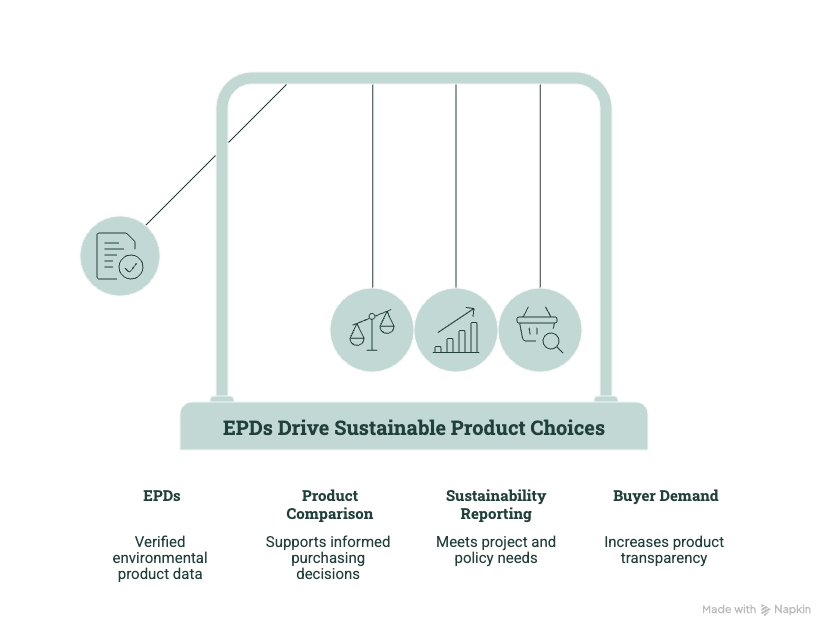
Table of Contents
1. What Does EPD Stand For?
2. How EPDs Are Created
3. What EPDs Measure
4. How to Read an EPD Step by Step
5. Where EPDs Are Used
6. EPD Policies by Region: U.S., Canada, Europe, and Global Markets
7. EPD Software and Development Options
8. Best Practices for Creating EPDs
9. Common EPD Questions
10. Summary
1. What Does EPD Stand For?
EPD stands for Environmental Product Declaration. In sustainability, construction, manufacturing, and procurement, an EPD is a verified report that communicates the environmental impact of a product. It is most commonly used to help buyers understand the footprint of materials and compare products within the same category.
An EPD is based on a Life Cycle Assessment, often called an LCA. The LCA measures the energy, materials, emissions, transportation, waste, and other environmental impacts connected to a product. The EPD takes that technical data and turns it into a standardized public document.
An EPD is not the same thing as a green certification. It does not automatically mean a product is sustainable, low carbon, or better than another product. It means the product’s environmental data has been calculated, verified, and published in a format buyers can review.
“An EPD is not a green label. It is a transparency document.”
2. How EPDs Are Created
Most EPDs follow a similar process. The exact steps can vary by product type, region, and program operator, but the goal is always the same: collect product data, calculate environmental impacts, verify the results, and publish the final document.
- Select the Product Category Rules.
Product Category Rules, or PCRs, explain how the environmental impact of a specific product type must be measured. They define what data is needed, which life cycle stages are included, and how results should be reported. - Collect product and manufacturing data.
This can include raw materials, energy use, fuel use, water use, production volumes, waste, packaging, supplier data, and transportation. For concrete and construction materials, it may also include plant data, mix designs, cement content, aggregate sources, and delivery assumptions. - Conduct the Life Cycle Assessment.
The LCA calculates the product’s environmental impacts using the data collected. This is where indicators like Global Warming Potential, energy use, water use, and other impact categories are measured. - Prepare the EPD report.
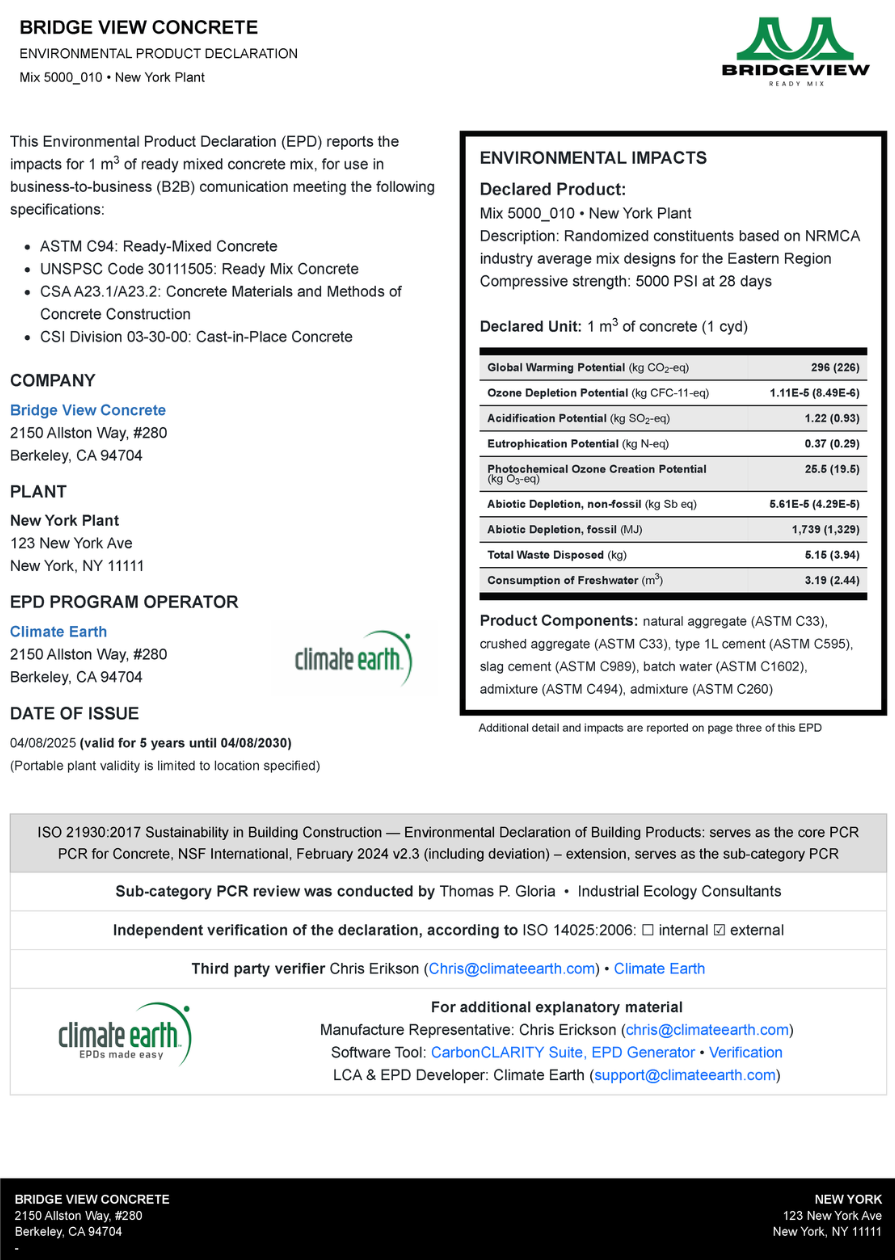
The LCA results are organized into a standardized EPD format. The report usually includes product information, declared unit, system boundary, impact tables, standards used, and verification information. - Complete third-party verification.
An independent verifier reviews the EPD to confirm that it follows the correct standards, PCR, and program rules. - Publish the EPD.
Once verified, the EPD is published through a program operator or registry so customers, project teams, and procurement teams can access it.
“The quality of an EPD depends on the quality of the data behind it.”
.png)
3. What EPDs Measure
EPDs measure environmental impacts across a product’s life cycle. The exact indicators depend on the product category rules and standards used. However, most EPDs include a set of common environmental impact categories.
The most searched and most commonly used number is Global Warming Potential, or GWP. GWP measures the climate impact of a product and is usually shown as kilograms of carbon dioxide equivalent, written as kg CO2e. This makes it easier to compare greenhouse gas impacts using one common unit.
Common EPD impact categories include:
- Global Warming Potential: climate impact, usually shown as kg CO2e
- Ozone Depletion Potential: impact on the ozone layer
- Acidification Potential: contribution to acid rain and related effects
- Eutrophication Potential: contribution to nutrient pollution in water systems
- Photochemical Ozone Creation Potential: contribution to smog formation
- Abiotic Resource Depletion: use of nonrenewable resources
- Primary Energy Use: renewable and nonrenewable energy demand
- Water Use: water consumed or used in production
- Waste Generation: waste created across life cycle stages
These categories help buyers understand more than just carbon. A product may perform well in one category and worse in another. That is why EPDs are most useful when they are read as a full environmental profile, not just a single number.
.png)
4. How to Read an EPD Step by Step
Reading an EPD can feel technical at first, but the process becomes easier when you know what to look for. Start with the product details, then check the unit, scope, GWP number, and verification information.
.png)
Step 1: Confirm the product
Start with the product name, manufacturer, product category, and description. Make sure the EPD is actually for the product you plan to use. This is especially important for construction materials because products can vary by plant, region, formula, or mix design.
Step 2: Check the declared unit or functional unit
The declared unit tells you what the environmental impacts are based on. For example, an EPD may report impacts per cubic yard of concrete, per metric ton of cement, per square meter of flooring, or per kilogram of product. You cannot compare EPDs fairly unless the units make sense together.
Step 3: Review the life cycle scope
Check whether the EPD is cradle-to-gate, cradle-to-grave, or cradle-to-gate with options. Cradle-to-gate usually covers raw materials through manufacturing. Cradle-to-grave may also include use, maintenance, demolition, disposal, reuse, or recycling.
Step 4: Find the GWP number
GWP is usually the most important number for embodied carbon reporting. It is shown as kg CO2e per declared unit. A lower GWP can indicate a lower carbon footprint, but only when the comparison is fair.
Step 5: Check whether the EPD is product-specific or industry-wide
A product-specific or plant-specific EPD usually gives more precise data than an industry-wide EPD. Industry-wide EPDs can still be useful, but they may not reflect the actual product being used on a project.
Step 6: Check the publication and expiration date
Many EPDs are valid for about five years, but always check the date. Manufacturing processes, suppliers, materials, energy sources, and transportation routes can change. An older EPD may not reflect the current product.
Step 7: Review the verifier and program operator
A credible EPD should identify the program operator and third-party verifier. This confirms that the EPD is not just a self-published environmental claim.
“Do not compare two EPDs until you know they are measuring the same type of product, with the same unit, under the same rules.”
6. Where EPDs Are Used
EPDs are used wherever buyers need verified environmental product data. They are especially common in construction because buildings and infrastructure use large quantities of materials with significant embodied carbon. Concrete, cement, steel, asphalt, glass, aluminum, insulation, gypsum, flooring, roofing, and wood products are all common EPD categories.
In construction, EPDs show up in:
- LEED projects
- BREEAM projects
- Data centers
- Universities
- Hospitals
- Airports
- Public infrastructure
- DOT projects
- Government buildings
- Corporate campuses
- Large private developments
EPDs are also used outside construction. They can apply to packaging, furniture, textiles, electronics, food products, chemicals, consumer goods, and other manufactured products. The common thread is that customers want verified environmental data instead of broad sustainability claims.
.png)
7. EPD Policies, Standards, and Regional Differences
EPD demand is growing globally, but each region is moving for slightly different reasons. In the United States, demand is often driven by Buy Clean policies, public procurement, and project specifications. In Canada, federal embodied carbon requirements are pushing teams to disclose and reduce material carbon. In Europe, EPDs are tied more deeply to harmonized construction standards, building life cycle assessment, and digital product data.
United States: Buy Clean and Low Embodied Carbon Procurement
In the United States, EPD demand is being driven by federal purchasing, state Buy Clean policies, DOT programs, and project-specific low-carbon material requirements. These programs use procurement to encourage lower-carbon construction materials. EPDs are useful because they provide standardized GWP data for materials like concrete, cement, asphalt, steel, and glass.
Important U.S. drivers include:
- Federal Buy Clean Initiative
- EPA Low Embodied Carbon Construction Materials Label Program
- GSA low embodied carbon material requirements
- FHWA Low Carbon Transportation Materials Program
- State Buy Clean laws and DOT programs
- LEED material transparency credits
- Private owner requirements for data centers, campuses, and infrastructure
The U.S. market is still fragmented. Requirements can vary by agency, state, project owner, material category, and funding source. That means manufacturers need to know which EPD type, standard, and program operator each target market will accept.
“In the U.S., EPD demand is often driven by the project. If the owner, agency, DOT, or spec requires carbon data, the supplier needs a credible EPD ready.”
Canada: Federal Embodied Carbon Requirements
In Canada, EPD demand is strongly tied to federal embodied carbon requirements for construction. Canada’s Standard on Embodied Carbon in Construction requires disclosure and reduction of embodied carbon on certain federal construction projects. This gives EPDs a clear role in documenting the carbon impact of materials.
Canada is also moving toward more specific data. For concrete, federal requirements point toward using the best available GWP data, with higher-resolution EPDs preferred when available. That means product-specific, facility-specific, or mix-specific data can be more valuable than broad averages.
The main difference from the U.S. is that Canada’s federal standard gives the market a more centralized signal. The U.S. has strong momentum, but it is more fragmented across federal, state, and local programs.
“In Canada, EPD demand is closely tied to federal embodied carbon disclosure. The market is moving toward better, more specific product data.”
Europe: EN 15804, CPR, DPP, RE2020, and Building LCA
Europe has one of the most mature EPD markets. Construction product EPDs commonly rely on EN 15804, which provides core rules for environmental declarations of construction products. This creates more consistency in how construction product impacts are reported.
Important European drivers include:
- EN 15804 for construction product EPDs
- ECO Platform for verified construction EPD harmonization
- EU Construction Products Regulation, or CPR
- Digital Product Passport, or DPP
- Ecodesign for Sustainable Products Regulation
- France RE2020
- INIES database for French FDES declarations
- Building-level life cycle assessment requirements
Europe is different because EPDs are more integrated into the technical and regulatory system. They are often used as inputs into whole-building life cycle assessment, not just as product documents. The direction is toward more harmonized, digital, and regulation-ready product data.
“In Europe, EPDs are becoming part of the data infrastructure for buildings.”
Rest of World: Export Markets and Emerging Requirements
Outside the U.S., Canada, and Europe, EPD demand varies by country and market. Some countries have active program operators and green building markets, while others are earlier in the process. Export requirements, international certification systems, public procurement, and large private projects are all increasing demand.
Global manufacturers should not assume one EPD will work everywhere. Requirements can differ by product category, PCR, program operator, standard, language, database, and local regulation. The safest approach is to understand the target market before developing the EPD.
.png)
8. EPD Software and Development Options
There are several ways to develop an EPD. A company can work with an LCA consultant, use EPD software, work with a program operator, or build an internal EPD process. The best path depends on the product category, number of products, quality of internal data, and how often EPDs need to be created or updated.
A consultant-led process can work well for companies that need one EPD or are just getting started. The consultant can help select the PCR, collect data, conduct the LCA, prepare the EPD, and support verification.
Software becomes more useful when a company needs EPDs at scale. If a manufacturer has many products, plants, regions, or product variations, software can reduce manual work and make the process more repeatable. This is especially useful for construction material producers that need EPDs across multiple plants, mixes, or product lines.
The best EPD software should:
- Support the right standards and PCRs
- Simplify data collection
- Improve repeatability
- Reduce manual spreadsheet work
- Support third-party verification
- Help update EPDs when products or suppliers change
- Make EPD data useful for sales, bids, compliance, and product improvement
Climate Earth's software is specifically built for concrete producers who need unlimited, instant, verified EPDs, and easy workflows to manage projects with carbon and EPD requirements.
9. Best Practices for Creating High-Quality EPDs
The strongest EPDs start with strong data. Companies should collect accurate information on raw materials, suppliers, production volumes, energy use, fuel use, water use, transportation, packaging, and waste. If the data is scattered across spreadsheets, departments, or plant systems, the EPD process will take longer.
Before developing an EPD, confirm:
- Which product category the EPD will cover
- Which PCR applies
- Which standard or regional requirement matters
- Which program operator will publish it
- Whether the EPD needs to be product-specific, plant-specific, or industry-wide
- Whether the target market requires ISO 21930, EN 15804, or another standard
- Whether the customer needs GWP only or a full environmental impact profile
- Whether internal data is clean enough to support verification
- Whether the EPD needs to support LEED, Buy Clean, federal procurement, or building LCA
A good EPD process should not end when the document is published. Companies should use EPD data to identify carbon hotspots, compare suppliers, improve products, support sales teams, and respond faster to customer requests. The best EPD programs turn environmental data into a practical business tool.
.png)
10. Common EPD Questions
How do I get an EPD for a manufactured product?
Start by identifying the correct Product Category Rules for your product. Then collect the required material, manufacturing, energy, transportation, supplier, and waste data (these are general examples of the type of data collected, but ultimately it depends on what type of product requires the EPD). After that, complete the LCA, prepare the EPD, complete third-party verification, and publish it through a recognized program operator.
Where can I find EPDs for construction materials?
You can find EPDs in program operator databases, manufacturer websites, and construction-focused tools like EC3. Common sources include EPD International, ASTM, NSF, UL Solutions, Smart EPD, NRMCA, INIES, IBU, and other regional systems. For project work, always confirm that the EPD meets the exact specification or certification requirement.
What is the meaning of EPD in environmental certifications?
In environmental certifications, EPD usually means Environmental Product Declaration. It is used as documentation that a product has verified life cycle environmental impact data. Certifications like LEED and BREEAM may recognize EPDs as part of material transparency, product disclosure, or life cycle impact credits.
What is the best software to generate EPD reports quickly?
The best EPD software depends on your industry, product category, data systems, and scale. Some tools are designed for broad LCA modeling, while others are built for specific industries like construction materials or concrete. A good platform should support the right standards, simplify data collection, improve repeatability, and help create verified EPDs without sacrificing credibility.
How do you read GWP on an EPD?
GWP stands for Global Warming Potential and is usually shown as kg CO2e per declared unit. It tells you the climate impact of the product for that unit. To compare GWP values correctly, make sure the EPDs use the same product category rules, declared unit, and life cycle scope.
Are EPDs required?
EPDs are not required for every product or every project. However, they are increasingly requested by green building programs, public procurement policies, Buy Clean programs, owner standards, and project specifications. In many construction markets, they are moving from a voluntary sustainability document to a practical requirement for bidding and compliance.
Does an EPD mean a product is low carbon?
No. An EPD does not automatically mean a product is low carbon. It means the product has verified environmental impact data, which can then be used to determine whether it performs better or worse than another comparable product.
How long is an EPD valid?
Many EPDs are valid for about five years, but the exact validity period depends on the program operator and applicable rules. Always check the publication date and expiration date before using an EPD for a project.
What is the difference between an EPD and an LCA?
An LCA is the technical study that measures environmental impacts. An EPD is the public-facing declaration that summarizes and reports those LCA results in a standardized format. The LCA does the measuring, and the EPD communicates the results.
Summary: Why EPDs Matter
An Environmental Product Declaration is one of the most important tools for product-level environmental transparency. It turns life cycle assessment data into a verified document that buyers, designers, contractors, owners, agencies, and manufacturers can use. It helps answer a simple question that is becoming more important across every market: what is the environmental impact of this product?
EPDs matter because the market is moving from claims to proof. Construction projects, public agencies, data centers, universities, manufacturers, and global supply chains are asking for verified data instead of broad sustainability language. Companies that understand EPDs now will be better prepared for the next wave of embodied carbon requirements, digital product data, Buy Clean policies, and low-carbon procurement.
For manufacturers, EPDs are more than a compliance document. They can support sales, improve product strategy, identify carbon hotspots, and make it easier to compete in markets where environmental performance is part of the buying decision. As more regions adopt product transparency rules, EPDs will become a standard part of how products are evaluated, compared, and selected.
Ready to get EPD-ready?
Understanding EPDs is the first step. The next step is knowing what product, plant, mix design, and materials data your team needs to collect. Climate Earth helps concrete producers create and manage verified EPDs across mixes, plants, and product lines.
Related articles

LEED v5 Requirements: What They Mean for Low Carbon Concrete

How to Read a Concrete EPD: Quick, Expert Guide