


Europe Ready Mix Concrete Carbon Requirements: CPR, DPP, EPDs & Country Rules

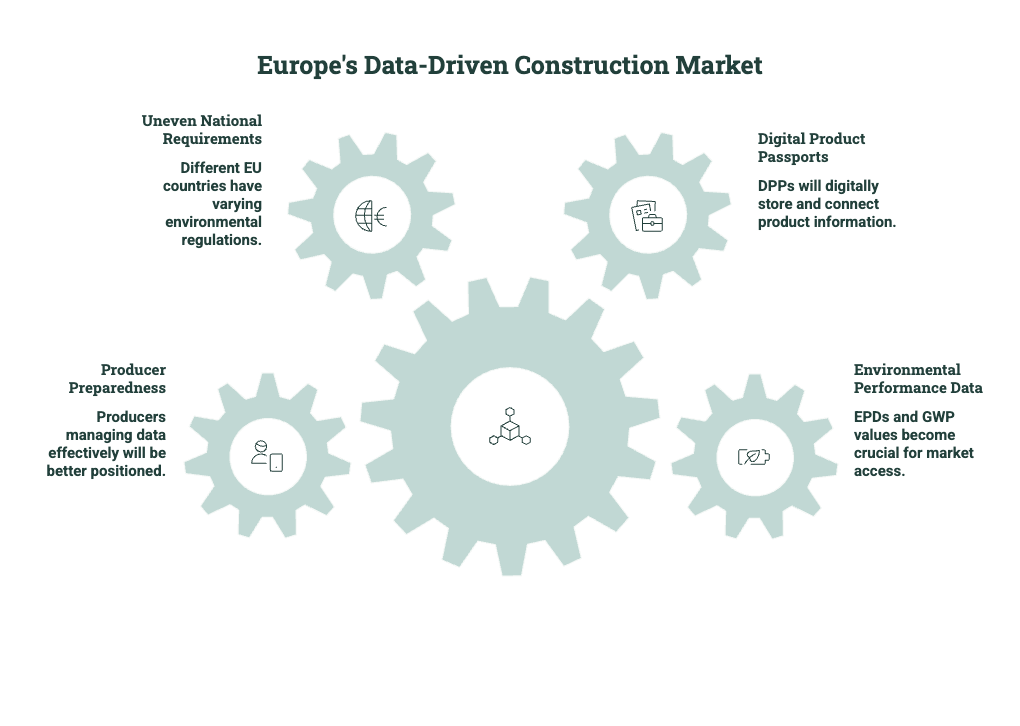
Europe is moving toward a more data-driven construction product market. For ready-mix concrete producers, this means environmental performance data, EPDs, GWP values, and eventually Digital Product Passports will become more important in market access, public procurement, and project specifications.
The biggest EU-level driver is the revised Construction Products Regulation, or CPR, formally Regulation (EU) 2024/3110. The new CPR strengthens the role of environmental performance information in construction product declarations. For ready-mix producers, the practical direction is clear: concrete products will need more structured environmental data, especially Global Warming Potential, or GWP.
The next major shift is the Digital Product Passport, or DPP. A DPP is not the same thing as an EPD, but it will likely become the digital container that carries EPD data, Declaration of Performance data, safety information, technical documentation, use information, and other product details. For producers, this means carbon data will need to be digital, traceable, and connected to real products, plants, mixes, and deliveries.
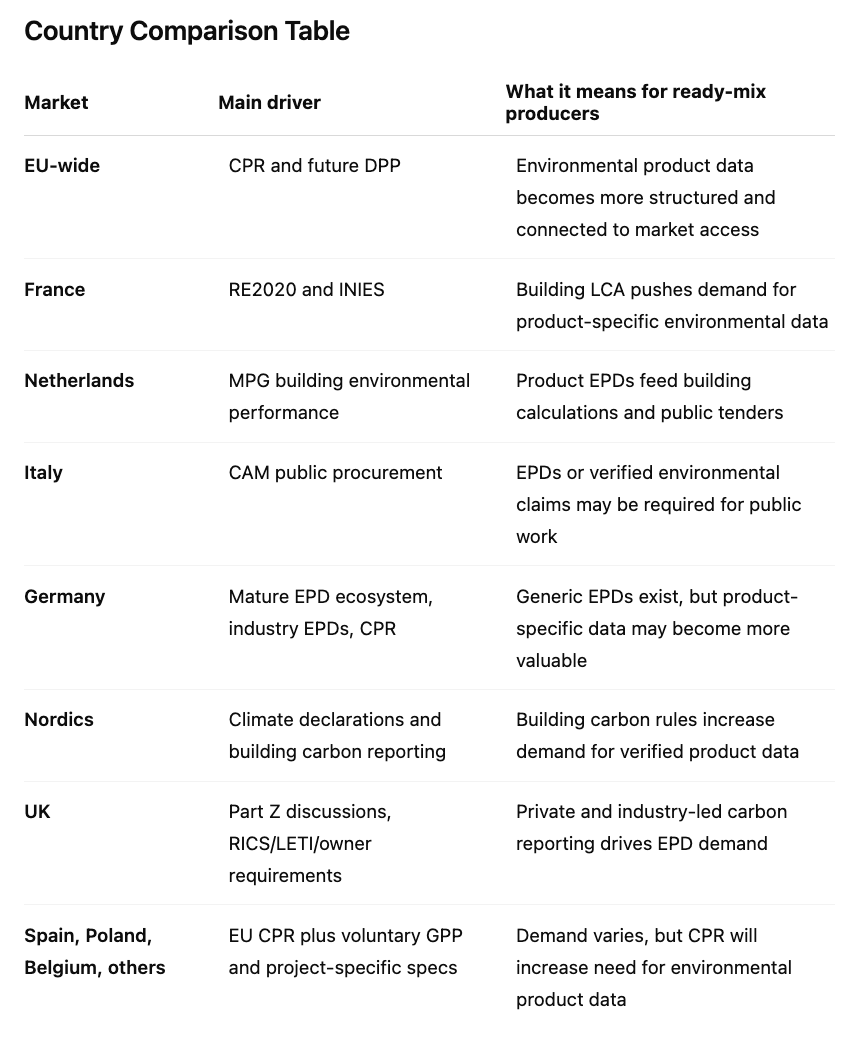
At the country level, requirements are already uneven. France uses RE2020 and the INIES database. The Netherlands uses MPG building-level environmental performance calculations. Italy has CAM public procurement rules. Germany relies more on industry EPDs and public/private project requirements. The Nordics are moving through climate declarations and building-level carbon reporting. The UK is outside the EU, but embodied carbon discussions, Part Z proposals, and private-sector requirements are shaping the market.
For ready-mix producers, the practical takeaway is simple: Europe is moving from voluntary sustainability claims to structured environmental product data. Producers that can manage EPDs, GWP values, mix data, plant data, transport assumptions, and DPP-ready digital records will be better prepared for public work, private projects, and future market access.
Key Takeaways
- The revised CPR changes the market. Environmental performance data is becoming part of the common technical language for construction products in Europe.
- DPPs will make concrete carbon data more digital and traceable. Producers should prepare for product records that link mix information, EPD data, Declaration of Performance data, technical documentation, and possibly delivery-level information.
- EN 15804+A2 is the core EPD standard for European construction products. Ready-mix producers should understand EN 15804+A2, concrete PCRs, ISO 14040/14044, ISO 14025, and ISO 21930.
- Country-specific rules still matter. France, the Netherlands, Italy, Germany, the Nordics, and the UK all approach embodied carbon differently.
- Public and private projects are already asking for EPDs. Data centers, public buildings, infrastructure, campuses, and green building projects may require product-specific carbon data before every EU requirement is fully enforced.
What Is Changing for Ready-Mix Concrete Producers in Europe?
Ready-mix concrete producers in Europe are entering a market where carbon data is becoming part of product performance. In the past, a producer might have treated an EPD as a voluntary sustainability document. Now, environmental performance is moving closer to the same world as strength, durability, CE marking, and technical documentation.
This matters because concrete is not a simple catalog product. Ready mix is local, mix-specific, plant-specific, and project-driven. A producer may supply many different mixes across strength classes, exposure classes, cement types, SCM combinations, aggregate sources, and transport distances. Each of those details can affect GWP.
The market is not moving in one single step. Some countries already have building-level carbon rules. Some public projects require EPDs. Some private owners require project carbon reports. CPR and DPP will add another layer by making environmental product data more structured and accessible across the EU.
Europe is not just asking whether a product is low carbon. It is asking producers to prove it with structured product data.
How the Revised CPR Affects Concrete Carbon Requirements
The Construction Products Regulation, or CPR, creates harmonized rules for placing construction products on the EU market. The revised CPR strengthens the role of environmental and sustainability performance information. For ready-mix producers, this matters because environmental data will increasingly sit alongside traditional product performance data.
The CPR is important because it creates a common technical language. That means producers, public authorities, contractors, designers, and customers can compare product performance using a more standardized structure. Historically, this focused on characteristics like mechanical performance, safety, durability, and use. The new direction brings environmental performance further into that structure.
For ready-mix concrete producers, this means environmental data may become part of the product documentation needed for market access and project acceptance. GWP will likely be the most important environmental number because it shows the climate impact of the concrete product. Other EPD impact categories may also matter depending on the market, country, and project.
CPR timeline producers should know
- Regulation (EU) 2024/3110 was adopted in 2024.
- The revised CPR entered into force in early 2025.
- Most provisions apply from January 2026.
- Digital Product Passport obligations will follow delegated acts and system setup.
- Practical DPP obligations for construction products are expected later, likely around 2028 depending on EU implementation timing.
For producers, the exact legal timing matters less than the operational direction. The companies that start organizing environmental data now will be better prepared as the CPR and DPP requirements become clearer.
.png)
How the Digital Product Passport Will Affect Ready-Mix Concrete
The Digital Product Passport, or DPP, is one of the biggest future changes for construction product data in Europe. A DPP is a digital record connected to a product. It can include product identity, performance information, environmental data, technical documents, safety information, instructions, certificates, and other compliance data.
For ready-mix concrete, the DPP will likely make EPD and GWP data easier to access and harder to hide. Instead of environmental data sitting in a PDF that someone emails during submittals, the data may be connected to a digital product record. That record may be accessed through a QR code, product ID, delivery document, platform, or registry.
A concrete DPP may include:
- Product or mix ID
- Producer name
- Plant location
- Declaration of Performance
- EPD or EPD-derived environmental data
- GWP A1-A3
- Optional A4 transport data
- Strength class
- Exposure class
- Cement type
- SCM type and quantity
- Recycled aggregate content if relevant
- Technical documentation
- Safety and use information
- Verification or certification details
- Date of issue and update history
This does not mean every ready-mix delivery will immediately need a perfect digital passport tomorrow. But it does mean producers should start preparing data systems that can connect mix designs, EPDs, GWP values, plants, suppliers, and project records.
DPPs will not replace EPDs. They will make EPD data more digital, traceable, and usable across the project supply chain.
What Standards Do European Concrete EPDs Need to Meet?
European concrete EPDs need to follow recognized LCA and EPD standards. The most important standard for construction product EPDs in Europe is EN 15804+A2. This is the core product category rule framework used for environmental declarations of construction products.
EN 15804+A2
EN 15804+A2 provides the core rules for construction product EPDs in Europe. It defines how environmental impacts should be calculated and reported for construction products. For ready-mix concrete, EN 15804+A2 is the backbone for EPD reporting across many European program operators and national databases.
ISO 14025
ISO 14025 is the main standard for Type III Environmental Product Declarations. It defines the framework for verified environmental declarations based on life cycle assessment.
ISO 14040 and ISO 14044
ISO 14040 and ISO 14044 are the core Life Cycle Assessment standards. They define the principles, framework, requirements, and guidelines for conducting LCAs.
ISO 21930
ISO 21930 applies to environmental declarations for construction products and services. It is often relevant where European and international construction product EPD frameworks overlap.
Concrete PCRs
A Product Category Rule, or PCR, is the product-specific rulebook. EN 15804+A2 gives the construction product core rules, while concrete-specific PCRs explain how those rules apply to ready-mix concrete. Program operators such as IBU, EPD Italy, EPD International, INIES, ECO Platform-connected systems, and other national programs may have additional requirements.
EN 206 and product standards
EN 206 is central to concrete specification, performance, production, and conformity in Europe. It is not an EPD standard, but it matters because carbon reduction cannot ignore concrete performance. Low-GWP concrete still needs to meet strength, exposure, durability, workability, and national application rules.
.png)
What Life Cycle Stages Matter: A1-A3 and A4
Most ready-mix concrete EPD conversations focus first on A1-A3, which is cradle-to-gate. These modules cover the impacts before the concrete leaves the plant.
A1: Raw materials
A1 includes cement, clinker, SCMs, aggregates, admixtures, water, recycled content, and other inputs. For most ready-mix concrete, cement and clinker content are the largest GWP drivers.
A2: Transport to the plant
A2 includes transportation of raw materials to the ready-mix plant. This matters in Europe because cement type, SCM availability, aggregate sources, and transport distances vary significantly by region.
A3: Manufacturing
A3 includes batching, plant energy, fuel, water management, and production-related impacts. This is often smaller than A1, but it still needs to be tracked.
A4: Delivery to site
A4 covers transport from the plant to the construction site. For ready-mix concrete, A4 can matter because the product is delivered locally and transport distance changes by project. Some EPDs include A4, while others focus on A1-A3. Producers should confirm what each project or national system requires.
.png)
Country-Specific Concrete Carbon Regulations in Europe
Europe is not one uniform market. The CPR creates a common EU framework, but country-level building rules, public procurement requirements, databases, and project expectations still vary.
🇫🇷 France: RE2020 and INIES
France is one of the most important markets for embodied carbon regulation. RE2020 requires building-level life cycle assessment for new buildings. This pushes designers to use product environmental data because the building’s carbon result depends on the materials selected.
France uses the INIES database for environmental and health declarations, including FDES documents for construction products. If a product does not have specific data in the database, designers may need to use conservative default values. That creates a strong market incentive for producers to publish product-specific environmental declarations.
For ready-mix producers, this means EPD-style data is not just useful for marketing. It can influence whether a product is attractive in a building LCA. Concrete mixes with verified lower GWP may be easier for designers to justify on projects trying to meet RE2020 limits.
Producer reality in France: If your concrete data is not available in the right database or format, designers may avoid it because it creates a worse building carbon result.
🇳🇱 Netherlands: MPG and Building-Level Environmental Performance
The Netherlands uses MPG, or Milieuprestatie Gebouwen, which measures the environmental performance of buildings. New buildings must meet environmental performance requirements, and the calculation relies on construction product environmental data.
This makes product EPDs valuable because they feed into building-level calculations. Dutch public tenders also commonly ask for product-specific EPDs or environmental data for concrete and other major construction materials.
For ready-mix producers, the Dutch market is a strong example of how building-level regulation creates product-level demand. The contractor or designer may not simply ask, “Do you have an EPD?” They may ask for the mix data needed to reduce the building’s overall environmental score.
Producer reality in the Netherlands: The lower-GWP concrete mix may help the whole building pass environmental performance requirements, which makes product-specific data valuable.
🇮🇹 Italy: CAM Public Procurement
Italy’s CAM, or Minimum Environmental Criteria, are mandatory in public procurement. CAM requirements apply to public works and include environmental criteria for construction materials.
For concrete, CAM has required environmental documentation such as a Type III EPD or verified environmental claim for compliance in public projects. CAM also includes practical material requirements, such as recycled content and transport-related criteria.
For ready-mix producers, Italy is one of the clearest examples of EPDs becoming part of public procurement. If a producer wants to supply public work, it may need verified environmental documentation ready before the project asks.
Producer reality in Italy: Public procurement can require the EPD or verified claim as a basic compliance document, not just a bonus point.
🇩🇪 Germany: Industry EPDs and Public/Private Project Demand
Germany does not have a single national Buy Clean concrete law like some other markets. However, Germany has a mature EPD ecosystem and strong industry involvement. German industry bodies have published generic EPDs for common concrete strength classes, and program operators like IBU are well-established.
German producers may see EPD requirements through public projects, private owners, certifications, and sustainability-driven procurement. The new CPR will increase the importance of structured environmental data, even where national law has not created a concrete-specific carbon cap.
For ready-mix producers, Germany shows how an industry-led EPD system can prepare the market before regulation becomes stricter. Generic EPDs can help, but product-specific or plant-specific data may become more important as projects ask for better carbon performance.
Producer reality in Germany: Generic industry EPDs are useful, but competitive bids may increasingly favor producers with more specific data and lower-GWP mixes.
🇳🇴 Nordics: Climate Declarations and Building Carbon Reporting
Nordic markets have been moving toward building climate declarations and whole-building carbon reporting. Sweden, Denmark, Finland, and Norway each have their own policy paths, but the general direction is similar: more building-level carbon reporting and more demand for product EPDs.
In Nordic markets, designers and contractors often need reliable product data to calculate a building’s climate impact. That creates demand for EPDs for concrete, cement, precast, steel, timber, insulation, and other major building materials.
For ready-mix producers, the Nordics are important because they show how building-level carbon rules can drive product-level EPD demand without every product having a separate “Buy Clean concrete” law.
Producer reality in the Nordics: If the building needs a climate declaration, the concrete package needs credible carbon data.
🇬🇧 United Kingdom: Part Z, LETI, and Private Sector Pressure
The UK is outside the EU, so CPR and DPP rules do not apply in the same way. However, the UK market is still moving toward embodied carbon reporting through industry initiatives, owner requirements, and policy discussions.
The proposed Part Z framework has pushed discussion around mandatory whole-life carbon assessment. LETI, RICS, UKGBC, and major private clients have also shaped expectations around embodied carbon measurement. Large UK projects may ask for EPDs, product carbon data, or whole-life carbon reporting even without an EU DPP requirement.
For ready-mix producers serving the UK, the practical question is not only compliance. It is whether the producer can support the carbon reporting process that designers, consultants, and owners are already using.
Producer reality in the UK: The requirement may come from the client, consultant, or carbon assessor rather than from a single regulation.
🇪🇺 Spain, Poland, Belgium, and Other Markets
Some European countries do not yet have a concrete-specific low-carbon procurement mandate. However, the CPR will still apply to EU construction products, and public or private projects may ask for EPDs voluntarily.
Belgium has regional low-carbon and building performance initiatives. Spain has green procurement activity and building code discussions. Poland and other markets may rely more on EU-level requirements and project-specific requests.
For producers, this does not mean “no EPD demand.” Large owners, EU-funded projects, green building certifications, and public tenders may still ask for product carbon data.
How GWP Baselines and Reduction Targets Work in Europe
Europe does not use one single concrete GWP baseline. Instead, baselines and thresholds vary by country, database, certification system, project type, and client requirement. Some markets calculate at the building level. Others use product-level EPD data. Some tenders set maximum GWP values. Others award points for lower-carbon alternatives.
Baselines may come from:
- National databases
- Industry-average EPDs
- Generic datasets
- Product-specific EPDs
- Building LCA tools
- Public procurement criteria
- Project-specific reference mixes
- Tender scoring systems
- Corporate carbon targets
The most important practical point is that concrete GWP should be compared by function. A C25/30 concrete mix, C35/45 concrete mix, high early strength mix, exposure-class-specific mix, and special infrastructure mix are not interchangeable. A fair comparison should consider strength class, exposure class, application, durability, workability, and transport assumptions.
Example reduction math
If a project baseline is 250 kg CO2e/m³ for a given concrete category:
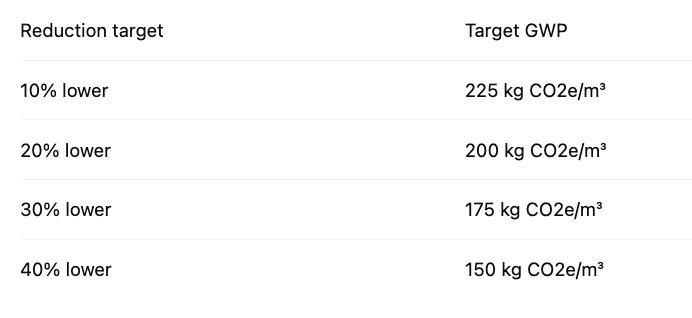
This is the math producers need during tender conversations. If the tender asks for 20% below baseline, the producer needs to know the accepted baseline, the proposed mix GWP, the EPD scope, and whether A4 transport is included.
A low-carbon mix is only low-carbon against a defined baseline.
Mix Optimization for Low-Carbon Concrete in Europe
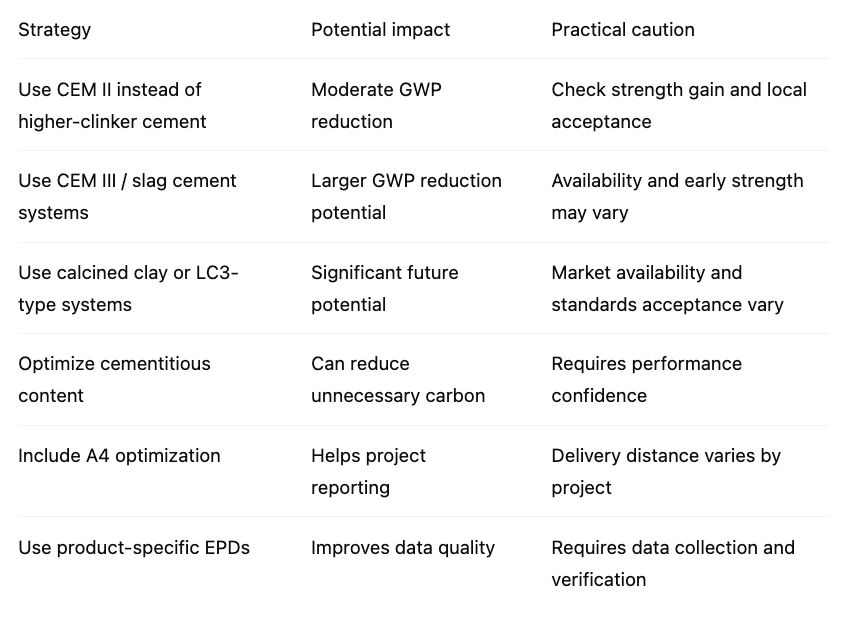
Low-carbon concrete in Europe is usually achieved through mix optimization, not one single change. The right strategy depends on cement type, clinker factor, SCM availability, national standards, performance requirements, and local supply.
Common levers include:
- Lower-clinker cement
- CEM II and CEM III cements
- Slag and fly ash where available
- Calcined clay and limestone-calcined clay cement systems
- Optimized cementitious content
- Recycled aggregates where allowed and practical
- Improved aggregate packing
- Admixtures that support lower paste content
- Performance-based specifications
- Later-age strength acceptance where possible
- Lower-carbon transport and plant energy
- Supplier-specific EPD data
Europe already has many lower-carbon cement options compared with some other markets, but producers still need to prove performance. A lower-GWP mix must still meet EN 206, national annexes, exposure classes, strength development, durability, pumpability, finishing, and project schedule requirements.
Example mix strategy table
🇳🇱 Practical Field Example 1: French Building Project Under RE2020
A ready-mix producer is supplying concrete for a new building in France. The design team is calculating whole-building carbon under RE2020 and using INIES data. If the concrete mix does not have specific environmental data, the design team may need to use more conservative default data.
The producer has two options. They can provide a generic industry value, or they can provide a product-specific FDES/EPD-style declaration with a lower GWP. If the specific data improves the building LCA result, the producer becomes more attractive to the design team and contractor.
Producer lesson: In France, the EPD is not just a sales document. It can affect the building carbon calculation and whether the designer wants to use your mix.
🇮🇹 Practical Field Example 2: Italian Public Tender Under CAM
A ready-mix producer wants to supply a public project in Italy. The tender includes CAM requirements and asks for environmental documentation for concrete. The producer needs a Type III EPD or verified environmental claim, along with evidence that the concrete meets other environmental criteria.
If the producer does not have the required documentation, it may not matter that the concrete is technically acceptable. The bid can become harder to support because the environmental documentation is part of compliance.
Producer lesson: In Italy, public procurement can turn EPDs into a must-have document before the job starts.
🇳🇱 Practical Field Example 3: Dutch Project Needing MPG Calculation
A contractor on a Dutch project asks the ready-mix producer for product-specific GWP data because the project must meet an MPG environmental performance calculation. The project team wants to know whether a lower-GWP concrete option can help improve the total building score.
The producer provides two mix options. One is a standard mix with generic data. The other is a lower-carbon mix with product-specific EPD data. The design team can use the lower-GWP data in the building calculation and may prefer the producer that can provide verified documentation.
Producer lesson: In the Netherlands, the value is not only “having an EPD.” It is having usable product data that improves the building-level calculation.
🇪🇺 Practical Field Example 4: Data Center Asking for Project Carbon Reporting
A private data center project in Europe asks for EPDs, mix GWP values, delivery assumptions, and total concrete carbon by mix volume. The project is not just checking compliance with one national rule. It is trying to meet a corporate carbon target.
The producer needs to connect mix designs, EPDs, GWP values, volumes, and transport assumptions. A PDF alone is not enough. The contractor needs a project-level carbon summary that can feed the owner’s reporting.
Producer lesson: Private owners can require data that is just as demanding as public regulation.
What Ready-Mix Producers Should Track Now
European ready-mix producers should start organizing data before DPP requirements fully arrive. Waiting until the project asks can create a scramble. Track:
- Mix ID
- Strength class
- Exposure class
- Cement type
- Cement quantity
- Clinker factor where available
- SCM type and quantity
- Aggregate type and source
- Recycled aggregate percentage
- Admixture type and quantity
- Water content
- Plant energy
- Production volume
- A2 transport distances
- A4 delivery distance where needed
- EPD certificate number
- Program operator
- Verification body
- EN 15804+A2 compliance
- GWP A1-A3
- GWP A4 if reported
- Date of issue and validity period
This data will support EPDs, DPPs, Declaration of Performance updates, public tenders, building LCA, and private project reporting.
What Is Coming Next in the European Market?
Ready-mix producers should expect Europe to keep moving toward more structured environmental product data.
1. More environmental data required
CPR will continue pushing environmental performance into the construction product performance framework. Producers should expect environmental data to become more connected to CE marking and product documentation.
2. DPP-ready product records
DPPs will require data that is digital, structured, machine-readable, and linked to product identity. This will make manual PDF-only workflows less practical over time.
3. More product-specific EPD demand
Generic EPDs will still help, but product-specific, plant-specific, and mix-specific EPDs will be more valuable when projects need accurate building LCA results.
4. More country-level building carbon requirements
France, the Netherlands, and the Nordics already show how building-level carbon rules drive product-level EPD demand. Other countries are likely to follow.
5. More public procurement pressure
Public procurement will keep using environmental criteria to push lower-carbon construction materials. Italy’s CAM is one model, but other countries may develop their own approaches.
6. More private owner requirements
Data centers, logistics, tech campuses, universities, and corporate owners will keep asking for EPDs and project carbon reporting because they need Scope 3 and embodied carbon data.
.png)
How Ready-Mix Producers Can Get Started
Ready-mix producers should not wait for the DPP deadline. The foundation is the same whether the request comes from CPR, RE2020, MPG, CAM, a public tender, or a private owner.
Producer readiness checklist
The producers that prepare now will not just comply. They will be easier to specify.
- Identify which markets and countries you sell into.
- Confirm which standards apply: EN 15804+A2, ISO 14025, ISO 14040/44, ISO 21930, EN 206, and country-specific PCRs.
- Identify which mixes need EPDs first.
- Organize mix design data by plant.
- Gather cement and SCM supplier EPDs.
- Track aggregate sources and recycled content.
- Track A2 and A4 transport assumptions.
- Calculate A1-A3 GWP by mix or product family.
- Decide whether you need plant-average, product-specific, or mix-specific EPDs.
- Publish EPDs through accepted program operators.
- Prepare DPP-ready data fields.
- Train sales, QC, technical, and dispatch teams on EPD and GWP basics.
- Build a process for project-level carbon reporting.
.png)
How Climate Earth Helps Producers Prepare for Europe’s CPR / DPP Market
Climate Earth helps concrete producers create and manage EPDs, GWP data, baseline comparisons, and low-carbon concrete documentation across plants, mixes, materials, and project requirements. Our platform is built to make concrete carbon data easier to calculate, update, and use in bids, submittals, public procurement, and project carbon reporting.
For European producers, that means a practical way to organize mix data, plant data, supplier data, EN 15804+A2-aligned EPD workflows, GWP values, A1-A3 data, optional A4 data, and DPP-ready product information. Instead of treating every EPD or carbon request as a one-off scramble, producers can build a repeatable workflow.
Why Choose Climate Earth?
- Built for concrete producers: Designed around mixes, plants, materials, GWP, EPDs, and project requirements.
- Supports EPD workflows: Helps producers manage EPD data instead of rebuilding the process every time a customer asks.
- Practical GWP visibility: See the carbon impact of mixes, materials, and project options.
- Ready for public procurement: Support data needs for country-specific regulations, tenders, and low-carbon project requirements.
- DPP-ready thinking: Organize the product data producers will need as digital product information becomes more important.
- Useful for bids and submittals: Help sales, QC, and technical teams provide credible carbon data when contractors, owners, engineers, or public agencies ask for it.
- Scalable across product lines: Support EPD and carbon reporting needs across ready mix, precast, block, pavers, aggregates, asphalt, dry mix, cement, and SCM-related workflows.
Ready to Get Started? Schedule a demo to see how Climate Earth can help your team create, manage, and use concrete EPDs and GWP data across your business.
FAQ: Europe Ready-Mix Concrete Carbon Requirements
What is the CPR?
The Construction Products Regulation is the EU framework for harmonized rules on construction product performance and market access. The revised CPR strengthens the role of environmental performance information for construction products.
How does the CPR affect ready-mix concrete producers?
The CPR pushes producers toward more structured environmental product data. Ready-mix producers should prepare to provide GWP and EPD-related information as part of product performance documentation.
What is a Digital Product Passport?
A Digital Product Passport is a digital product record that can carry product identity, performance information, environmental data, technical documents, safety information, and compliance records. For concrete, it will likely make EPD and GWP data more accessible and traceable.
Is a DPP the same as an EPD?
No. An EPD reports verified environmental impact data. A DPP is a digital record that may include or link to the EPD, along with other product and compliance information.
What standard do European construction product EPDs use?
European construction product EPDs commonly use EN 15804+A2. EPDs may also rely on ISO 14025, ISO 14040/14044, ISO 21930, and concrete-specific PCRs.
What is EN 15804+A2?
EN 15804+A2 is the core European standard for environmental product declarations of construction products. It defines how construction product impacts should be calculated and reported.
Which countries have the strongest embodied carbon requirements?
France, the Netherlands, Italy, and the Nordics are among the most important markets to watch. France uses RE2020 and INIES. The Netherlands uses MPG. Italy uses CAM for public procurement. Nordic countries are moving through climate declarations and building carbon reporting.
Does Germany require concrete EPDs?
Germany does not have one standalone national Buy Clean concrete law, but it has a mature EPD ecosystem and strong industry EPD usage. Public and private projects may still ask for EPDs, and CPR will increase the importance of environmental product data.
What should ready-mix producers do first?
Start by organizing mix, plant, cement, SCM, aggregate, transport, and EPD data. Then identify which mixes need EN 15804+A2-aligned EPDs and prepare for DPP-ready digital product records.
Will DPPs be required immediately?
No. DPP obligations depend on EU delegated acts and system setup. Producers should expect DPP requirements to phase in later, likely around 2028 for priority construction product categories depending on implementation.
Summary: What European Ready-Mix Producers Should Know
Europe’s ready-mix concrete market is moving toward more transparent, digital, and regulated carbon data. The revised CPR will make environmental performance information more important in construction product documentation. DPPs will make that information more digital and traceable. Country-specific rules like France RE2020, Netherlands MPG, Italy CAM, and Nordic climate declarations are already pushing producers toward EPDs and GWP reporting.
For producers, the practical shift is clear. EPDs are becoming less optional. GWP values are becoming part of project comparison. Digital product data is becoming part of future compliance. The producer that can organize mix data, plant data, supplier data, EPDs, A1-A3 GWP, optional A4, and project carbon summaries will be better prepared for public procurement and private project demand.
The best time to prepare is now. Producers that wait until the DPP deadline or a public tender requirement arrives may find themselves scrambling. Producers that build repeatable EPD and carbon data workflows now will be easier to specify, easier to compare, and better positioned in Europe’s low-carbon construction market.
Related articles

LEED v5 Requirements: What They Mean for Low Carbon Concrete

How to Read a Concrete EPD: Quick, Expert Guide