

Concrete Sustainability: Guide to Sustainable Concrete & Project Examples

Concrete sustainability is about more than making concrete “green.” It is about designing, producing, documenting, and using concrete in ways that reduce environmental impact while still delivering strength, durability, safety, resilience, and long service life.
For ready mix producers, concrete sustainability is becoming practical and measurable. Customers are asking for EPDs, GWP values, low-carbon concrete options, recycled content, SCMs, project carbon reports, and proof that concrete products support green building, public procurement, and private owner sustainability goals.
For broader industry context, the Concrete Sustainability Council provides a useful overview of responsible sourcing and sustainability certification for concrete supply chains and Climate Earth provides useful tools to prove and deliver sustainable concrete successfully.
Why Concrete Sustainability Matters
Sustainable concrete matters because concrete is used in huge volumes. Even modest improvements in mix design, cement efficiency, material sourcing, and durability can have a large impact across a building, road, bridge, warehouse, or infrastructure project.
The biggest concern is usually embodied carbon. Cement production releases CO2 from kiln energy and from the chemical process of making clinker. Because cement is often the largest carbon driver in concrete, many sustainability strategies focus on reducing clinker, lowering cement content, using SCMs, or switching to lower-carbon cement options.
But carbon is not the only issue. Sustainable concrete also supports longer service life, reduced repairs, efficient material use, better resilience, and lower waste. A durable concrete structure that lasts for decades can reduce the need for replacement materials and future construction impacts.
Concrete sustainability should not be measured only by what happens on pour day. It should also consider how long the concrete performs.
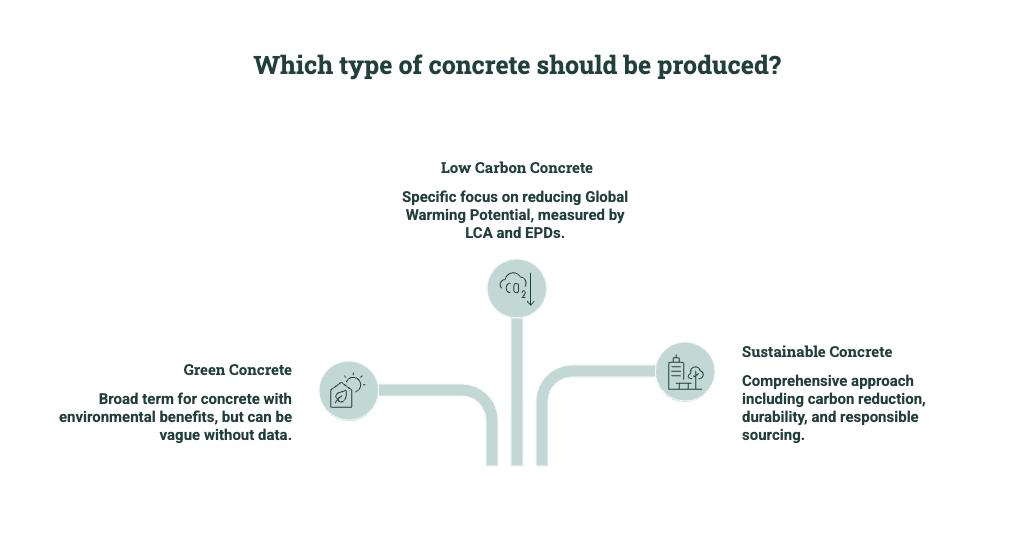
Sustainable Concrete vs. Green Concrete vs. Low Carbon Concrete
These terms are often used together, but they are not exactly the same. Green concrete is a broad term for concrete with an environmental benefit. It may include recycled materials, SCMs, lower cement content, carbon mineralization, or lower GWP. The challenge is that “green” can be vague if it is not backed by verified data.
Low carbon concrete is more specific. It refers to concrete with lower Global Warming Potential compared with a baseline, benchmark, or project requirement. Low carbon concrete is usually measured using Life Cycle Assessments and documented through an EPD.
Sustainable concrete is broader than both. It includes carbon reduction, but also durability, responsible sourcing, water use, waste reduction, resilience, recycled content, local materials, maintenance, and end-of-life considerations.
EPDs, GWP, and Sustainable Concrete
EPDs and GWP are now central to concrete sustainability because they turn broad sustainability claims into measurable data. If a producer says a mix is “green,” the customer may ask, “What is the GWP?” or “Do you have an EPD?”
An Environmental Product Declaration is a verified report that shows the environmental impacts of a concrete product or mix. GWP is the carbon footprint number inside that report. It is usually shown as kg CO2e per cubic yard or kg CO2e per cubic meter.
Most ready mix concrete EPDs focus on A1-A3, which includes raw materials, transportation of raw materials to the plant, and batching operations. Some projects also ask for A4, which covers delivery from the plant to the jobsite.
.png)
A producer cannot always win a sustainability conversation with claims alone. Contractors, owners, public agencies, and designers increasingly need data they can submit, compare, and verify. That makes EPDs and GWP values part of the producer’s sales and technical toolkit.
The future of sustainable concrete is not just better mixes. It is better mixes with better data.
What Makes Concrete More Sustainable?
Sustainable concrete usually comes from combining multiple strategies. No single solution works for every project, plant, region, or specification. The best strategy depends on local materials, performance requirements, climate, schedule, cost, and documentation needs.
1. Lower clinker and cement impact
Because cement is often the largest carbon driver, lowering clinker impact is one of the most important sustainability strategies. Producers may use portland-limestone cement, blended cement, SCMs, or lower-carbon cement technologies where available.
2. Use SCMs
Supplementary cementitious materials such as slag, fly ash, silica fume, natural pozzolans, calcined clay, and glass pozzolans can replace a portion of portland cement. SCMs can reduce GWP while supporting strength and durability when used correctly.
3. Optimize cementitious content
Some mixes are over-designed. Reducing unnecessary cementitious content can lower carbon and cost if performance is maintained. This requires good QC, trial batches, strength data, and field feedback.
4. Improve aggregate gradation
Better aggregate packing can reduce paste demand. Less paste often means less cementitious material. Tools like combined gradation review and the Tarantula Curve can help producers improve workability while lowering paste volume.
5. Use admixtures strategically
Water reducers, super-plasticizers, set controllers, and air-entraining admixtures can help lower water demand, improve workability, maintain pumpability, and support lower paste or higher SCM mixes.
6. Design for durability
Durability is a sustainability strategy. Concrete that resists freeze-thaw damage, sulfate attack, chloride exposure, cracking, abrasion, and moisture-related deterioration can reduce repairs and extend service life.
7. Reduce waste
Returned concrete, wash water, batching accuracy, better dispatch, and improved jobsite coordination all affect sustainability. Wasted concrete is wasted material, energy, cost, and carbon.
8. Use local materials where practical
Concrete is often locally produced, which can reduce transportation impacts. When A4 delivery is counted, plant selection and haul distance become more important.
9. Support performance-based specifications
Performance-based specs give producers more room to meet strength, durability, and GWP requirements without being locked into outdated prescriptive cement minimums or SCM caps.
.png)
What Sustainable Concrete Looks Like in a Bid
In a bid or submittal, sustainable concrete usually appears as documentation, not just a product name. The customer may ask for EPDs, GWP values, SCM percentages, recycled content, product-specific data, or proof that the mix meets a project carbon requirement. Common requests include:
- Submit a Type III verified EPD.
- Provide A1-A3 GWP for each concrete mix.
- Show lower-carbon alternatives by strength class.
- Provide concrete GWP by mix and volume.
- Meet a maximum GWP threshold.
- Show a percentage reduction below baseline.
- Provide documentation for LEED or whole-building LCA.
- Provide project carbon reporting.
- Identify SCM content or Portland Limestone cement use.
- Provide product data for public procurement or owner review.
Green building programs are one reason these requests are becoming more common. LEED is one of the most recognized green building systems in the U.S., while BREEAM is widely used internationally and in Europe. For public procurement and federal work, producers may also see low embodied carbon material requirements tied to EPA, GSA, or FHWA programs.
For producers, this means sustainability needs to be connected to sales, QC, technical services, and operations. The producer needs to know what mix is being supplied, what data supports it, and whether the documentation matches the project requirement.
Examples of Sustainable Concrete Projects
Sustainable concrete shows up in many types of projects. The details change, but the pattern is similar: the owner or contractor wants concrete that meets performance requirements while reducing environmental impact and supporting documentation needs.
.png)
1. Meta Data Center, DeKalb, Illinois
Meta worked with researchers and concrete suppliers to test and deploy AI-optimized low-carbon concrete mixes for data center construction. The project focused on designing concrete mixes that could reduce environmental impact while still meeting compressive strength and field performance requirements.
For producers, this is a strong example because it shows where the market is going. Large data center owners are not only asking for concrete. They are asking for performance, carbon data, and faster ways to test lower-GWP mix options.
Why it matters for producers: Data centers use large concrete volumes and often have corporate carbon goals. Producers that can provide EPDs, GWP data, and lower-carbon mix options will be better positioned for this type of work.
2. Amazon HQ2, Arlington, Virginia
Amazon’s HQ2 project in Arlington, Virginia has been referenced as a major project using concrete with carbon mineralization technology. Carbon mineralization injects captured CO2 into fresh concrete, where it reacts and becomes permanently stored while supporting concrete performance.
For producers, this is a useful example of how lower-carbon concrete can show up on high-profile corporate projects. The owner may not only ask for a mix design. They may also ask for documentation, carbon accounting, and proof that the strategy supports the project’s sustainability goals.
Why it matters for producers: Large corporate owners are helping drive demand for concrete with lower embodied carbon. Even when a regulation does not require it, the owner’s sustainability goals can create the requirement.
3. Grand Paris Express, France
The Grand Paris Express is one of Europe’s major infrastructure programs and has been associated with lower carbon cement and concrete strategies, including the use of low carbon cement technologies and supplementary cementitious materials. Large infrastructure projects like this matter because they use major volumes of concrete and often face public sector sustainability pressure.
For producers, this is a good example of how low carbon concrete is tied to infrastructure, not just buildings. Public projects may require EPDs, carbon reporting, environmental documentation, or lower carbon material options.
Why it matters for producers: Infrastructure projects can move the market because they create repeat demand across large volumes. If public owners ask for lower-carbon concrete, producers need EPDs, product data, and mix options ready before bid day.
4. Tottenham Hotspur Stadium, United Kingdom
Tottenham Hotspur Stadium has been cited as a project using low carbon cement products. Stadiums are a helpful example because they combine high concrete volumes with public visibility, complex performance requirements, and strong pressure to manage sustainability claims carefully.
For producers, the lesson is that low carbon materials still need to meet demanding construction schedules and technical requirements. A lower carbon concrete strategy must be practical for placement, strength gain, durability, and contractor workflow.
Why it matters for producers: High profile projects can make sustainable concrete visible to owners, contractors, and specifiers. Producers need credible product data so sustainability claims can be supported with documentation.
Sustainable Concrete and Performance-Based Specs
Sustainable concrete works best when specifications allow mix design flexibility. Prescriptive specs can block sustainability by requiring high cement minimums, limiting SCMs, requiring unnecessary early strength, or preventing lower-carbon cement options.
Performance-based specifications are more useful because they focus on what the concrete must achieve. They can still include strength, durability, exposure requirements, air content, slump, shrinkage, permeability, finishability, pumpability, and GWP limits. They just give the producer more room to design the mix properly.
You cannot ask for sustainable concrete and then write a spec that blocks the producer from using sustainable mix design tools.
How Ready Mix Producers Can Build a Concrete Sustainability Program
A concrete sustainability program does not need to start with every mix at every plant. Producers can start with priority products and build from there.
.png)
Step 1: Identify high-volume and high-demand mixes
Start with the mixes customers ask for most often, especially those used in slabs, foundations, paving, infrastructure, warehouses, data centers, and public projects.
Step 2: Generate EPDs for priority mixes
EPDs help producers respond to sustainability requests with verified data. Product-specific or plant-specific EPDs are especially useful when customers need actual product data.
Step 3: Track GWP
Know the GWP of common mixes. Compare standard mixes against lower-GWP alternates and benchmarks.
Step 4: Create sustainable mix options
Develop practical lower-GWP options by strength class, application, plant, and project type. Include notes on SCM content, strength timing, set time, and placement considerations.
Step 5: Improve data systems
Do not rely only on scattered spreadsheets and PDFs. Producers need organized plant data, product data, supplier data, EPDs, GWP values, and documentation.
Step 6: Train sales and QC teams
Sustainability questions often come through sales first. Teams should understand basic terms like EPD, GWP, LCA, SCMs, low-carbon concrete, and project carbon reporting.
Step 7: Prepare standard submittal language
Make it easy to provide EPDs, GWP values, baseline comparisons, and project carbon summaries when customers ask.
Step 8: Review specs early
Look for sustainability requirements, EPD language, GWP thresholds, SCM limits, cement restrictions, and prescriptive requirements that may block lower-carbon options.
Common Mistakes Producers Should Avoid
The first mistake is using vague sustainability claims without data. Customers increasingly want EPDs, GWP values, and documentation, not just “green” language.
The second mistake is assuming sustainability only means carbon. Carbon matters, but durability, waste, water, recycled content, responsible sourcing, and service life also matter.
The third mistake is waiting until a customer asks. If the EPD is not ready or the data is scattered, the producer may miss the opportunity.
The fourth mistake is creating a low-carbon mix that does not perform. Sustainable concrete still needs to place, finish, cure, and meet the project’s performance requirements.
The fifth mistake is ignoring the spec. If the project has cement minimums, SCM caps, or early strength requirements, the producer may need to flag conflicts before bid day.
.png)
How Climate Earth Helps Concrete Producers
Climate Earth helps concrete producers respond faster to EPD requests, GWP limits, low carbon concrete specs, Buy Clean requirements, public tenders, data center projects, and private owner carbon goals.
Our platform helps teams generate verified EPDs, track GWP across mixes and plants, review project specifications, compare lower-carbon mix options, and create carbon-informed project bid reports. With Climate Earth, producers can reduce manual spreadsheet work, support bids faster, and manage EPD and low carbon concrete requirements in one connected workflow.
Why Producers Choose Climate Earth
- Generate verified plant-specific and product-specific EPDs faster
- Track GWP across mixes, products, plants, and regions
- Review specs automatically for EPD, GWP, strength, SCM, water-cement ratio, and reporting requirements
- Compare and enhance mixes with AI-assisted tools
- Create carbon-informed project-based bid reports
- Integrate with QC systems and internal workflows
- Support ISO 14025 and EN 15804+A2-aligned reporting
- Reduce manual work across sales, QC, technical, sustainability, and operations teams
Ready to Get Started?
Respond faster to EPDs, GWP limits, and low carbon concrete requirements with software built for concrete producers. Book a demo to see how Climate Earth helps your team generate EPDs, manage GWP data, review specs, support bids, and win more low carbon concrete work.
FAQ: Concrete Sustainability
What is concrete sustainability?
Concrete sustainability means reducing the environmental impact of concrete while maintaining strength, durability, safety, resilience, and long service life. It includes carbon reduction, EPDs, responsible sourcing, waste reduction, water management, recycled content, and durability.
What is sustainable concrete?
Sustainable concrete is concrete designed to reduce environmental impact across its life cycle while still meeting project performance requirements.
Is sustainable concrete the same as low-carbon concrete?
No. Low-carbon concrete focuses mainly on reducing GWP. Sustainable concrete is broader and can include durability, recycled content, waste reduction, water use, responsible sourcing, resilience, and long service life.
What is green concrete?
Green concrete is a broad term for concrete with environmental benefits. It is strongest when supported by verified data, such as EPDs and GWP values.
How is concrete sustainability measured?
Concrete sustainability can be measured using EPDs, GWP, LCA, SCM content, cement intensity, recycled content, water use, waste reduction, responsible sourcing, and durability performance.
Why are EPDs important for sustainable concrete?
EPDs provide verified environmental product data. They help project teams compare concrete mixes, support green building requirements, and document GWP.
What is GWP in concrete?
GWP stands for Global Warming Potential. It is the carbon footprint indicator used to compare concrete mixes, usually reported as kg CO2e per cubic yard or cubic meter.
How can ready mix producers make concrete more sustainable?
Producers can use SCMs, Portland Limestone cement, optimized cementitious content, aggregate gradation, admixtures, better dispatch, waste reduction, durable mix design, and verified EPD data.
What project types ask for sustainable concrete?
Data centers, warehouses, universities, hospitals, DOT projects, public infrastructure, commercial buildings, corporate campuses, and European building LCA projects may ask for sustainable concrete documentation.
Does sustainable concrete cost more?
Sometimes, but not always. Some strategies may reduce cost by reducing cement content. Others may add cost depending on materials, availability, testing, and project requirements.
Can sustainable concrete perform as well as traditional concrete?
Yes, when designed properly. Sustainable concrete still needs to meet strength, durability, slump, air, finishability, pumpability, set time, and schedule requirements.
Summary
Concrete sustainability is about reducing environmental impact while protecting the performance that makes concrete essential. It includes low-carbon concrete, EPDs, GWP tracking, SCMs, cement efficiency, durability, waste reduction, recycled content, responsible sourcing, and long service life.
For ready mix producers, sustainability is becoming part of normal project conversations. Customers are asking for verified EPDs, lower-GWP mixes, project carbon reporting, and documentation that supports green building, public procurement, private owner goals, and future digital product data requirements.
The opportunity for producers is to make sustainability practical. That means offering concrete that works in the field and data that works in the bid. Producers that can provide verified EPDs, explain GWP clearly, and support sustainable project requirements will be better positioned as the market continues to shift.
Related articles
LEED v5 Requirements: What They Mean for Low Carbon Concrete

How to Read a Concrete EPD: Quick, Expert Guide