

What Is an LCA? Life Cycle Assessment Basics
A Life Cycle Assessment, often shortened to LCA, is a method used to measure the environmental impact of a product, service, process, or material over its life.
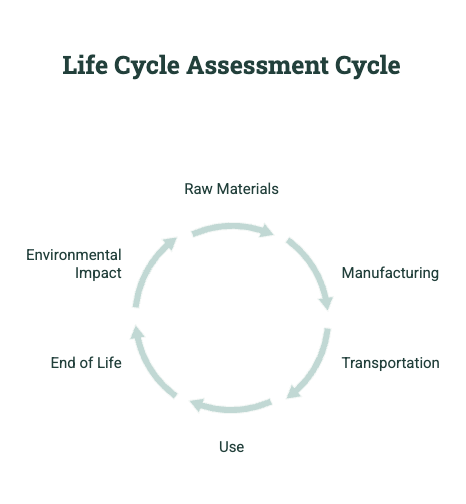
It looks at what goes into making something, what comes out of that process, and what happens as the product is transported, used, reused, recycled, or thrown away. In simple terms, an LCA helps answer one big question: what is the environmental cost of this product from start to finish?
Think about a t-shirt. An LCA does not only look at the shirt when it is hanging in a store. It looks at the cotton, farming, water, dye, factory energy, shipping, washing, drying, and what happens when someone eventually gets rid of it.
That is why LCA is useful. It helps companies, designers, manufacturers, builders, and policy teams see where the biggest environmental impacts happen. Once those “hotspots” are clear, they can make better decisions about materials, suppliers, energy, transportation, product design, and waste.
Key Takeaways
- An LCA measures environmental impact across a product’s life. It can include raw materials, manufacturing, transportation, use, maintenance, recycling, and disposal.
- An LCA helps find environmental hotspots. A hotspot is the part of the life cycle that creates the biggest impact, such as cement in concrete, electricity in manufacturing, or fuel in transportation.
- An LCA is often the technical foundation behind an EPD. The LCA does the measuring, and the Environmental Product Declaration communicates the results in a verified, standardized format.
What Does LCA Stand For?
LCA stands for Life Cycle Assessment. It is sometimes also called Life Cycle Analysis, but Life Cycle Assessment is the more standard term. The word “life cycle” means the full journey of a product, from raw material extraction to what happens at the end of its useful life.
The word “assessment” matters because LCA is not just a guess or opinion. It is a structured method that uses data to estimate environmental impacts. It can measure things like greenhouse gas emissions, energy use, water use, waste, pollution, and resource use.
A simple way to explain LCA is this: it is like following a product’s entire life story and counting the environmental effects along the way. Instead of only asking, “Is this product recyclable?” an LCA asks, “What happened before, during, and after this product was used?”
“LCA helps you see the full picture, not just the part of the product that is easiest to notice.”
Why Life Cycle Assessment Matters
Life Cycle Assessment matters because many environmental impacts are hidden. A product may look clean when it reaches the customer, but a lot may have happened before that point. Raw materials had to be extracted, processed, transported, manufactured, packaged, and delivered.
Without LCA, companies can accidentally focus on the wrong problem. For example, a company might spend time changing packaging when most of the product’s impact actually comes from raw materials. Another company might focus on transportation when the biggest impact is electricity used during manufacturing.
LCA helps avoid those blind spots. It gives teams a clearer way to compare options and make practical decisions. It can support product design, supply chain planning, carbon reduction, Environmental Product Declarations, green building projects, policy compliance, and sustainability reporting.
.png)
A Brief History of LCA
Life Cycle Assessment grew out of the need to understand products more completely. Companies and researchers realized that looking at only one stage of a product’s life could be misleading. A product might seem better in one area but worse once raw materials, manufacturing, transportation, use, and disposal are included.
Early LCA work developed as industries began studying energy use, packaging, waste, and resource efficiency. Over time, the method became more formal and standardized. The goal was to create a more consistent way to measure environmental impacts across products and systems.
Today, LCA is supported by international standards such as ISO 14040 and ISO 14044. ISO 14040 describes the principles and framework for life cycle assessment. ISO 14044 provides requirements and guidelines for conducting LCA studies.
LCA has become more important as companies move from broad sustainability claims to measurable environmental data. It is now used in product development, construction, manufacturing, procurement, carbon reporting, Environmental Product Declarations, policy, and climate strategy. As buyers and regulators ask for more proof, LCA is becoming one of the main tools used to provide it.
.png)
How an LCA Works
An LCA follows four main phases. These phases are defined in the ISO LCA framework, and they help keep the process organized. The four phases are goal and scope definition, life cycle inventory, life cycle impact assessment, and interpretation.
The easiest way to understand the process is to imagine you are studying a product from beginning to end. First, you decide what you are studying and why. Then you collect the data. Then you calculate the environmental impacts. Finally, you interpret the results and decide what they mean.
Here is the basic process:
- Goal and scope definition
- Life Cycle Inventory, or LCI
- Life Cycle Impact Assessment, or LCIA
- Interpretation
.png)
Step 1: Goal and Scope Definition
The first step in an LCA is deciding what you are studying and why. This is called the goal and scope phase. It sets the rules for the whole assessment.
The goal explains the purpose of the LCA. A company may want to reduce product emissions, compare two materials, support an EPD, respond to a customer request, meet a procurement requirement, or find the biggest environmental hotspots in a product line. The goal matters because it shapes what data needs to be collected.
The scope explains the boundaries of the study. It answers questions like: What product are we studying? How much of the product are we measuring? Which life cycle stages are included? What environmental impacts are being measured? What will be left out?
One important part of this step is the functional unit. The functional unit is the exact measure used for comparison. For example, it could be one cubic yard of concrete, one kilogram of packaging, one square meter of flooring, or one t-shirt used and washed a certain number of times.
Simple example
If you compare two coffee cups, you need to define what “one cup” means. Are you comparing one single-use paper cup to one reusable ceramic mug? Are you assuming the mug is used once, 50 times, or 500 times? That choice changes the results.
The goal and scope phase prevents confusion later. It makes sure everyone understands what is being measured. A weak goal and scope can make the whole LCA less useful.
Step 2: Life Cycle Inventory
The second step is Life Cycle Inventory, often called LCI. This is the data collection stage. It is where the LCA team gathers information about everything going into and coming out of the product system.
Inputs are things the product uses. These can include raw materials, fuel, electricity, water, chemicals, packaging, and transportation. Outputs are things the system releases, such as emissions to air, emissions to water, waste, byproducts, and other environmental releases.
This stage is usually the most time-consuming part of an LCA. Data may come from bills, supplier records, production systems, batch records, plant data, transportation records, purchase orders, or industry databases. In many cases, companies use a mix of primary data and secondary data.
Primary data vs secondary data
Primary data comes from the actual company, plant, supplier, or process being studied. It is usually more specific and more useful. For example, a concrete producer’s actual cement use, electricity use, and plant production data would be primary data.
Secondary data comes from databases, industry averages, published studies, or generic sources. It is useful when specific data is not available. However, too much secondary data can make an LCA less precise.
“The better the data, the more useful the LCA.”
Step 3: Life Cycle Impact Assessment
The third step is Life Cycle Impact Assessment, often called LCIA. This is where the inventory data is translated into environmental impact categories. In other words, the raw data becomes results people can understand and use.
For example, the LCI may include natural gas use, diesel fuel use, electricity use, transportation miles, and material inputs. The LCIA turns those inputs and outputs into impact results such as global warming potential, acidification, eutrophication, water use, and resource depletion. This step helps show what the environmental impacts actually mean.
The most common impact category people look for is Global Warming Potential, or GWP. GWP measures climate impact and is usually shown as kilograms of carbon dioxide equivalent, written as kg CO2e. It lets different greenhouse gases be counted in one common unit.
Common LCA impact categories
- Global Warming Potential: climate impact, usually shown as kg CO2e
- Acidification: contribution to acid rain and related environmental damage
- Eutrophication: nutrient pollution that can damage water systems
- Ozone depletion: impact on the ozone layer
- Smog formation: contribution to ground-level air pollution
- Resource depletion: use of limited natural resources
- Energy use: renewable and nonrenewable energy demand
- Water use: water consumed or used across the life cycle
- Waste generation: waste created during production, use, or disposal
These categories matter because sustainability is not only about carbon. Carbon is important, but it is not the whole story. A product can perform well in one impact category and poorly in another.
.png)
Step 4: Interpretation
The final step is interpretation. This is where the LCA results are reviewed, explained, and turned into decisions. The goal is not just to produce numbers. The goal is to understand what the numbers mean.
During interpretation, the team looks for the biggest environmental hotspots. They also check whether the data is complete, consistent, and reliable enough for the goal of the study. If the LCA is being used for public claims, EPDs, or comparisons, the review needs to be especially careful.
This step often leads to practical recommendations. A company might switch suppliers, reduce energy use, change a material, redesign packaging, adjust transportation, improve manufacturing efficiency, or create a lower-carbon version of a product. The interpretation step turns the LCA from a report into a decision-making tool.
“The point of an LCA is not just to calculate impact. The point is to make better decisions.”
What Are the Main Types of LCA?
Not every LCA covers the same life cycle stages. Some studies look at the full life of a product, while others focus on a smaller part of the life cycle. The right type depends on the purpose of the study.
Cradle-to-grave LCA
A cradle-to-grave LCA looks at the product from raw material extraction all the way to final disposal, recycling, or end of life. This gives the broadest view. It is useful when the use phase or disposal phase could have a major impact.
For example, a washing machine may have a large impact during use because it consumes electricity and water over many years. A cradle-to-grave LCA would capture that. Looking only at manufacturing would miss a major part of the story.
Cradle-to-gate LCA
A cradle-to-gate LCA looks at the product from raw material extraction through manufacturing, ending when the product leaves the factory gate. It usually does not include use, maintenance, or end of life. This approach is common for construction materials and Environmental Product Declarations.
For example, a concrete LCA may focus on raw materials, transportation to the plant, and production. This makes sense because concrete is often used as part of a larger building or infrastructure project. The project team may then use the product data in a larger building-level carbon calculation.
Cradle-to-cradle LCA
A cradle-to-cradle approach looks at how materials can be reused, recycled, or kept in a circular system. Instead of treating disposal as the final step, it asks whether the end of one product’s life can become the beginning of another product’s life. This is common in circular economy discussions.
This approach can be useful for products designed for reuse or recycling. However, it still needs clear assumptions. Recycling benefits can be complicated, so the LCA must explain how those benefits are counted.
Gate-to-gate LCA
A gate-to-gate LCA looks at one specific stage in a larger process. For example, it may study only one manufacturing step inside a factory. This can be useful when a company wants to improve one part of production.
Gate-to-gate studies are more limited than full life cycle studies. They can still be valuable when the goal is internal improvement. They are often used as building blocks for larger LCAs.
Attributional vs consequential LCA
An attributional LCA looks at the environmental impacts connected to a product as it exists today. It asks, “What impacts are assigned to this product?” This is the type most people think of when they hear LCA.
A consequential LCA looks at what changes if a decision is made. It asks, “What happens if we choose this option instead of that option?” This can be useful for policy, large-scale decisions, and market changes, but it is usually more complex.
.png)
What Is GWP in LCA?
GWP stands for Global Warming Potential. It is one of the most important LCA results because it measures climate impact. GWP is usually shown as kg CO2e, which means kilograms of carbon dioxide equivalent.
The phrase “carbon dioxide equivalent” matters because carbon dioxide is not the only greenhouse gas. Methane and nitrous oxide also contribute to climate change. GWP converts these gases into one common unit so they can be added together and compared.
A simple way to think about kg CO2e is this: it is a common language for climate impact. If a product has a GWP of 100 kg CO2e, that means its climate impact is equivalent to 100 kilograms of carbon dioxide for the unit being measured. To compare two products fairly, the unit, scope, data quality, and method need to match.
How LCA Connects to EPDs
LCA and EPDs are closely connected, but they are not the same thing. The LCA is the technical study that measures environmental impacts. The EPD is the public-facing document that reports those results in a standardized, verified format.
A simple way to remember it is this:
- LCA = the measurement
- EPD = the published report
- PCR = the rulebook for the product category
EPDs are especially common in construction because project teams need verified product data. Architects, engineers, contractors, owners, and agencies may use EPDs to compare materials, calculate embodied carbon, support LEED credits, respond to Buy Clean policies, or meet project specifications. Without the LCA, there is no reliable environmental data to put into the EPD.
.png)
Where LCA Is Used
LCA is used anywhere people need to understand the environmental impact of a product, service, material, or process. It is common in manufacturing, construction, product design, packaging, policy, procurement, and sustainability reporting. It is also becoming more important as companies are asked to prove environmental claims with data.
Product design and R&D
Product teams use LCA to compare materials and design choices. For example, a company may compare plastic, aluminum, glass, or paper packaging. The LCA can show which option has the lowest impact across the life cycle.
This is useful because the “obvious” answer is not always right. A material that seems greener may require more energy to produce or transport. LCA helps teams avoid decisions that look good on the surface but perform worse overall.
Manufacturing
Manufacturers use LCA to identify carbon and resource hotspots. A hotspot might be electricity, fuel, raw materials, transportation, or waste. Once the hotspot is identified, the company can focus improvement efforts where they matter most.
For example, a factory might discover that most of a product’s footprint comes from electricity use. In that case, switching energy sources or improving efficiency may do more than changing packaging. LCA helps companies focus on the highest-impact actions.
Construction and building materials
Construction uses LCA to measure embodied carbon and environmental impacts from materials. Concrete, cement, asphalt, steel, glass, aluminum, insulation, flooring, and wood products are all common LCA categories. These materials can have a major impact before a building is even occupied.
LCA is also used at the building level. A whole-building LCA looks at the environmental impact of many materials and systems together. This can help owners and design teams compare design options and reduce embodied carbon.
Procurement and supply chain
Procurement teams use LCA to compare suppliers and materials. If two products perform the same function, LCA can help show which option has a lower environmental impact. It can also help companies understand Scope 3 emissions, which are emissions that happen in the value chain.
This matters because many companies have more impact in their supply chain than in their own operations. LCA gives procurement teams better information than price alone. It can help them choose suppliers that support sustainability and carbon goals.
Policy and regulation
LCA is used in policy because it provides a structured way to measure environmental impacts. Governments and agencies use LCA methods to support product rules, procurement programs, carbon policies, and environmental footprint methods. In Europe, the Product Environmental Footprint method is an example of a policy-related effort to harmonize product environmental footprinting.
Policy teams use LCA because it can look beyond one issue. It can help avoid shifting a problem from one stage of the life cycle to another. For example, a policy that reduces disposal waste but increases manufacturing emissions may not be a true improvement.
Marketing and product claims
Marketing teams use LCA to support environmental claims, but they need to be careful. LCA results should not be used to make vague claims like “eco-friendly” unless the data actually supports it. Clear, specific claims are safer and more credible.
For example, saying “this product’s GWP is lower than our previous version based on a cradle-to-gate LCA” is more useful than saying “this product is green.” LCA can support strong marketing when the claim is specific, transparent, and backed by data.
.png)
LCA Software and Tools
LCA can be done with consultants, internal teams, specialized software, or a mix of all three. The right path depends on the product, data quality, internal expertise, and whether the results will be used publicly. A simple internal hotspot study may not need the same level of review as a public EPD or product comparison.
Common LCA software and tool categories include:
- Professional LCA software: tools used by LCA experts for detailed modeling
- EPD and product footprint platforms: tools designed to generate repeatable product footprints and EPD-ready data
- Construction LCA tools: tools used for building materials, embodied carbon, and whole-building LCA
- Open-source LCA tools: useful for research, education, and custom modeling
- Spreadsheet-based studies: sometimes used for early estimates, but harder to scale and verify
The best LCA tool is not always the most complicated one. The best tool is the one that fits the goal. A manufacturer with many products may need scalable software, while a company creating one EPD may work better with a consultant-led process.
Best Practices for a Good LCA
A good LCA starts with a clear goal. If the team does not know why the study is being done, the results will be hard to use. The goal should explain whether the LCA is for product improvement, comparison, EPD development, procurement, internal decision-making, or public communication.
The next best practice is to use the best data available. Primary data is usually better when the company has it. Secondary data is sometimes necessary, but it should be used carefully and explained clearly.
A strong LCA should also be transparent about assumptions. Every LCA has boundaries, estimates, and choices. The report should explain what was included, what was excluded, what data was used, and where uncertainty exists.
LCA best practice checklist
Before starting an LCA, confirm:
- What product, service, or process is being studied
- Why the LCA is being done
- Who will use the results
- What functional unit will be used
- Which life cycle stages are included
- Which impact categories matter
- What data is available
- Where secondary data may be needed
- Whether the results will be used publicly
- Whether critical review or verification is required
- Whether the LCA needs to support an EPD, carbon report, or policy requirement
.png)
Common LCA Mistakes
One common mistake is comparing products that do not have the same functional unit. If one study measures one square meter of flooring and another measures one kilogram of flooring, the results may not be directly comparable. The unit has to match the decision being made.
Another common mistake is focusing only on carbon. GWP is important, but it is not the only impact category. A product may reduce carbon while increasing water use, toxicity, or resource depletion.
A third mistake is using weak or outdated data. If the data does not reflect the real product, plant, supplier, or process, the results may not be useful. A polished report cannot fix bad data.
A fourth mistake is treating LCA as a one-time report. Products, suppliers, energy sources, and transportation routes change. A useful LCA process should be updated when important inputs change.
“An LCA is only helpful if it reflects the real decision you are trying to make.”
Simple LCA Example: A Concrete Mix
Imagine a ready-mix concrete producer wants to understand the carbon footprint of a concrete mix. The LCA would start by defining the product and unit, such as one cubic yard of concrete. Then the producer would collect data on cement, aggregates, supplementary cementitious materials, admixtures, water, plant energy, and transportation.
The LCA would likely show that cement is one of the biggest drivers of GWP. That does not mean cement is the only thing that matters. It means that reducing cement content, using lower-carbon cement options, improving mix design, or using supplementary cementitious materials may be important strategies.
The LCA could then support an EPD for that concrete mix. The EPD would publish the environmental impact data in a verified format that project teams could use for bids, submittals, embodied carbon calculations, LEED documentation, or low-carbon procurement requirements.
.png)
Simple LCA Example: A T-Shirt
A t-shirt may seem simple, but its life cycle can include farming cotton, producing fabric, dyeing, sewing, packaging, shipping, washing, drying, and disposal. An LCA can show which part of that chain creates the biggest impact. Sometimes the largest impact is not where people expect.
For example, the use phase can matter if the shirt is washed and dried many times. Manufacturing energy and dyeing can also be major contributors. Cotton farming may bring impacts from water, land use, and fertilizer.
This kind of LCA can help a clothing company make better decisions. It might choose different fibers, reduce dye impacts, use renewable energy, improve washing guidance, or design longer-lasting products. The point is to use the data to improve the product, not just publish a number.
LCA vs Carbon Footprint
A carbon footprint usually focuses on greenhouse gas emissions. It is often reported as kg CO2e. This is useful when the main question is climate impact.
An LCA is broader. It can include carbon, but it can also include water use, energy use, acidification, eutrophication, ozone depletion, toxicity, waste, and resource depletion. This makes LCA more complete than a carbon footprint alone.
That does not mean every project needs a full LCA. Sometimes a carbon footprint is enough for the decision being made. But if a company wants to understand overall environmental impact, LCA gives a fuller picture.
LCA vs EPD
An LCA is the study. An EPD is the verified report created from LCA results. They are connected, but they are used in different ways.
The LCA is usually more detailed and technical. It includes modeling choices, assumptions, data sources, calculations, and interpretation. The EPD summarizes the results in a standardized public format.
For a manufacturer, this means LCA can be used internally to improve products, while an EPD can be used externally to communicate verified environmental data. Many companies need both. The LCA helps them understand the impact, and the EPD helps them prove it to the market.
Common LCA Questions
What is LCA?
LCA stands for Life Cycle Assessment. It is a method used to measure the environmental impact of a product, service, process, or material across its life cycle. It can include raw materials, manufacturing, transportation, use, maintenance, recycling, and disposal.
What are the four phases of LCA?
The four phases are goal and scope definition, life cycle inventory, life cycle impact assessment, and interpretation. These phases help structure the study so the results are more useful and credible. They are part of the ISO LCA framework.
What is LCA used for?
LCA is used for product design, manufacturing improvement, supply chain decisions, construction material analysis, carbon reporting, EPD development, procurement, policy, and sustainability strategy. It helps people make decisions based on measured environmental impact instead of assumptions. It is especially useful for finding hotspots.
What is a functional unit in LCA?
A functional unit is the exact measure used in the LCA. It explains what the results are based on. Examples include one cubic yard of concrete, one kilogram of packaging, one square meter of flooring, or one product used for a specific amount of time.
What is the difference between LCA and EPD?
An LCA is the technical study that measures environmental impact. An EPD is the public-facing document that reports LCA results in a verified and standardized format. The LCA does the measuring, and the EPD communicates the results.
What is GWP in LCA?
GWP stands for Global Warming Potential. It measures climate impact and is usually shown as kg CO2e. It combines different greenhouse gases into one common unit so they can be compared.
Is LCA only about carbon?
No. Carbon is one important part of LCA, but LCA can measure many other environmental impacts. These may include water use, acidification, eutrophication, ozone depletion, smog formation, resource depletion, energy use, and waste.
How long does an LCA take?
The timeline depends on the product, data quality, scope, and purpose. A simple internal screening LCA may be completed faster than a full verified study. An LCA used for an EPD, public claim, or product comparison usually takes more time because the data and review requirements are higher.
Can companies do an LCA themselves?
Companies can do some LCA work internally, especially if they have good data and software. However, public claims, EPDs, and comparative studies often require expert support, critical review, or verification. The more public or high-stakes the result, the more careful the process needs to be.
Summary: Why LCA Matters
A Life Cycle Assessment helps explain the environmental impact of a product from beginning to end. It looks beyond the final product and studies the materials, energy, transportation, use, waste, and emissions behind it. This gives companies and buyers a clearer way to understand what is really driving environmental impact.
LCA matters because it turns sustainability from a vague idea into measurable data. It helps companies find hotspots, compare options, improve products, support EPDs, respond to customer requests, and prepare for carbon reporting or procurement requirements. It also helps avoid decisions that sound sustainable but only shift the impact somewhere else.
For construction, manufacturing, product design, and procurement, LCA is becoming more important every year. Buyers want proof. Regulators want better product data. Companies that understand LCA will be better prepared to compete in markets where environmental performance is part of the buying decision.
Trying to understand the carbon impact of your products?
LCA is the foundation behind EPDs, GWP reporting, and low-carbon concrete requirements. For producers, the challenge is turning plant, material, and mix data into usable environmental reports. Climate Earth helps concrete producers simplify LCA and EPD workflows without relying on disconnected spreadsheets.
Learn how Climate Earth supports concrete LCA and EPD reporting.
Related articles

LEED v5 Requirements: What They Mean for Low Carbon Concrete

How to Read a Concrete EPD: Quick, Expert Guide