


EPD Software for Ready-Mix Concrete Producers | Climate Earth

EPD software helps ready-mix concrete producers manage the data needed for Environmental Product Declarations, or EPDs. It should connect mix designs, plant data, supplier data, Global Warming Potential, or GWP, and verified EPD workflows.
The practical goal is simple: help sales, quality control, technical services, and operations answer project questions faster. That includes checking whether a mix meets a GWP limit, finding the right EPD, and preparing bid or submittal documents.
This guide explains what ready-mix producers should look for when comparing EPD software. It also explains the difference between a quick carbon estimate and a verified EPD.
Key Takeaways
- Concrete EPD software should be built around how producers actually work. Mix designs, plants, materials, suppliers, production data, and project submittals all need to connect.
- A carbon calculator is not always the same as a verified EPD platform. A calculator can estimate GWP, but verified EPDs require PCR alignment, LCA methodology, third-party verification, documentation, and program operator requirements.
- Data ownership, LCA expertise, and concrete-specific workflows matter. Producers should know who owns the EPD, who controls the data, how assumptions are handled, and whether experts are involved before results go to customers.
What Is EPD Software for Concrete Producers?
EPD software for concrete producers helps calculate, manage, and report the environmental impact of concrete mixes and related materials. The main number most project teams ask for is Global Warming Potential, or GWP. GWP is usually shown as kg CO2e per cubic yard or cubic meter of concrete.
Good EPD software should make it easier to connect mix designs, plant data, supplier data, transportation assumptions, energy use, and verified EPD outputs. It should help producers answer questions like: What is the GWP of this mix? Which material is driving carbon? Does this mix have a verified EPD? Can we provide the right documentation for this project?
The best software does not just create a PDF and disappear. It helps producers build a repeatable workflow so sales, QC, technical services, operations, and leadership can use carbon data in real customer conversations.
“The goal is not just to create an EPD. The goal is to make EPD data usable when a project needs it.”
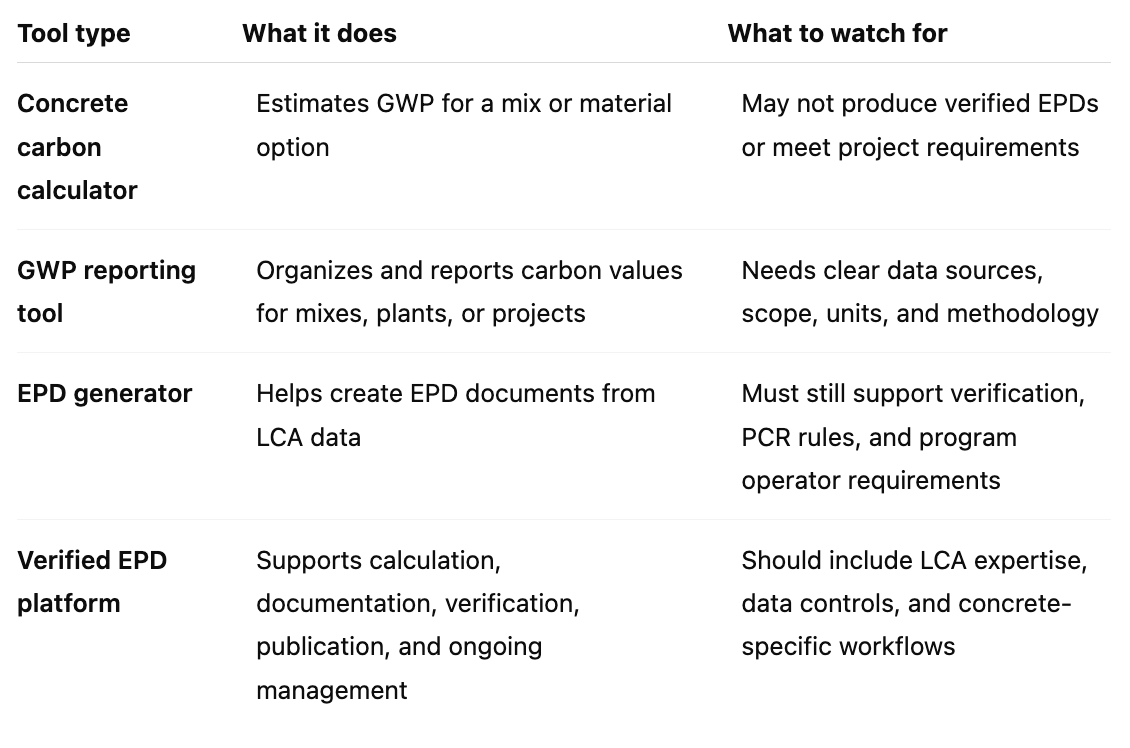
Carbon Calculator vs. GWP Reporting vs. Verified EPD Platform
People often use these terms interchangeably, but they are not the same thing. A producer should know the difference before choosing software.
A basic calculator may be useful for early mix comparisons. But if a contractor or owner asks for a third-party verified Type III EPD, a simple estimate is not enough. Formal EPDs need to follow the correct Product Category Rule, use the correct LCA approach, and go through third-party verification.
This distinction matters in the field. A sales rep may need a quick GWP estimate for a conversation. A QC manager may need a verified EPD for a submittal. A sustainability lead may need portfolio-level data across plants. The software should support all of those needs without mixing them up.
Why Ready-Mix Producers Need Concrete-Specific EPD Software
Ready mix is different from a standard manufactured product. A producer may have hundreds or thousands of mixes across multiple plants. Each mix can change based on cement type, SCM availability, aggregate source, admixtures, water-cementitious ratio, strength, slump, exposure class, and project requirements.
That is why generic LCA software can become difficult for ready-mix teams. A general tool may be powerful, but it may not fit how producers actually work. Sales needs answers quickly. QC needs accurate mix data. Operations needs plant-level data. Technical teams need performance context. Leadership needs to understand which products are ready for carbon-driven projects.
Concrete EPD software should be built around producer workflows, not just sustainability reporting. It should help teams manage mix-level data, plant-level data, supplier inputs, GWP results, verified EPDs, and customer requests without forcing everyone to become an LCA expert.
.png)
The First Question: Does the Software Meet the Standards Your Projects Require?
This should be the first filter. If the software does not support the standards, PCRs, and project requirements your customers care about, the rest of the features do not matter.
Concrete EPDs are not just carbon estimates. They need to follow specific standards and rules. That may include ISO 14025 for Type III Environmental Product Declarations, ISO 14040 and ISO 14044 for Life Cycle Assessment, ISO 21930 for construction product EPDs, the current concrete PCR, and the specific program operator requirements used for publication and verification.
For producers working in or selling into Europe, EN 15804+A2 is especially important. Europe is also moving toward more structured digital product information through systems like Digital Product Passports, or DPPs. DPPs are not the same thing as EPDs, but they point toward the same direction: more accessible, structured, product-level environmental data.
Ask directly:
- Does the software support ISO 14025?
- Does it support ISO 21930 for construction product EPDs?
- Does it follow ISO 14040 and ISO 14044 for LCA?
- Does it support the current concrete PCR, including Version 3 requirements?
- Can it handle A1-A3 reporting?
- Can it handle optional A4 when transportation to site is needed?
- Can it support EN 15804+A2 for European construction product EPDs?
- Is the platform preparing for digital product data requirements like DPPs in Europe?
- Can it support the program operators and verifiers your customers accept?
- Can it handle project-specific GWP thresholds, benchmarks, and reporting formats?
This matters because a DOT project, LEED project, data center, warehouse, university, federal project, or European project may each ask for carbon data differently. Producers need software that can adapt to the requirement, not a tool that only works in one narrow situation.
“Before asking how fast the software is, ask whether it can produce data your customer will actually accept.”
What the Current Concrete PCR Means for Software
The current concrete PCR matters because it defines how concrete EPDs should be created. It affects the declared unit, life cycle stages, data quality, performance characteristics, background data, EPD type, software documentation, and reporting structure.
For ready-mix producers, this means software should be able to handle the real details behind a concrete EPD. It should not only calculate a GWP number. It should support the data and documentation needed to make that number defensible.
A concrete EPD platform should be able to manage:
- A1 raw material supply
- A2 transportation to the plant
- A3 manufacturing
- Optional A4 delivery to the job site
- One cubic meter and cubic yard reporting where needed
- Plant-specific data
- Mix-specific data
- Supplier EPDs and upstream datasets
- Data gaps
- Background database versions
- LCA software versions
- LCIA methodology
- EPD type and scope
- Product and performance characteristics
- Verification documentation
This is where software either helps or hurts. If the system cannot track the information required by the PCR, the producer may still end up doing manual cleanup before verification or submittal.
.png)
The Second Question: Is the Company Behind the Software Independent and Transparent?
This is where producers should be careful. You are not just buying software. You are trusting a company with sensitive mix, plant, supplier, customer, and carbon data. You should understand who owns the software company, what other businesses they are connected to, and whether there are potential conflicts of interest.
For example, if a software provider is owned by, connected to, or financially tied to a material supplier, ready-mix competitor, EPD database, verification service, or certification body, producers should understand what safeguards are in place. This does not automatically mean the software is bad. It does mean the relationship should be clear.
EPDs depend on trust. The company helping create the EPD should not blur the line between software provider, data owner, competitor, verifier, and database manager without explaining how independence is protected.
Ask directly:
- Who owns the software company?
- Is the provider owned by or connected to a ready-mix producer, cement company, material supplier, or competitor?
- Does the provider own or operate an EPD database?
- Does the provider have a relationship with a verification body or certification service?
- Who verifies the EPD?
- Are EPD creation, verification, and database management clearly separated?
- Who can access our confidential mix and plant data?
- Are there clear protections around producer data and competitive information?
This should not be an awkward question. It is basic due diligence. If your EPDs will be used for bids, compliance, and customer trust, the process should be clean and easy to explain.
“When carbon data affects project decisions, independence and transparency matter.”
The Third Question: Is the Software Truly Built for Concrete Producers?
Concrete is local, technical, and always tied to performance. A mix is not just a product number in a catalog. It has strength requirements, placement needs, slump, air, exposure class, cementitious content, SCMs, aggregates, admixtures, curing assumptions, and plant-specific realities.
A platform built for general product LCAs may not understand those details. A platform built for concrete should help producers connect carbon data to the way they already manage mixes, plants, materials, and submittals.
Ask directly:
- Has the company worked with ready-mix producers before?
- Is the software focused on concrete and construction materials?
- Can it handle mix-level EPDs?
- Can it manage multiple plants?
- Can it connect cement, SCMs, aggregates, admixtures, plant energy, and transportation?
- Can it compare mixes by strength, performance, and GWP?
- Can it help identify what is driving the GWP of a mix?
- Can it support ready mix, precast, block, pavers, aggregates, asphalt, dry mix, and SCM-related workflows?
- Can sales, QC, and technical teams actually use the outputs?
- Can it connect to my QC system?
The last question matters most. If only one sustainability person can understand the tool, it may not help during a real bid or submittal. A concrete producer needs software that works for the people dealing with customers every day.
.png)
The Fourth Question: Does It Include Real LCA Expertise and Human Support?
Software can make EPDs faster, but it does not replace LCA expertise. Concrete carbon data needs to follow PCR rules, LCA standards, declared units, data quality requirements, allocation rules, system boundaries, and verification expectations. If the data is wrong going into the tool, the output will not magically become correct.
This matters because producer data is often messy. Mix designs may live in one system. Plant energy data may live somewhere else. Supplier EPDs may be missing. Transportation distances may need to be confirmed. A project spec may ask for something slightly different than the last one.
That is why producers should look for software backed by people who understand LCA, concrete, EPDs, specs, and verification. When a contractor asks a question, or a verifier flags an issue, or a spec requires a specific format, producers need access to someone who can help.
Ask directly:
- Are LCA experts involved in setup and review?
- Who checks assumptions before verification?
- Can the team help organize messy producer data?
- Can they explain data gaps and how to fix them?
- Can they support third-party verification?
- Can they help when a project team questions the EPD?
- Can they help with spec language or project carbon requirements?
- Is support coming from people who understand concrete, or just software support?
- Will someone be available when a bid or submittal deadline is on the line?
“Software can calculate. Experts help make sure the calculation can be defended.”
The Fifth Question: How Is AI Being Used?
AI can be useful in EPD software. But AI should not be treated as the source of truth for verified EPDs.
EPDs need traceable, auditable, standards-compliant data. That means every important input should connect back to a real source, such as a mix design, supplier EPD, plant energy record, production volume, fuel record, or transportation assumption. AI can help, but it should not invent data, guess assumptions, or replace expert review.
Ask directly:
- Is AI used in the platform?
- What does AI actually do?
- Does AI collect data, map data, create assumptions, or generate results?
- Can every input be traced back to a source?
- Is there human review before data is used in an EPD?
- Is our confidential data used to train AI models?
- How does the platform prevent incorrect or hallucinated data?
- Who checks whether AI-assisted data follows the PCR and standards?
Be careful with any vendor that makes AI sound like a shortcut around standards. AI may help speed up the process, but verified EPDs still require real data, LCA expertise, and third-party verification.
“AI can help organize the work. It should not replace traceable records, LCA review, or verification.”
The Sixth Question: Will It Actually Help During Bidding and Specs?
This is the practical test. A producer does not need EPD software just to say they have EPD software. The tool should help when a contractor, owner, engineer, DOT, or developer asks for carbon documentation.
A useful platform should help producers answer questions like:
- Can this mix meet the project’s GWP limit?
- Do we have an EPD for this plant?
- Can we compare lower-carbon options?
- What is driving GWP in this mix?
- Can we benchmark our mixes against project requirements?
- Can we create a whole-project carbon report?
- Can we show the contractor how different mix options affect the total project carbon?
- Can sales and technical teams explain the data clearly?
- Can we respond before the deadline?
This is where the difference between “a calculator” and “a business tool” becomes obvious. A calculator gives you a number. A stronger EPD platform helps you use that number to support the project, guide the conversation, and stand out as a knowledgeable concrete partner.
.png)
What “Good” Looks Like for Ready-Mix Producers
A producer doing this well does not treat EPDs as one-off paperwork. They treat carbon data as part of how they support projects. They know which plants have EPD coverage, which mixes are ready for carbon-driven specs, which suppliers have better data, and which options can reduce GWP while still meeting performance.
Companies that are ahead of the curve usually have:
- Clean mix design records
- Plant-level data organized
- Supplier EPDs where available
- Mix-level GWP visibility
- Verified EPDs tied to actual plants and products
- Sales and QC teams that understand the basics
- A process for responding to customer carbon requests
- A way to compare lower-carbon options before submittal
- Support for project-level carbon reporting when needed
This is what contractors and owners care about. They do not want vague sustainability claims. They want to know whether the mix meets the spec, what the GWP is, whether the EPD is valid, and whether the producer can provide the right documentation on time.
Red Flags When Choosing EPD Software
Not every tool that says “EPD” is the right fit for concrete producers. Some tools are too generic. Some rely too heavily on estimates. Some make AI sound like a shortcut. Some have unclear ownership or overlapping roles in the EPD ecosystem. Some create nice-looking reports that sales and QC teams cannot actually use.
Watch out for these red flags:
- The company cannot clearly explain which standards it supports.
- It does not support the current concrete PCR.
- It cannot handle A1-A3 and optional A4.
- It is not preparing for EN 15804+A2 or European digital product data needs where relevant.
- It does not clearly distinguish internal estimates from verified EPDs.
- It was not built for concrete producers.
- It cannot manage plant-specific or mix-specific data.
- It does not include LCA expert support.
- It treats AI output as final data.
- It cannot show data sources behind GWP values.
- It cannot export producer data in a usable way.
- It is unclear who owns the software company or whether there are conflicts of interest.
- It has overlapping roles in EPD creation, verification, database management, or material supply that are not clearly explained.
- It cannot help with bid, spec, submittal, or project-level reporting questions.
- It has no clear support path when a project deadline is urgent.
The biggest red flag is a vendor that makes EPDs sound effortless. EPD software can make the process easier, faster, and more scalable. But it still needs real data, real methodology, real review, and real verification.
.png)
EPD Software Evaluation Checklist for Concrete Producers
Use this checklist before choosing a concrete EPD software provider.
Standards and compliance
- Does it support ISO 14025?
- Does it support ISO 21930?
- Does it follow ISO 14040 and ISO 14044?
- Does it support the current concrete PCR?
- Can it handle A1-A3 and optional A4?
- Can it support EN 15804+A2 where needed?
- Is it preparing for DPP-style digital product data requirements in Europe?
- Can it support project-specific GWP thresholds and benchmarks?
- Can it distinguish internal estimates from verified EPDs?
Concrete fit
- Has the provider worked with ready-mix producers?
- Is the software built for concrete and construction materials?
- Can it manage multiple plants?
- Can it manage mix-level data?
- Can it connect supplier EPDs and material inputs?
- Can it compare mixes by strength, performance, and GWP?
- Can sales, QC, and technical teams actually use it?
- Can it connect to my QC system?
Company independence and transparency
- Who owns the software company?
- Is the provider connected to a ready-mix competitor, cement company, material supplier, database, verifier, or certification body?
- Are those relationships clearly disclosed?
- How is producer confidentiality protected?
- Are EPD creation, verification, and database roles clearly separated?
Data and AI
- Who controls the producer’s mix, plant, supplier, and production data?
- Can the producer export its data?
- Is the data used to train AI?
- Is data shared with third parties or benchmarks?
- Can every input be traced back to a source?
- Is AI-assisted data reviewed by humans?
- Are assumptions documented?
LCA expertise and support
- Are LCA experts involved?
- Can the provider help organize messy data?
- Can they support verification questions?
- Can they help with supplier data issues?
- Can they help with specs and project carbon requirements?
- Will a real person be available when a bid or submittal deadline is urgent?
Business value
- Will this help respond to bids faster?
- Will this help during submittals?
- Will this help benchmark mixes against GWP requirements?
- Will this help produce whole-project carbon reports?
- Will this help sales teams explain lower-carbon options?
- Will this help the producer stand out as a trusted low-carbon concrete partner?
.png)
Why Climate Earth Is Built for Concrete Producers
Climate Earth helps concrete producers create and manage EPDs across ready mix, block, pavers, precast, cement, aggregates, asphalt, dry mix, and SCMs. Our platform is built to make concrete carbon data easier to calculate, update, and use across bids, submittals, and low-carbon project requirements.
That matters because concrete producers do not need a generic sustainability dashboard. They need a practical way to manage mix data, plant data, supplier data, GWP reporting, EPD workflows, project benchmarks, and customer requests. Climate Earth is designed around the way concrete and construction material producers actually operate.
Why Choose Climate Earth?
- Built for concrete and construction materials: Climate Earth is designed around the way concrete producers actually manage mixes, plants, materials, and project requirements.
- Faster EPD workflows: Create and manage EPDs without rebuilding the process from scratch every time a customer asks for carbon data.
- Practical GWP visibility: See the carbon impact of mixes, materials, and product options so your team can respond with confidence.
- Support for bids and submittals: Make it easier for sales, technical, and QC teams to provide verified EPD data when owners, contractors, DOTs, or agencies ask for it.
- Ready for low-carbon requirements: Prepare for Buy Clean policies, LEED projects, DOT programs, data centers, universities, warehouses, and owner-driven carbon specs.
- Scalable across product lines: Support EPD needs across ready mix, precast, block, pavers, cement, aggregates, asphalt, dry mix, and SCM-related workflows.
Ready to Get Started? Schedule a demo to see how easy it can be to create, manage, and use concrete EPDs across your business.
Common Questions About EPD Software for Concrete Producers
What is EPD software?
EPD software helps producers calculate, manage, and report environmental product data. For concrete producers, this usually includes GWP calculations, mix-level carbon data, plant information, supplier inputs, LCA documentation, and verified EPD workflows.
Is a concrete carbon calculator the same as EPD software?
Not always. A concrete carbon calculator may estimate GWP, while EPD software should support the full process of creating, verifying, publishing, and managing EPDs. Producers should make sure they know whether a tool produces internal estimates, verified EPDs, or both.
What standards should concrete EPD software support?
Concrete EPD software should support the standards and rules required by the producer’s market. This may include ISO 14025, ISO 21930, ISO 14040/14044, the current concrete PCR, A1-A3 reporting, optional A4, and EN 15804+A2 for European construction product EPDs.
Why does company ownership matter when choosing EPD software?
Company ownership matters because producers are trusting the provider with confidential mix, plant, supplier, and carbon data. Producers should understand whether the software company is connected to competitors, material suppliers, EPD databases, verifiers, or certification bodies. The goal is not to assume a conflict, but to make sure roles are transparent and data is protected.
Can AI create verified concrete EPDs?
AI can help collect, organize, and review data, but it should not replace LCA expertise, source documentation, PCR compliance, or third-party verification. Verified EPDs need traceable data and defensible methodology.
Why does LCA expertise matter if software does the calculations?
LCA expertise matters because EPDs depend on standards, PCRs, system boundaries, declared units, data quality rules, allocation assumptions, background datasets, and verification requirements. Software can speed up the process, but experts help make sure the results are correct and defensible.
How does EPD software help during bidding?
Good EPD software can help producers benchmark mixes against GWP limits, identify lower-carbon options, match EPDs to specific mixes and plants, support submittals, and provide project-level carbon reporting. This helps producers respond faster and have stronger technical conversations with customers.
What should ready-mix producers look for in EPD software?
Ready-mix producers should look for concrete-specific workflows, standards support, LCA expert support, transparent company ownership, clear data practices, careful AI use, GWP benchmarking, verified EPD workflows, project reporting, and usable outputs for sales, QC, and technical teams.
Summary: Choosing EPD Software That Works in the Real World
EPD software should make life easier for concrete producers, not create another disconnected system. The right platform helps teams calculate GWP, manage EPDs, organize data, support verification, benchmark mixes, respond to specs, and provide project carbon documentation when customers ask for it.
For ready-mix producers, the best EPD software is practical, concrete-specific, standards-ready, and backed by real LCA expertise. It should help connect mix designs, plant data, supplier inputs, PCR requirements, verified EPDs, and project submittals. It should also make sure sales, QC, operations, and technical services can use the information without becoming LCA experts.
As EPD demand grows across Buy Clean programs, DOT work, LEED projects, data centers, universities, warehouses, and private owner requirements, producers need more than a carbon calculator. They need a reliable EPD platform that helps them compete, respond faster, and become a trusted low-carbon concrete partner.
Related articles

LEED v5 Requirements: What They Mean for Low Carbon Concrete

How to Read a Concrete EPD: Quick, Expert Guide