


What Is GWP? Global Warming Potential Basics

Global Warming Potential, often shortened to GWP, is a way to measure how much a greenhouse gas contributes to climate change compared with carbon dioxide.
It gives scientists, companies, governments, and buyers one common way to compare different gases. In simple terms, GWP helps answer this question: how much warming does this gas cause compared with CO2?
This matters because not all greenhouse gases behave the same way. Carbon dioxide, methane, nitrous oxide, and refrigerant gases all trap heat in the atmosphere, but they do not trap the same amount of heat or stay in the atmosphere for the same length of time. GWP gives us a way to compare them using one shared unit.
That shared unit is usually called carbon dioxide equivalent, written as CO2e. If you see a product’s carbon footprint listed as kg CO2e, that means the climate impact has been converted into the equivalent amount of carbon dioxide. This makes it easier to compare products, materials, buildings, companies, or activities.
Key Takeaways
- GWP measures climate impact. It shows how much heat a greenhouse gas traps compared with carbon dioxide over a set time period.
- GWP is usually reported as CO2e. CO2e means carbon dioxide equivalent, which lets different greenhouse gases be added together and compared.
- GWP is one of the most important numbers in LCAs and EPDs. It is used to report product carbon footprints, compare materials, support embodied carbon reporting, and meet low-carbon procurement requirements.
.png)
What Does GWP Stand For?
GWP stands for Global Warming Potential. It is a climate impact measurement used to compare greenhouse gases. Carbon dioxide is used as the reference gas, and its GWP is set at 1.
If another gas has a higher GWP than carbon dioxide, it means that gas traps more heat over the chosen time period. For example, methane has a much higher warming effect than carbon dioxide over shorter time frames, even though it does not stay in the atmosphere as long. Nitrous oxide and some refrigerant gases can also have very high GWP values.
The easiest way to understand GWP is to think of it like a conversion factor. Different greenhouse gases are like different currencies. GWP converts them into one shared currency: CO2e.
“GWP is the conversion tool that turns different greenhouse gases into one comparable climate impact number.”
GWP Explained Simply
Imagine three blankets. One blanket is thin, one is medium, and one is super thick. If you put them over the Earth, the thick blanket traps more heat than the thin one.
Greenhouse gases are like those blankets. Carbon dioxide is the gas we use as the basic comparison blanket. Other gases, like methane or nitrous oxide, can act like thicker blankets because they trap more heat.
GWP tells us how thick each gas’s “warming blanket” is compared with carbon dioxide. CO2 has a GWP of 1. If another gas has a GWP of 25, that means one kilogram of that gas warms the planet like 25 kilograms of CO2 over the chosen time period.
That is why people use CO2e. It lets us say, “These different gases together have the same warming impact as this much carbon dioxide.” It turns a complicated mix of gases into one easier number.
Why GWP Matters
GWP matters because climate impact is not only about carbon dioxide. Many gases contribute to warming, and some are far more powerful than CO2. Without GWP, it would be hard to compare the climate effect of different gases, products, materials, or activities.
For businesses, GWP helps turn emissions data into something useful. It can show whether a product’s footprint is mostly driven by fuel, electricity, raw materials, refrigerants, agricultural emissions, manufacturing processes, or transportation. Once the biggest sources are clear, companies can decide where to reduce impact.
For buyers and project teams, GWP helps compare options. A lower GWP product may have a lower climate impact, but only if the comparison is fair. The products need to serve the same function, use the same unit, and be measured using the same method.
.png)
A Brief History of GWP
Global Warming Potential became important as scientists and policymakers needed a way to compare different greenhouse gases. Carbon dioxide was already the main reference point for climate change, but it was not the only gas causing warming. Methane, nitrous oxide, and fluorinated gases also mattered.
The Intergovernmental Panel on Climate Change, or IPCC, helped formalize GWP as a way to compare greenhouse gases over specific time horizons. This made it possible to express different gases in carbon dioxide equivalent. That became important for climate agreements, greenhouse gas inventories, carbon accounting, product footprints, and life cycle assessments.
Over time, GWP became one of the most widely used climate metrics. It is now used in corporate carbon reporting, national greenhouse gas inventories, product carbon footprints, Environmental Product Declarations, Life Cycle Assessments, refrigerant rules, agriculture reporting, and embodied carbon policies. It is one of the main reasons carbon data can be compared across products, companies, and industries.
.png)
How GWP Is Measured
GWP measures how much heat a greenhouse gas traps in the atmosphere compared with carbon dioxide. It looks at two main things. First, how strongly the gas absorbs heat. Second, how long the gas stays in the atmosphere.
Some gases are very powerful but do not last as long. Methane is a good example. It creates a strong warming effect in the short term, but it breaks down faster than carbon dioxide.
Other gases may stay in the atmosphere for a very long time. Some fluorinated gases used in refrigerants and industrial processes can have extremely high GWP values. This is why small leaks of high-GWP refrigerants can still have a large climate impact.
GWP is usually measured over a time period. The most common time period is 100 years, often written as GWP100. Some studies also use 20-year GWP, written as GWP20, because it shows the stronger short-term warming effect of gases like methane.
What Is CO2e?
CO2e stands for carbon dioxide equivalent. It is the unit used to express the warming impact of different greenhouse gases in one common number. The “e” means equivalent.
For example, if a gas has a GWP of 30, then 1 kilogram of that gas has the same warming impact as 30 kilograms of carbon dioxide over the chosen time period. That would be reported as 30 kg CO2e. This makes it possible to add different greenhouse gases together.
You will see CO2e in carbon footprints, LCAs, EPDs, sustainability reports, emissions inventories, and climate disclosures. It is one of the most common units in climate reporting. When someone says a product has a carbon footprint of 500 kg CO2e, they mean all relevant greenhouse gases have been converted into the warming equivalent of carbon dioxide.
“CO2e is the common language of carbon reporting.”
How to Calculate CO2e Using GWP
The basic calculation is simple:
Amount of greenhouse gas × GWP factor = CO2e
If you emit 1 kilogram of a gas with a GWP of 10, the result is 10 kilograms of CO2e. If you emit 5 kilograms of a gas with a GWP of 20, the result is 100 kilograms of CO2e. The math is simple, but choosing the right data and GWP factor matters.
Here is a basic example:
- A process releases 2 kg of methane.
- The methane GWP factor is applied.
- The methane is converted into kg CO2e.
- The result can be added to CO2, nitrous oxide, or other gases in the same footprint.
This is how different emissions can be combined into one climate impact number. It is also why carbon footprints can include more than carbon dioxide. CO2e makes different gases comparable.
.png)
GWP20 vs GWP100
GWP depends on the time period being used. The most common time period is 100 years, called GWP100. This is widely used in greenhouse gas inventories, Life Cycle Assessments, product carbon footprints, and Environmental Product Declarations.
GWP20 uses a 20-year time period. It gives more weight to gases that create strong short-term warming, especially methane. This can be useful when the goal is to understand near-term climate impact.
The choice between GWP20 and GWP100 can change how emissions look. Methane, for example, looks much more powerful over 20 years than over 100 years because it traps a lot of heat but does not last as long as CO2. That does not mean one time period is always “right” and the other is always “wrong.” It means you need to know which one is being used.
For most product reporting, EPDs, and construction material comparisons, GWP100 is commonly used. If a report uses GWP20, it should clearly say so. Never compare GWP numbers unless the same time horizon is being used.
GWP vs Carbon Footprint
GWP and carbon footprint are related, but they are not the same thing. GWP is the factor used to compare greenhouse gases. A carbon footprint is the final result that uses GWP to express total climate impact.
A carbon footprint usually includes emissions from several sources. These may include energy, fuel, raw materials, transportation, refrigerants, manufacturing, waste, or land use. GWP helps convert those different greenhouse gases into CO2e.
A simple way to remember it:
- GWP = the conversion factor
- CO2e = the common unit
- Carbon footprint = the total climate impact
For example, if a product’s carbon footprint is 100 kg CO2e, that number may include carbon dioxide, methane, nitrous oxide, and other greenhouse gases. GWP is what makes that combined number possible.
.png)
GWP vs Embodied Carbon
GWP and embodied carbon are also connected, but they are not the same thing. GWP is a measurement of climate impact. Embodied carbon is the greenhouse gas emissions tied to making, transporting, installing, maintaining, and eventually disposing of materials.
In construction, embodied carbon is usually reported using GWP. For example, the embodied carbon of a concrete mix, steel beam, insulation board, or glass product may be shown as kg CO2e per unit. That GWP result may come from a Life Cycle Assessment or Environmental Product Declaration.
Embodied carbon is the broader concept. GWP is the metric used to measure its climate impact. If a project team wants to reduce embodied carbon, they often look for lower-GWP materials and designs.
GWP in Life Cycle Assessment
In a Life Cycle Assessment, GWP is one of the most important impact categories. An LCA looks at the environmental impacts of a product, process, material, or service across defined life cycle stages. GWP measures the climate change impact within that broader assessment.
For example, an LCA for a t-shirt may measure the GWP from cotton farming, fabric production, dyeing, sewing, packaging, shipping, washing, drying, and disposal. An LCA for concrete may measure the GWP from cement, aggregates, admixtures, water, plant energy, and transportation. The result shows where the climate impact is coming from.
GWP is useful because it helps identify hotspots. A hotspot is the part of the life cycle that creates the largest share of impact. Once a hotspot is known, companies can make better decisions about materials, suppliers, energy, transportation, or design.
.png)
GWP in Environmental Product Declarations
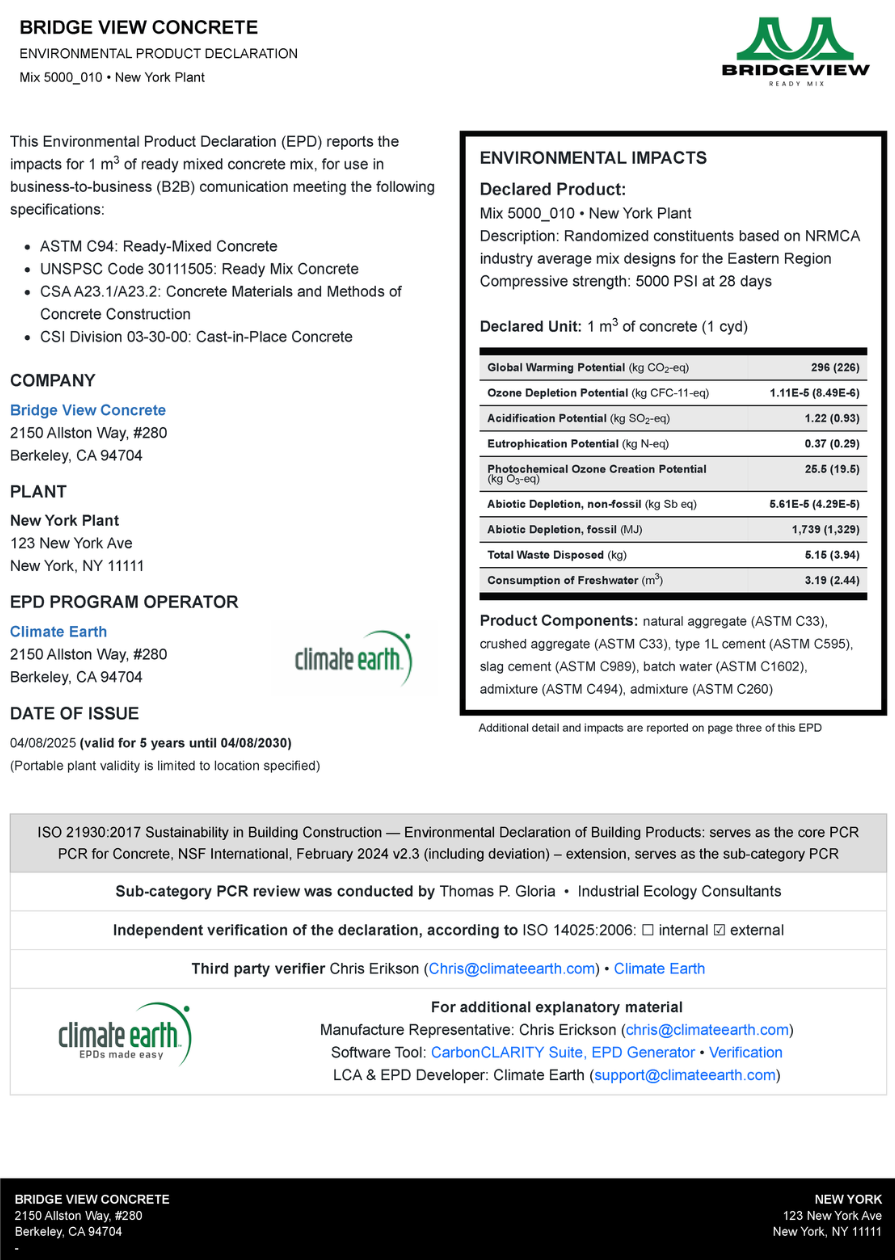
GWP is one of the most important numbers in an Environmental Product Declaration, or EPD. An EPD is a verified document that reports a product’s environmental impact based on a Life Cycle Assessment. GWP is usually the number people look at first because it shows the product’s climate impact.
In an EPD, GWP is usually reported as kg CO2e per declared unit. For concrete, that may be kg CO2e per cubic yard or cubic meter. For cement, it may be kg CO2e per metric ton. For flooring, it may be kg CO2e per square meter.
GWP values in EPDs are used by architects, engineers, contractors, owners, procurement teams, agencies, and sustainability consultants. They help compare materials, calculate embodied carbon, support green building credits, and meet low-carbon procurement requirements. However, EPDs should only be compared when the products, units, scopes, and product category rules are aligned.
“A lower GWP number only matters if the comparison is fair.”
How to Read GWP on an EPD
Reading GWP on an EPD is easier when you follow a clear process. Do not jump straight to the lowest number. First, make sure the EPDs are actually comparable.
Step 1: Check the product
Make sure the EPD is for the product you are actually using. A concrete mix, insulation board, steel product, or flooring material can vary by plant, region, supplier, or formulation. The more specific the EPD is, the more useful the GWP number usually is.
Step 2: Check the declared unit
The declared unit tells you what the GWP number is based on. It may be one cubic yard of concrete, one metric ton of cement, one square meter of flooring, or one kilogram of product. You cannot compare GWP values fairly if the units do not match.
Step 3: Check the life cycle stages
Look at whether the GWP covers cradle-to-gate, cradle-to-grave, or another scope. For construction products, the A1 to A3 stages are often used to show raw material supply, transport to manufacturing, and manufacturing. Some EPDs include more stages, such as transport to site, installation, use, end of life, or reuse benefits.
Step 4: Find the GWP value
The GWP value is usually shown in an environmental impact table. It may be listed as GWP, climate change, global warming potential, or kg CO2e. Make sure you are reading the correct column and the correct life cycle stage.
Step 5: Compare only when the rules match
Two GWP numbers are not automatically comparable. The products should serve the same function, use the same declared unit, follow the same product category rules, and include the same life cycle stages. Otherwise, the lower number may not mean what you think it means.
Where GWP Is Used
GWP is used anywhere people need to measure climate impact. It shows up in product footprints, company emissions reports, national greenhouse gas inventories, Life Cycle Assessments, Environmental Product Declarations, construction specifications, and climate policy.
Common places where GWP is used include:
- Product carbon footprints
- Life Cycle Assessments
- Environmental Product Declarations
- Corporate greenhouse gas reporting
- Scope 1, Scope 2, and Scope 3 emissions
- Construction material comparisons
- Embodied carbon calculations
- LEED and green building documentation
- Buy Clean and low-carbon procurement programs
- Refrigerant management
- Agriculture and food system emissions
- Packaging and manufacturing sustainability
GWP is useful because it connects climate science to real decisions. It can help a company choose a lower-impact material. It can help an owner compare building products. It can help a manufacturer understand whether raw materials, energy, transportation, or refrigerants are driving emissions.
GWP in Construction and Building Materials
GWP has become especially important in construction because buildings and infrastructure use large amounts of materials. Concrete, cement, steel, asphalt, aluminum, glass, insulation, gypsum, and flooring can all carry significant embodied carbon. GWP gives project teams a way to measure and compare that climate impact.
In construction, GWP is often used in product-level EPDs and whole-building Life Cycle Assessments. A project team may use EPDs to calculate the upfront carbon of a building or infrastructure project. They may also compare different material options to reduce the overall carbon footprint.
For concrete, GWP is often tied to cement content, supplementary cementitious materials, aggregate sources, admixtures, plant energy, and transportation. For steel, it may be tied to production method, recycled content, energy source, and mill data. For insulation, it may include both manufacturing impacts and blowing agents, depending on the product type.
This is why GWP is becoming part of bids, submittals, specifications, and procurement. It is not just a sustainability number anymore. In many projects, it is becoming part of how materials are evaluated.
.png)
GWP and Buy Clean Policies
Buy Clean policies are one reason GWP is becoming more visible. These policies use public purchasing to encourage lower-carbon construction materials. Instead of only asking whether a product meets technical requirements, buyers also ask for its embodied carbon or GWP.
In the United States, Buy Clean programs and low embodied carbon material requirements often rely on EPDs to provide GWP data. Materials such as concrete, cement, asphalt, steel, and glass are commonly included because they are major contributors to construction emissions. Project teams use GWP to understand whether a material is below a benchmark or meets a project requirement.
This does not mean every project uses the same rules. Requirements can vary by agency, state, owner, material category, and funding source. That is why manufacturers need to understand how their product’s GWP is calculated, documented, verified, and accepted.
GWP in Refrigerants and Manufacturing
GWP is not only used for construction materials. It is also very important in refrigerants. Some refrigerant gases have extremely high GWP values, which means small leaks can create a large climate impact.
This matters for HVAC systems, refrigeration, cold storage, manufacturing, grocery stores, data centers, and industrial facilities. A system with a high-GWP refrigerant may have a bigger climate risk if leaks occur. That is why many regulations and sustainability programs focus on reducing high-GWP refrigerants.
Manufacturing can also involve high-GWP gases, depending on the industry. Electronics, chemicals, foams, cooling systems, and industrial processes may use or release gases that need to be counted in carbon reporting. GWP helps convert those gases into CO2e so they can be included in the total footprint.
GWP in Agriculture and Food
GWP is also important in agriculture and food systems. Methane and nitrous oxide are major greenhouse gases in this sector. Methane can come from livestock, manure, rice production, and organic waste. Nitrous oxide can come from fertilizer use and soil processes.
Because methane and nitrous oxide have higher GWP values than carbon dioxide, they can strongly affect the carbon footprint of food products. This is why LCAs for food often look closely at farming practices, fertilizer, feed, manure management, energy, transportation, packaging, and waste.
GWP helps food companies and buyers understand where climate impact is coming from. It can support better farming practices, supplier decisions, packaging choices, and waste reduction strategies. It can also help companies communicate product carbon footprints more clearly.
Common GWP Mistakes
One common mistake is treating GWP as the only environmental impact that matters. GWP measures climate impact, but it does not measure everything. Water use, toxicity, land use, resource depletion, acidification, and eutrophication may also matter depending on the product.
Another mistake is comparing GWP numbers with different scopes. A cradle-to-gate GWP number should not be compared directly with a cradle-to-grave number unless you understand what is included. The boundaries of the study matter.
A third mistake is ignoring the declared unit. A GWP number per kilogram is not the same as a GWP number per square meter or per cubic yard. Always check the unit before comparing products.
A fourth mistake is using old or generic data when specific data is available. Industry averages can be helpful, but they may not reflect the real product, plant, supplier, or process. Better data usually leads to better decisions.
A fifth mistake is assuming “lower GWP” always means “better overall.” A product may have lower climate impact but worse performance in another category. GWP is important, but it should be read in context.
.png)
How Companies Can Reduce Product GWP
Companies can reduce product GWP by finding the biggest climate hotspots and improving them. The right strategy depends on the product and industry. A concrete producer, packaging company, food manufacturer, and electronics manufacturer will not have the same carbon drivers.
Common ways to reduce product GWP include:
- Use lower-carbon raw materials
- Improve energy efficiency
- Switch to lower-carbon electricity
- Reduce fuel use
- Optimize transportation
- Reduce waste
- Improve product design
- Use recycled or recovered materials when appropriate
- Reduce high-GWP refrigerant leaks
- Work with lower-carbon suppliers
- Improve manufacturing yields
- Update formulas or mix designs
- Extend product life
- Improve reuse or recycling pathways
The best first step is usually an LCA or product footprint study. That shows where the GWP is coming from. Once the hotspots are clear, companies can focus on changes that actually matter.
“The fastest way to reduce GWP is to stop guessing and find the hotspot.”
.png)
GWP Example: Concrete
Concrete is a useful example because GWP is becoming more important in construction. A concrete mix’s GWP is usually reported in kg CO2e per cubic yard or cubic meter. The number may come from an LCA or an EPD.
In many concrete mixes, cement is one of the biggest contributors to GWP. That is because cement production is energy-intensive and releases process emissions. However, transportation, plant energy, aggregates, admixtures, and mix design choices can also matter.
A producer may reduce GWP by optimizing the mix design, using supplementary cementitious materials, improving cement efficiency, selecting lower-carbon inputs, or improving plant operations. The goal is not just to make the number lower. The product still has to meet strength, performance, durability, and project requirements.
GWP Example: Refrigerants
Refrigerants are another clear example of why GWP matters. Some refrigerant gases trap far more heat than carbon dioxide. If they leak from cooling equipment, their climate impact can be large even when the leaked amount is small.
A company managing refrigeration or HVAC systems may reduce GWP by choosing lower-GWP refrigerants, improving leak detection, maintaining equipment, and replacing older systems. This is especially relevant for grocery stores, warehouses, manufacturing facilities, hospitals, data centers, and large buildings.
This example shows why GWP is not only about materials. It can also apply to gases used inside equipment and operations. The same CO2e logic helps compare and report their climate impact.
GWP Example: Packaging
Packaging can also be studied using GWP. A company may compare plastic, paper, glass, aluminum, or reusable packaging options. The result is not always obvious because each material has different impacts from raw materials, manufacturing, weight, transportation, reuse, and recycling.
A heavier package may create more transportation emissions. A lighter package may be harder to recycle. A reusable package may only perform better if it is reused enough times.
GWP helps compare the climate impact of these choices, but the comparison must be fair. The packaging options need to perform the same function and use the same assumptions. Otherwise, the lowest GWP number may be misleading.
GWP vs Other Environmental Metrics
GWP is one of the most important environmental metrics, but it is not the only one. It measures climate impact. It does not fully explain water use, air quality, land use, toxicity, or resource depletion.
Other environmental metrics may include:
- Water consumption
- Energy demand
- Acidification
- Eutrophication
- Ozone depletion
- Smog formation
- Human toxicity
- Ecotoxicity
- Land use
- Resource depletion
- Waste generation
This is why LCAs and EPDs often report more than GWP. If the goal is climate impact, GWP may be the most important number. If the goal is broader environmental performance, you need to look at other categories too.
.png)
GWP FAQ
What does GWP mean?
GWP stands for Global Warming Potential. It measures how much warming a greenhouse gas causes compared with carbon dioxide over a chosen time period. Carbon dioxide has a GWP of 1.
What is GWP used for?
GWP is used to compare greenhouse gases and calculate carbon footprints. It is used in LCAs, EPDs, greenhouse gas inventories, product carbon footprints, corporate reporting, construction material comparisons, refrigerant management, and climate policy.
What does kg CO2e mean?
kg CO2e means kilograms of carbon dioxide equivalent. It is a unit that converts different greenhouse gases into one common climate impact number. This makes it easier to add and compare emissions.
Is GWP the same as carbon footprint?
No. GWP is a conversion factor used to compare greenhouse gases. A carbon footprint is the total climate impact, usually reported in CO2e.
What is GWP in an EPD?
In an EPD, GWP is the climate impact of the product for a declared unit. It is usually shown as kg CO2e. It is one of the most important numbers used to compare embodied carbon in construction materials.
What is GWP in LCA?
In an LCA, GWP is one impact category that measures climate change impact. It is calculated from greenhouse gas emissions across the life cycle stages included in the study.
What is GWP100?
GWP100 is Global Warming Potential measured over a 100-year time horizon. It is the most commonly used time horizon in many carbon footprints, LCAs, EPDs, and greenhouse gas inventories.
What is the difference between GWP20 and GWP100?
GWP20 measures warming impact over 20 years, while GWP100 measures it over 100 years. GWP20 gives more weight to short-lived gases like methane. GWP100 is more commonly used for product carbon reporting and EPDs.
Does lower GWP always mean better?
Not always. Lower GWP means lower climate impact for the measured unit and scope, but it does not automatically mean the product is better overall. You also need to consider performance, durability, safety, water use, toxicity, cost, and whether the comparison is fair.
How do companies reduce GWP?
Companies reduce GWP by finding the biggest sources of climate impact and improving them. This may involve lower-carbon materials, cleaner energy, better efficiency, lower fuel use, better transportation, supplier changes, reduced waste, or lower-GWP refrigerants.
Summary: Why GWP Matters
Global Warming Potential is one of the most important climate metrics because it makes different greenhouse gases comparable. It converts emissions into carbon dioxide equivalent, or CO2e, so people can understand the total warming impact of a product, process, company, or project.
GWP matters because it turns climate impact into a number that can be measured, reported, and improved. It is used in Life Cycle Assessments, Environmental Product Declarations, corporate carbon reporting, Buy Clean policies, refrigerant management, construction material comparisons, and product carbon footprints.
For companies, GWP is more than a technical term. It helps identify hotspots, compare options, reduce emissions, support customer requests, and prepare for low-carbon procurement. As buyers ask for more proof behind sustainability claims, understanding GWP will become a basic part of product strategy, construction decisions, and environmental reporting.
Need to report or reduce concrete GWP?
Once you understand GWP, the next step is learning how your mix designs, cement content, SCMs, and materials choices affect your numbers. Climate Earth helps concrete producers calculate, compare, and manage GWP data so they can respond to project requirements with confidence.
See how producers can manage concrete GWP data more effectively.
Related articles

LEED v5 Requirements: What They Mean for Low Carbon Concrete

How to Read a Concrete EPD: Quick, Expert Guide