


Low Carbon Concrete: A Practical Guide
Low carbon concrete is becoming one of the most important topics in ready mix. Contractors, owners, engineers, DOTs, public agencies, and private developers are asking for concrete that performs the same in the field but carries a lower carbon footprint on paper.
For producers, this is not just a sustainability trend. Low carbon concrete is starting to show up in bids, submittals, EPD requests, GWP limits, Buy Clean requirements, LEED projects, data centers, warehouses, public infrastructure, and private owner specifications. The producers that understand how to measure, reduce, document, and explain concrete carbon will be easier to work with and better positioned to win low-carbon work.
Key Takeaways
- Low carbon concrete is concrete with a lower carbon footprint than a comparable baseline mix. It still needs to meet strength, durability, slump, air, finishability, pumpability, schedule, and project specifications.
- GWP is the main number used to measure concrete carbon. Global Warming Potential is usually reported in kg CO2e per cubic yard or kg CO2e per cubic meter.
- EPDs are how low-carbon claims become usable project data. A verified Environmental Product Declaration shows the environmental impacts of a concrete mix or product, including GWP.
- Cement is usually the largest carbon driver in concrete. Most low carbon concrete strategies focus on reducing clinker, optimizing cementitious content, using SCMs, improving aggregate gradation, or selecting lower-carbon cement options.
- The best low carbon concrete strategy is not one product or one technology. It is usually a combination of mix optimization, material selection, performance-based specs, EPD data, and early coordination with the project team.
Low carbon concrete is not just less cement. It is a concrete mix that meets the job with less carbon.
What Is Low Carbon Concrete?
Low carbon concrete is concrete produced with a lower carbon footprint than a comparable traditional mix. The comparison matters. A 3,000 psi slab mix, 5,000 psi column mix, air-entrained paving mix, high-early-strength mix, and mass concrete mix should not all be judged against the same baseline.
A low carbon concrete mix should still perform like concrete. It still needs to meet the required strength, durability, slump, air content, exposure class, finishability, pumpability, set time, and schedule. A mix that has a lower carbon number but creates field problems is not a practical solution.
The best definition for producers is this: Low carbon concrete is the lowest practical GWP mix that still meets the project’s performance, placement, durability, schedule, and documentation requirements.
That definition is important because it keeps the conversation grounded. Low-carbon concrete is not just a marketing label. It is a measurable, performance-based mix design challenge.
.png)
Low Carbon Concrete vs. Green Concrete vs. Sustainable Concrete
People often use “low carbon concrete,” “green concrete,” and “sustainable concrete” as if they mean the same thing. They are related, but not identical.
Green concrete is a broad term. It may refer to concrete with recycled materials, SCMs, lower cement content, lower GWP, carbon mineralization, or other environmental benefits. The problem is that “green” can be vague without data.
Sustainable concrete is broader than carbon. It can include durability, service life, responsible sourcing, reduced waste, recycled content, water use, resilience, and lower environmental impact. A durable mix that lasts longer can be more sustainable than a mix that only looks good in a carbon calculation.
Low carbon concrete is more specific. It usually means concrete with lower Global Warming Potential compared with a baseline, benchmark, or project requirement. This is the term most connected to EPDs, GWP limits, Buy Clean policies, and low embodied carbon specifications.
.png)
Why Traditional Concrete Has a High Carbon Footprint
Concrete is made from cementitious materials, aggregates, water, and admixtures. The biggest carbon driver is usually cement. Cement production emits CO2 from fuel used to heat kilns and from the chemical process of turning limestone into clinker.
That is why low carbon concrete conversations often focus on clinker, cement content, SCMs, blended cement, and mix optimization. Aggregates, admixtures, plant energy, transportation, and delivery also matter, but in many ready mix designs, cementitious materials dominate the GWP.
This does not mean concrete is “bad.” Concrete is essential for buildings, roads, bridges, water systems, foundations, infrastructure, and resilient construction. The practical question is not whether the world will stop using concrete. The question is how producers can deliver the concrete projects need with lower embodied carbon.
The opportunity is not to use no concrete. The opportunity is to use better concrete, better documented.
How Concrete Carbon Is Measured
Concrete carbon is usually measured through a Life Cycle Assessment, or LCA. The LCA calculates environmental impacts from the materials and processes used to make the concrete. The results are often reported in an Environmental Product Declaration, or EPD.
For ready mix concrete, the most watched number is usually GWP, or Global Warming Potential. GWP is the climate impact number used to compare concrete mixes. It is reported as kg CO2e per cubic yard or kg CO2e per cubic meter, depending on the market.
Most concrete EPDs focus on A1-A3, also called cradle-to-gate:
- A1: Raw materials, including cement, SCMs, aggregates, admixtures, and water
- A2: Transportation of raw materials to the concrete plant
- A3: Batching and plant operations
Some projects may also ask for A4, which covers delivery from the plant to the jobsite.
.png)
Simple project carbon example
If a mix has a GWP of 320 kg CO2e/yd³ and the project uses 5,000 yd³, the concrete package represents: 320 × 5,000 = 1,600,000 kg CO2e
That is why low carbon concrete matters most on high-volume mixes. A small GWP reduction multiplied by thousands of yards can become a meaningful project-level reduction.
What Makes Concrete “Low Carbon”?
Concrete is low carbon when its GWP is lower than a relevant comparison point. That comparison point might be an industry average, regional benchmark, project baseline, previous mix, agency threshold, or maximum GWP value by strength class.
This is where many project teams get confused. “Low carbon” does not mean one universal number. A 4,000 psi structural mix may have a different acceptable GWP than a 3,000 psi slab mix. An air-entrained exterior mix may not compare fairly to a non-air interior mix. A high-early-strength mix may carry more carbon because the project schedule demands faster performance. A fair comparison should consider:
- Strength class
- Exposure class
- Air entrainment
- Application
- Durability requirements
- Placement method
- Schedule and early strength needs
- Region and available materials
- Declared unit
- EPD scope
For producers, the right question is not just, “Is this low carbon?” The better question is: Low carbon compared to what, for what application, and under what spec?
Main Strategies for Producing Low-Carbon Concrete
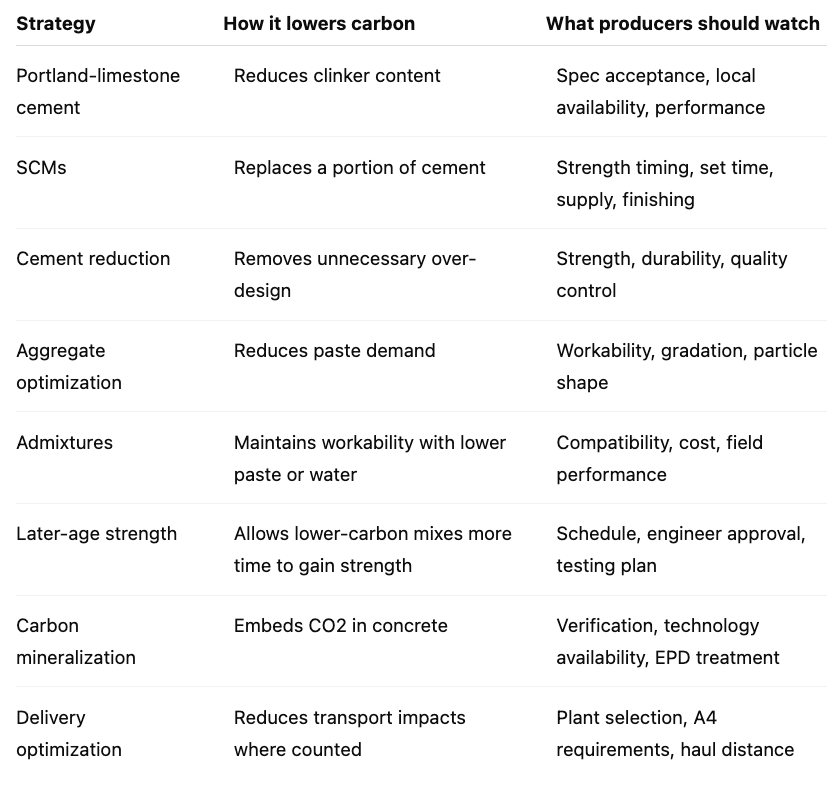
There is no single low-carbon concrete solution that works for every producer, market, or project. The best approach is usually a portfolio of strategies. Some reduce the cement footprint. Some reduce cement demand. Some improve mix efficiency. Some make verified data easier to provide.
1. Use portland-limestone cement
Portland-limestone cement, often called PLC or Type IL in the U.S. and GUL in Canada, reduces clinker content by replacing a portion of portland cement with limestone. For many producers, it is one of the most practical first steps because it can often be used in existing mix designs where allowed by standards and specifications.
PLC may not be enough by itself for aggressive GWP limits, but it can lower the baseline and make additional optimization easier.
2. Replace a portion of cement with SCMs
Supplementary cementitious materials, or SCMs, can replace part of portland cement and reduce GWP. Common SCMs include slag, fly ash, silica fume, natural pozzolans, glass pozzolans, and calcined clay.
SCMs can support lower-carbon concrete, but they need to be used carefully. They can affect early strength, set time, curing sensitivity, finishing, color, availability, and cost. The right SCM strategy depends on local materials, project specs, and performance requirements.
3. Reduce unnecessary cementitious content
Many mixes carry more cementitious material than needed because they were designed conservatively years ago, copied from old specs, or adjusted to avoid risk. Reducing unnecessary cementitious content can lower both GWP and cost when done correctly.
This should be done through trial batches, strength history, performance testing, and field feedback. The goal is not to under-design the mix. The goal is to remove unnecessary over-design.
4. Optimize aggregate gradation
Aggregates make up most of the volume of concrete. A better aggregate skeleton can reduce voids and lower paste demand. Less paste can mean less cementitious material, which can lower GWP.
Tools like combined gradation reviews and the Tarantula Curve can help producers identify gaps in aggregate sizing, excess fines, poor intermediate aggregate balance, or high paste demand. Aggregate optimization is practical because it can improve workability and lower carbon without relying only on SCM availability.
5. Use admixtures to maintain workability
Admixtures help producers lower water demand, improve workability, control set time, maintain pumpability, and support lower paste volume. Water reducers and superplasticizers can be especially useful when lowering cementitious content or increasing SCM replacement.
Low-carbon concrete still needs to place, pump, consolidate, and finish. Admixtures help make carbon reduction practical in the field.
6. Allow later-age strength when possible
Some low-carbon mixes gain strength more slowly, especially when using higher SCM replacement. If a project does not truly need early strength, allowing 56-day strength or later-age acceptance can open the door to lower-GWP mixes.
This requires early communication with engineers, contractors, and owners. It is also one of the clearest examples of why performance-based specs matter.
7. Use carbon mineralization or carbon capture technologies
Some technologies inject captured CO2 into fresh concrete, where it mineralizes and becomes embedded in the concrete. Other carbon capture, utilization, and storage technologies focus on cement manufacturing, aggregates, or other parts of the supply chain.
These technologies can be part of a lower-carbon strategy, but producers should still evaluate performance, cost, availability, verification, and how the impact is reported in EPDs.
8. Improve plant and delivery efficiency
Plant energy, batching operations, raw material transportation, and delivery distance can affect GWP, especially when A4 delivery is included. These factors usually do not drive as much carbon as cement, but they still matter for project-level reporting and operational efficiency.
Low Carbon Concrete Strategy Table
Are All Low Carbon Concrete Mixes Equal?
No. Not all low carbon concrete mixes are equal. A mix can have a low GWP but still be difficult to finish. A mix can look good in a carbon calculator but not have a verified EPD. A mix can use high SCM replacement but miss early strength. A mix can reduce cement but increase risk if aggregate gradation and admixtures are not balanced.
That is why producers should avoid treating low-carbon concrete as a single product line. It is better to think in terms of low-carbon mix options by strength, application, plant, and project requirement. A good low-carbon concrete mix should be:
- Lower GWP than the baseline or project threshold
- Supported by a valid EPD or credible GWP data
- Designed for the actual application
- Practical to batch at the plant
- Placeable and finishable in the field
- Durable for the exposure condition
- Cost-aware
- Accepted by the spec
- Easy to explain to the customer
Low carbon concrete has to pass twice: once in the carbon calculation and once on the jobsite.
Low Carbon Concrete and EPDs
EPDs are what turn a low carbon claim into usable project documentation. Without an EPD or verified GWP calculation, “green concrete” can sound vague. With an EPD, the producer can show the actual environmental impact of the mix in a standardized format.
For ready mix producers, EPDs are increasingly important because customers may ask for:
- Type III verified EPDs
- Product-specific EPDs
- Plant-specific EPDs
- Mix-specific GWP values
- Industry average comparison
- Baseline reduction calculations
- GWP limits by strength class
- Project carbon reporting by mix and volume
An EPD does not automatically mean a mix is low carbon. It means the mix has verified environmental data. The next step is comparing that GWP value to the project’s baseline, threshold, or reduction target.
.png)
Low Carbon Concrete and GWP Limits in Project Specs
Low carbon concrete requirements are moving into project specs. Sometimes the requirement is direct: “Provide a mix below this GWP limit.” Other times it appears as an EPD requirement, a Buy Clean requirement, a LEED documentation request, or an owner sustainability goal.
Common spec language may include:
- “Submit a Type III verified EPD for each concrete mix.”
- “Concrete mixes must not exceed the maximum GWP value listed by strength class.”
- “Provide mixes at least 10% below the regional benchmark.”
- “Report A1-A3 GWP for all concrete supplied.”
- “Provide project carbon totals by mix, volume, and GWP.”
- “Submit lower-carbon alternate mixes for high-volume placements.”
For producers, this means low-carbon concrete is not just a technical issue. It is a bid response issue. Sales, QC, technical services, operations, and sustainability teams need to understand how to read the spec, check the GWP, and prepare the documentation.
Performance-Based Specs Make Low-Carbon Concrete Easier
Low carbon concrete works best when the project spec allows producers to optimize the mix. A performance-based spec tells the producer what the concrete must achieve. A prescriptive spec tells the producer exactly what ingredients or proportions to use.
Prescriptive specs can block lower-carbon options. For example, a spec might require a high minimum cement content, cap SCMs too low, require a certain cement type, or demand early strength that the schedule does not actually need. These requirements may make it harder to reduce GWP.
Performance-based specs can still protect the project. They can require strength, durability, exposure performance, shrinkage limits, air content, finishability, pumpability, and GWP limits. They simply give the producer more flexibility to meet those requirements with a smarter mix.
You cannot ask for low-carbon concrete and then write a spec that prevents the producer from lowering carbon.
Practical Field Examples
Example 1: Warehouse slab with a GWP target
A contractor asks for a lower-GWP slab mix on a large warehouse project. The producer reviews the current mix and sees that it has more paste than needed. By improving aggregate gradation, reducing cementitious content, using a water reducer, and switching to accepted lower-carbon cement, the producer lowers GWP while keeping finishability acceptable.
Producer lesson: High-volume slab mixes are often the best place to start because small reductions multiply across large volumes.
Example 2: DOT project requiring EPDs
A DOT project asks for EPDs but does not yet set a hard GWP limit. The producer treats this as preparation, not just paperwork. They generate EPDs for common mixes and start tracking which mixes sit above or below likely future benchmarks.
Producer lesson: EPD reporting today can become GWP compliance tomorrow.
Example 3: Data center asking for low-carbon options
A data center owner asks for standard and lower-GWP options by mix. The producer provides three options: current mix, moderate low-carbon mix, and aggressive low-carbon mix. Each option includes GWP, SCM content, expected strength timing, and placement notes.
Producer lesson: Private owners may want options, not just one compliant mix.
Example 4: Low-carbon mix blocked by the spec
A producer has a lower-GWP mix that performs well, but the spec includes a high cement minimum and a low SCM cap. The producer flags the conflict and proposes a performance-based alternative with EPD data and trial batch results.
Producer lesson: Sometimes the biggest barrier to low-carbon concrete is the spec, not the material.
.png)
How Producers Can Start a Low-Carbon Concrete Program
Ready mix producers do not need to solve every carbon issue at once. The best approach is to start with the mixes and plants most likely to face customer requests.
Step 1: Identify priority mixes
Start with high-volume mixes, public project mixes, common strength classes, and mixes used in data centers, warehouses, infrastructure, universities, hospitals, and commercial work.
Step 2: Generate or update EPDs
Make sure priority mixes have valid EPDs or reliable GWP data. Product-specific EPDs are especially useful when customers need actual mix data.
Step 3: Benchmark current GWP
Compare current mix GWP against industry averages, regional benchmarks, project limits, and common reduction targets.
Step 4: Find carbon drivers
Look at cement content, cement type, SCMs, aggregate gradation, admixtures, plant data, and transportation assumptions.
Step 5: Create low-carbon alternates
Build practical lower-GWP options by strength class and application. Include performance notes so sales and QC teams understand when each option is appropriate.
Step 6: Test before selling
Run trial batches, check strength gain, workability, set time, air, finishability, pumpability, and durability. Do not sell a mix that only works on paper.
Step 7: Train sales and QC teams
The team should be able to explain EPDs, GWP, baselines, and low-carbon options in plain language. Customers need confidence, not jargon.
Step 8: Prepare bid-ready documentation
Create templates for EPD submittals, GWP comparisons, baseline reduction math, and project carbon reports.
.png)
How Climate Earth Helps Concrete Producers
Climate Earth helps concrete producers respond faster to EPD requests, GWP limits, low carbon concrete specs, Buy Clean requirements, public tenders, data center projects, and private owner carbon goals.
Our platform helps teams generate verified EPDs, track GWP across mixes and plants, review project specifications, compare lower-carbon mix options, and create carbon-informed project bid reports. With Climate Earth, producers can reduce manual spreadsheet work, support bids faster, and manage EPD and low carbon concrete requirements in one connected workflow.
Why Producers Choose Climate Earth
- Generate verified plant-specific and product-specific EPDs faster
- Track GWP across mixes, products, plants, and regions
- Review specs automatically for EPD, GWP, strength, SCM, water-cement ratio, and reporting requirements
- Compare and enhance mixes with AI-assisted tools
- Create carbon-informed project-based bid reports
- Integrate with QC systems and internal workflows
- Support ISO 14025 and EN 15804+A2-aligned reporting
- Reduce manual work across sales, QC, technical, sustainability, and operations teams
Ready to Get Started?
Respond faster to EPDs, GWP limits, and low carbon concrete requirements with software built for concrete producers. Book a demo to see how Climate Earth helps your team generate EPDs, manage GWP data, review specs, support bids, and win more low carbon concrete work.
FAQ: Low Carbon Concrete
What is low carbon concrete?
Low-carbon concrete is concrete designed to have a lower carbon footprint than a comparable traditional mix while still meeting performance requirements. It is usually measured using GWP.
What does GWP mean in concrete?
GWP stands for Global Warming Potential. It is the carbon footprint number used to compare concrete mixes, usually reported as kg CO2e per cubic yard or cubic meter.
Is low carbon concrete the same as green concrete?
Not exactly. Green concrete is a broader and sometimes vague term. Low-carbon concrete is more specific because it focuses on measurable carbon reduction compared with a baseline or requirement.
How is low carbon concrete measured?
Low-carbon concrete is measured through LCA and often documented in an EPD. The key number most project teams look at is GWP.
What is an EPD for low carbon concrete?
An EPD is a verified environmental report that shows the impact of a concrete mix or product. It helps producers prove the GWP value behind a low-carbon concrete claim.
Why does cement drive concrete carbon?
Cement production releases CO2 from fuel use and from the chemical process of making clinker. That makes cementitious materials one of the largest contributors to concrete GWP.
How can producers reduce concrete GWP?
Producers can reduce GWP with Portland Limestone cement, SCMs, optimized cementitious content, aggregate gradation, admixtures, later-age strength, carbon mineralization, and better plant or delivery efficiency.
Can low carbon concrete perform the same as traditional concrete?
Yes, when designed properly. Low-carbon concrete still needs to meet strength, durability, slump, air, finishability, pumpability, set time, and schedule requirements.
Does low carbon concrete cost more?
Sometimes, but not always. Some strategies may reduce cost by lowering cement content. Others may add cost depending on materials, technology, supply, and project requirements.
What projects are asking for low carbon concrete?
Low-carbon concrete is showing up in public infrastructure, DOT projects, Buy Clean programs, LEED projects, universities, hospitals, data centers, warehouses, corporate campuses, and large commercial projects.
What should ready mix producers do first?
Start by generating EPDs for priority mixes, tracking GWP, identifying high-volume mixes, reviewing cement and SCM options, and building lower-GWP alternates that are ready for bids.
Summary
Low carbon concrete is becoming a practical requirement for ready mix producers. It is no longer just a sustainability phrase. It is showing up in EPD requests, GWP limits, Buy Clean policies, public tenders, private owner requirements, and project carbon reporting.
The best low carbon concrete strategies are practical. They reduce GWP while protecting performance. That means using the right mix of cement optimization, SCMs, Portland Limestone cement, aggregate gradation, admixtures, later-age strength, EPD data, and performance-based specs.
For producers, the opportunity is bigger than compliance. The teams that can provide verified EPDs, explain GWP clearly, offer lower-carbon options, and support bids with reliable documentation will be easier for contractors, owners, engineers, agencies, and specifiers to work with.
Low carbon concrete is not just about making a greener mix. It is about delivering concrete that works in the field and data that works in the bid.
Related articles

LEED v5 Requirements: What They Mean for Low Carbon Concrete

How to Read a Concrete EPD: Quick, Expert Guide