


Low Carbon Concrete Project Specs: How Concrete Producers Meet GWP Limits in Bids

Low carbon concrete requirements are moving into real project specs. Ready mix producers are now seeing requests for Environmental Product Declarations, GWP limits, baseline reductions, Buy Clean documentation, and project-level carbon reporting in bids and submittals. These requirements are showing up in federal projects, DOT work, public buildings, universities, data centers, warehouses, infrastructure jobs, and private owner specs.
For producers, this changes the bidding process. It is no longer enough to submit a mix design that meets strength, slump, exposure, and durability requirements. On more projects, the mix also needs a documented carbon footprint, usually shown as Global Warming Potential, or GWP.
The practical question is not just, “Do we have an EPD?” The better question is, “Can this mix meet the GWP limit, can we prove it, and can we still meet the job requirements?” This guide explains how low carbon concrete specs show up in bids, how to read GWP requirements, how baseline math works, what documents to prepare, and how ready-mix producers can respond without scrambling at the last minute.
Key Takeaways
- Low carbon concrete specs are becoming bid requirements, not just sustainability language. Producers may be asked for EPDs, GWP values, project carbon reports, or proof that a mix is below a specific threshold.
- GWP limits only make sense when compared to the right baseline. A 3,000 psi slab mix, 4,000 psi structural mix, high-early mix, and air-entrained exterior mix should not all be compared to the same number.
- Performance-based specs give producers more room to reduce carbon. Prescriptive specs with high cement minimums, low SCM caps, or unnecessary early strength requirements can block lower-GWP mix options.
- The producer that can respond with clean EPD and GWP data will be easier to work with. Contractors, owners, engineers, and DOTs want documentation they can use in bids, submittals, and project reporting.
What Is a Low Carbon Concrete Project Spec?
A low carbon concrete project spec is a specification that asks for concrete with lower embodied carbon. That requirement may be written as an EPD requirement, a maximum GWP limit, a percentage reduction below a baseline, or a project-level carbon reporting requirement. Sometimes it is in Division 03. Sometimes it is buried in sustainability, procurement, LEED, Buy Clean, or owner requirements.
For ready-mix producers, the spec usually turns into a documentation request. The contractor may ask for the EPD, the GWP number, the mix design, the baseline comparison, or a letter confirming compliance. On larger projects, they may also ask for total concrete carbon by mix and volume.
The biggest mistake is treating the carbon requirement as separate from the concrete requirement. A low-carbon mix still needs to meet the job. Strength, durability, exposure class, finishability, pumpability, set time, schedule, and cost all still matter.
The lowest-carbon mix is not automatically the best mix. The best mix is the lowest practical GWP that still performs.
How GWP Limits Show Up in Concrete Specs
GWP stands for Global Warming Potential. It is the carbon footprint number used to measure the climate impact of a concrete mix. In North America, it is often shown as kg CO2e per cubic yard or kg CO2e per cubic meter. In Europe and Canada, kg CO2e per cubic meter is common.
In a project spec, GWP limits may show up several different ways. Some specs require a verified Type III EPD for each concrete mix. Some set a maximum GWP value by strength class. Some require a mix to be 10%, 20%, or 30% lower than a baseline. Others ask for a project-level embodied carbon report using concrete volume multiplied by mix GWP.
Common spec language may look like this:
- “Provide a product-specific Type III Environmental Product Declaration for each concrete mix.”
- “Concrete mixes must not exceed the maximum GWP values listed by compressive strength.”
- “Submit concrete mixes with at least 10% lower GWP than the regional baseline.”
- “Provide A1-A3 GWP values for all concrete supplied to the project.”
- “Include A4 transportation impacts where delivery distance is required.”
- “Submit total project embodied carbon by mix ID, volume, and EPD GWP.”
- “EPDs must be third-party verified and valid at the time of submittal.”
The wording changes from project to project, but the core ask is usually the same. The project team wants credible carbon data that can be reviewed, compared, and approved.
.png)
Where These Requirements Are Showing Up
Low-carbon concrete specs are showing up in both public and private work. Public projects often use policy language like Buy Clean, low embodied carbon materials, EPD requirements, or GWP thresholds. Private projects may not mention policy at all, but the owner may still ask for carbon data because of ESG, LEED, Scope 3, or corporate climate goals.
In the U.S., producers may see these requirements through GSA projects, FHWA-funded transportation work, state Buy Clean laws, DOT programs, and city requirements. New York, Colorado, Portland, and other jurisdictions have created concrete EPD or GWP requirements that producers need to track. In Canada, federal embodied carbon requirements may ask for concrete EPDs, GWP disclosure, and reductions below a baseline. In Europe, CPR, DPP, RE2020, MPG, CAM, and building-level carbon rules are pushing producers toward verified product data.
Private projects are also becoming a major driver. Data centers, semiconductor plants, warehouses, universities, hospitals, and corporate campuses can use huge volumes of concrete. These owners often want EPDs, lower-GWP options, and whole-project carbon reporting even when no local law requires it.
Project types most likely to ask for GWP or EPD data
- Federal buildings
- DOT and transportation projects
- Bridges, roads, transit, airports, and public works
- Universities and hospitals
- Data centers
- Semiconductor and advanced manufacturing projects
- Warehouses and logistics facilities
- Large commercial campuses
- LEED and green building projects
- City and municipal projects
- Public infrastructure funded by state or federal programs
The first request may not come from the government. It may come from a contractor asking for the EPD before bid day.
EPDs, PCRs, and Standards: What Producers Need to Know
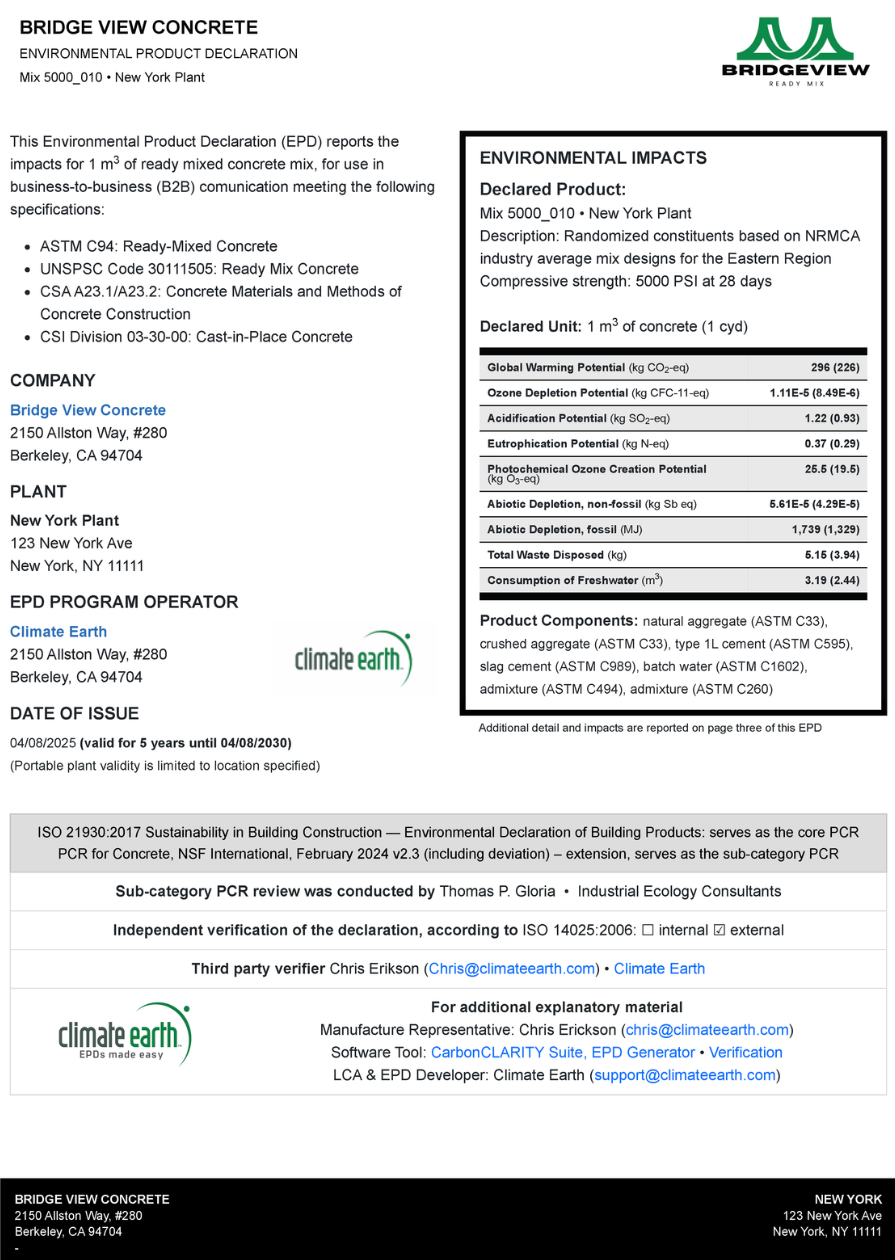
An EPD, or Environmental Product Declaration, is a third-party verified document that reports the environmental impact of a product. For concrete, the most important number in the EPD is usually GWP. An EPD is not just a marketing sheet. It follows specific LCA rules, product category rules, and verification requirements.
A PCR, or Product Category Rule, is the rulebook for creating an EPD for a specific product category. For ready-mix concrete, the PCR defines what data is required, how impacts are calculated, what life cycle stages are included, and how results are reported. This matters because a mix’s GWP needs to be calculated consistently if it is going to be accepted in a bid.
Most concrete EPDs focus on A1-A3, also called cradle-to-gate. A1 includes raw materials like cement, SCMs, aggregates, admixtures, and water. A2 includes transportation of raw materials to the plant. A3 includes batching and plant operations. Some projects also ask for A4, which is delivery from the plant to the job site.
Common EPD and LCA standards
For producers, the practical takeaway is this: make sure the EPD matches the project requirement. The spec may require a product specific EPD, plant specific EPD, current PCR version, valid publication date, certain program operator, or A1-A3 scope. If the EPD does not match what the project accepts, it may not help the bid.

How to Read a GWP Requirement in a Bid
When a bid mentions GWP, do not jump straight to the mix design. First, slow down and decode the requirement. Most mistakes happen because the team compares the wrong unit, wrong mix type, wrong scope, or wrong baseline.
Ask these questions first:
- Is the project asking for an EPD or just a GWP estimate?
Many public projects require a third-party verified Type III EPD. An internal calculator estimate may be useful for planning, but it may not be accepted for compliance. - What unit is being used?
U.S. projects may use kg CO2e per cubic yard. Canadian and European projects often use kg CO2e per cubic meter. Make sure the unit matches before comparing numbers. - What life cycle modules are included?
Most concrete EPDs use A1-A3. Some projects may include A4 delivery to site. A mix that passes under A1-A3 may look different if long delivery distances are included. - What baseline or threshold applies?
The project may use NRMCA regional averages, agency tables, a project-specific baseline, or a maximum GWP cap by strength class. - What mix category is being compared?
Strength, air entrainment, exposure class, performance requirements, and application all matter. Do not compare a 4,000 psi air-entrained exterior mix to a 3,000 psi interior slab mix. - Does the spec allow optimization?
Check for cement minimums, SCM limits, cement type restrictions, early strength requirements, and performance-based alternatives.
Before you optimize the mix, make sure you understand what number the project is actually asking you to beat.
.png)
Baselines, Benchmarks, and GWP Limits
A GWP baseline is the reference point used to decide whether a concrete mix is lower carbon. It answers the question: lower than what? Without a baseline, “low-carbon concrete” is just a claim.
Baselines may come from industry averages, regional benchmarks, NRMCA data, state agency tables, DOT-collected EPDs, city thresholds, project reference mixes, or owner carbon targets. Some specs use a fixed cap. Others ask for a percentage reduction. Some ask for a total project carbon report instead of judging each mix on its own.
A good baseline should match the concrete’s function. A baseline should consider strength, exposure, application, durability, and region. A high-early-strength mix should not be compared to a normal schedule mix without context.
Example: baseline reduction math
The formula is: Reduction percentage = (Baseline GWP - Proposed Mix GWP) ÷ Baseline GWP × 100
If a 4,000 psi mix has a baseline of 360 kg CO2e/yd³ and the producer offers a mix at 306 kg CO2e/yd³:
360 - 306 = 54 kg CO2e/yd³ reduction
54 ÷ 360 = 15% reduction
That proposed mix is 15% below the baseline.
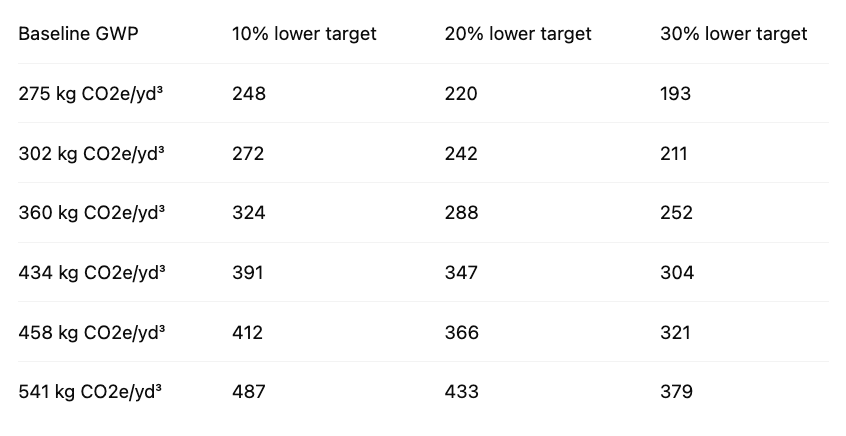
Quick target table
This table is useful during bid review. If the spec says 20% below baseline, your team can quickly calculate the target GWP before deciding whether the existing mix works or needs optimization.
Examples of GWP Limits in the Market
Some agencies are starting to publish strength-based GWP limits. New York’s Buy Clean Concrete guidelines are a good example of how this can work. The state uses concrete strength ranges and assigns maximum GWP values, which means producers need to know both the mix strength and the GWP. Example strength-based limits from New York-style guidance include values such as:
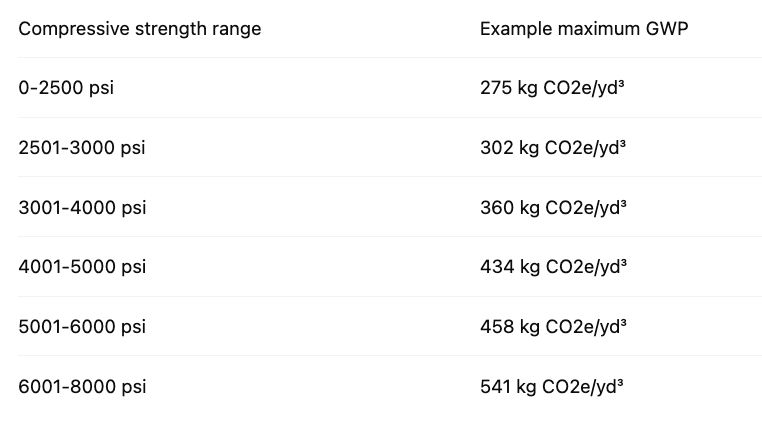
The point is not that every state will use the same table. The point is that this is the kind of structure producers should expect. A spec may say your 4,000 psi mix has to be below one value, while your 5,000 psi mix has to be below another.
Cities are also using this model. Portland, Oregon has used concrete embodied carbon thresholds that require product-specific Type III EPDs and GWP values below published limits. For producers, city-level requirements can matter just as much as state or federal rules if they affect local public work.
Prescriptive Specs vs. Performance-Based Specs
This is where low-carbon concrete gets practical. A project may ask for lower GWP, but the spec may still include old prescriptive requirements that make carbon reduction harder. That is where producers need to pay attention.
A prescriptive spec tells the producer exactly how the concrete must be made. It may require a minimum cement content, limit SCM replacement, require a certain cement type, or demand early strength even when the schedule does not truly need it. These requirements may be familiar, but they can block low-carbon mix options.
A performance-based spec tells the producer what the concrete needs to achieve. It may define strength, durability, exposure class, permeability, shrinkage, finishability, schedule, and GWP. This gives the producer more room to optimize the mix while still meeting the job’s performance needs.

The best low-carbon specs usually protect performance while allowing mix design flexibility. If a project wants lower carbon, the spec should not also force unnecessary cement content or ban the materials needed to reduce GWP.
You cannot ask for low-carbon concrete and then write a spec that prevents the producer from lowering carbon.
Mix Optimization: How Producers Can Meet GWP Limits
Most ready-mix producers will meet GWP limits through practical mix optimization. The goal is not to chase the lowest possible number at any cost. The goal is to lower GWP while still meeting strength, durability, workability, schedule, finishability, and cost requirements.
Common levers include reducing unnecessary cementitious content, using SCMs, switching to portland-limestone cement where available, improving aggregate gradation, using admixtures more effectively, allowing later-age strength, and using supplier-specific EPD data. Cement and cementitious materials are usually the biggest drivers, so they are often the first place to look.
A 10% reduction may be possible with modest changes. A 20% reduction may require a more deliberate combination of PLC, SCMs, and optimized cementitious content. A 30% or larger reduction may require stronger spec flexibility, later-age strength, reliable SCM supply, and early coordination with the engineer.
Practical mix levers

Whole-Project Carbon Reporting
Some projects are moving beyond one EPD per mix. They are asking for total concrete carbon across the project. This is especially common on large buildings, universities, data centers, warehouses, and projects using whole-building LCA.
A project-level concrete carbon report multiplies the GWP of each mix by the volume used. This helps owners and contractors see which mixes drive the most carbon. A high-volume slab mix may matter more to the project total than a small quantity of specialty high-strength concrete.
Example project carbon report
This is where producers can stand out. A contractor may not just need a PDF EPD. They may need help understanding which mixes drive the project carbon total and where lower-GWP substitutions will have the biggest impact.

The most important mix to optimize is often the one with the most volume, not the one with the highest GWP.
Field Example 1: DOT Bid Asking for EPDs First
A ready-mix producer is bidding on a DOT project where the agency asks for EPDs but does not yet set a hard GWP cap. The producer might be tempted to treat this as paperwork. That would be a mistake.
DOTs often collect EPDs before they set limits. Once the agency has enough data, it can build regional benchmarks and future thresholds. Producers that already have mix-level EPDs and GWP data will be ahead when the program moves from reporting to compliance.
Producer lesson: EPD collection is usually the first step toward future GWP limits. Treat it like market preparation, not a one-time document request.
Field Example 2: Public Project With a GWP Cap
A producer receives a spec for a 4,000 psi concrete mix with a maximum GWP value. The current mix has an EPD, but the GWP is close to the cap. The producer needs to decide whether to submit the existing mix or optimize before bid day.
The team reviews cement content, SCM availability, admixture options, aggregate gradation, and strength timing. If the project allows a performance-based alternative, the producer may be able to reduce cementitious content or increase SCMs while still meeting performance. If the spec is too prescriptive, the producer may need to request clarification or submit an alternate.
Producer lesson: Having an EPD is not enough. Producers need enough GWP visibility to know whether the mix passes before the submittal is due.
Field Example 3: Data Center Asking for Total Carbon
A data center project asks for EPDs, GWP values by mix, concrete volumes, and total kg CO2e for the concrete package. The owner is tracking embodied carbon across the project and needs data for reporting. The producer cannot simply send one EPD and move on.
The producer needs to connect mix IDs, plant data, EPDs, GWP values, and estimated volumes. They may also need to provide lower-GWP alternates for high-volume slab and foundation mixes. The producer that can provide a clean project carbon summary becomes easier for the contractor to work with.
Producer lesson: Large private projects may require carbon reporting that looks more like a project dashboard than a standard submittal.
Field Example 4: Low-Carbon Mix Blocked by the Spec
A producer has a lower-GWP mix that performs well in lab testing. It uses portland-limestone cement, SCMs, and optimized cementitious content. The problem is that the project spec requires a high minimum cement content and caps SCM replacement.
The owner wants low-carbon concrete, but the spec blocks the mix design tools needed to achieve it. The producer should flag the conflict early and request a performance-based alternative. The request should include the proposed mix GWP, performance data, strength timing, durability information, and EPD documentation.
Producer lesson: Sometimes the biggest barrier to low-carbon concrete is not the material. It is the spec language.
.png)
Bid-Ready Workflow for Producers
When a low-carbon concrete requirement shows up in a bid, producers need a repeatable process. The goal is to avoid a last-minute scramble between sales, QC, technical services, dispatch, and operations.
Step 1: Identify the carbon requirement
Look for terms like EPD, GWP, embodied carbon, low-carbon concrete, Buy Clean, project carbon report, whole-building LCA, LEED, or material disclosure. Confirm whether the requirement is mandatory or optional. Some specs make GWP a compliance requirement, while others use it for scoring.
Step 2: Confirm the EPD type
Determine whether the project needs a product-specific EPD, plant-specific EPD, mix-specific EPD, industry-average EPD, or internal GWP estimate. Confirm the required program operator, PCR, validity period, and whether the EPD must be third-party verified.
Step 3: Confirm scope and unit
Check whether the project wants A1-A3 only or A1-A4. Confirm whether the unit is kg CO2e per cubic yard or kg CO2e per cubic meter. Make sure everyone is comparing the same scope and unit.
Step 4: Find the baseline or cap
Identify the GWP threshold, baseline, percentage reduction, or benchmark source. If the baseline is unclear, ask for clarification before assuming your own. The baseline drives the target.
Step 5: Match the mix category
Make sure the mix strength, exposure class, application, air entrainment, and performance requirements match the baseline or threshold. Do not compare unlike mixes.
Step 6: Check the current mix
Look up the current EPD or GWP value for the mix. If it passes, prepare the documentation. If it does not pass, move to optimization.
Step 7: Optimize carefully
Review cementitious content, SCMs, cement type, admixtures, aggregate gradation, supplier data, and strength timing. Confirm performance before offering the lower-GWP mix.
Step 8: Prepare the submittal
Include the EPD, mix design, GWP value, baseline comparison, reduction calculation, and any project carbon summary required. Make it easy for the contractor or engineer to approve.
Step 9: Keep the records
Save the EPD, calculations, assumptions, and final submitted mix. If the project is audited or a customer asks later, your team needs a clean record.
.png)
Producer Checklist for Low-Carbon Concrete Bids
Use this checklist before submitting a low-carbon concrete bid.
Spec review
- Identify the EPD or GWP requirement.
- Confirm whether the requirement is mandatory or optional.
- Confirm the applicable mix category.
- Check whether the spec uses a cap, baseline, or reduction percentage.
- Confirm whether project-level carbon reporting is required.
Documentation
- Provide the valid EPD.
- Confirm PCR and program operator.
- Confirm A1-A3 or A1-A4 scope.
- Confirm declared unit.
- Include mix ID, plant, strength, exposure class, and application.
- Include baseline and reduction math where required.
Mix design
- Review cement content.
- Review cement type.
- Review SCM options.
- Check aggregate gradation.
- Check admixture strategy.
- Confirm strength gain.
- Confirm finishability, pumpability, set time, and schedule.
- Confirm performance requirements.
Team coordination
- Sales knows what the customer asked for.
- QC knows which mix is being submitted.
- Technical services confirms performance.
- Operations confirms plant and material availability.
- Procurement confirms supplier data.
- Dispatch understands A4 reporting if required.
.png)
Common Mistakes Producers Should Avoid
One common mistake is assuming an EPD automatically means the mix meets the spec. An EPD only provides the data. The GWP still has to be below the project’s cap or reduction target.
Another mistake is comparing the wrong units. A number in kg CO2e per cubic meter cannot be compared directly to a number in kg CO2e per cubic yard. Unit conversion matters, especially on projects with mixed U.S., Canadian, or European references.
A third mistake is ignoring A4 delivery. Some requirements focus only on A1-A3, while others include delivery to site. If A4 is included, plant selection and haul distance can affect compliance.
A fourth mistake is waiting until submittal day. If the EPD does not exist, the data is messy, or the mix needs optimization, the producer may not have time to respond. Low-carbon bid readiness needs to happen before the project lands.
A fifth mistake is not flagging conflicting spec language. If a project asks for low carbon but includes unnecessary cement minimums or SCM caps, producers should raise the issue early. A performance-based alternative may be the only practical way to meet both carbon and performance goals.
The worst time to discover your mix misses the GWP limit is after the bid is already due.
How Climate Earth Helps Producers Meet GWP Limits in Bids
Climate Earth helps concrete producers create and manage EPDs, GWP data, baseline comparisons, and low-carbon concrete documentation across plants, mixes, materials, and project requirements. Our platform is built to make concrete carbon data easier to calculate, update, and use in bids, submittals, and project conversations.
For ready mix producers, that means a practical way to organize mix data, plant data, supplier data, EPDs, GWP values, reduction targets, and project carbon reporting. Instead of treating every low-carbon concrete request as a one-off scramble, producers can build a repeatable workflow.
Why Choose Climate Earth?
- Built for concrete producers: Designed around mixes, plants, materials, GWP, EPDs, and project requirements.
- Practical GWP visibility: See the carbon impact of mixes and materials before the bid deadline.
- Support for verified EPD workflows: Create and manage EPDs without rebuilding the process from scratch every time a customer asks.
- Baseline comparison tools: Compare mix options against project baselines, GWP thresholds, and reduction targets.
- Useful for bids and submittals: Help sales, QC, and technical teams provide carbon data when contractors, owners, engineers, DOTs, or agencies ask for it.
- Project carbon reporting: Support reporting by mix, volume, and total kg CO2e when owners ask for whole-project carbon data.
- Ready for low-carbon requirements: Prepare for Buy Clean policies, GSA requirements, FHWA and DOT programs, LEED projects, data centers, universities, warehouses, and owner-driven carbon specs.
Ready to Get Started? Schedule a demo to see how Climate Earth can help your team create, manage, and use concrete EPDs and GWP data across bids, submittals, and low-carbon project requirements.
FAQ: Low-Carbon Concrete Project Specs
What is a low-carbon concrete spec?
A low-carbon concrete spec is a project requirement that asks for concrete with documented lower embodied carbon. It may require an EPD, a maximum GWP value, a percentage reduction below baseline, or project-level carbon reporting.
What is GWP in concrete?
GWP stands for Global Warming Potential. It is the carbon footprint number for a concrete mix, usually shown as kg CO2e per cubic yard or kg CO2e per cubic meter.
Is an EPD the same as a GWP value?
No. An EPD is the verified document. GWP is one of the impact values inside the EPD. In concrete bids, GWP is usually the number used to check carbon compliance.
What does A1-A3 mean?
A1-A3 means cradle-to-gate. A1 covers raw materials, A2 covers transportation of raw materials to the plant, and A3 covers plant production.
What does A4 mean?
A4 covers delivery from the concrete plant to the jobsite. Some projects ask for A4 because delivery distance affects project-level carbon.
How do producers meet GWP limits?
Producers can use SCMs, portland-limestone cement, optimized cementitious content, improved aggregate gradation, admixtures, supplier-specific EPDs, and performance-based specs. The mix still needs to meet strength, durability, and schedule requirements.
What if the spec requires low carbon but also has high cement minimums?
That can create a conflict. Producers should raise the issue early and propose a performance-based alternative with EPD data, GWP values, and performance documentation.
Is a carbon calculator enough for a bid?
Sometimes a calculator is useful for planning, but many public and private projects require a third-party verified Type III EPD. Producers should confirm what the project accepts.
What is whole-project carbon reporting?
Whole-project carbon reporting calculates total carbon by multiplying each mix’s GWP by the volume used. Large projects may ask for this to understand the total concrete package carbon.
When should producers start preparing?
Before the bid arrives. Producers should organize mix data, plant data, supplier EPDs, GWP values, and baseline comparison workflows in advance.
Summary: How Producers Can Win More Low-Carbon Concrete Bids
Low-carbon concrete specs are becoming more common across public and private projects. Producers are being asked for EPDs, GWP values, baseline reductions, project carbon reports, and proof that mixes meet both carbon and performance requirements. These requests are no longer limited to one policy, one state, or one type of project.
For ready-mix producers, the winning approach is preparation. Know your common mix GWPs. Keep EPDs organized. Understand which mixes can meet 10%, 20%, or 30% reduction targets. Review specs for carbon conflicts. Train sales and QC teams to respond clearly.
The producers that can answer carbon questions quickly will be easier for contractors, engineers, owners, DOTs, and agencies to work with. Low-carbon concrete is not just about compliance. It is becoming a way for producers to stand out, support better project conversations, and win more work as GWP limits become part of normal bidding.
Related articles

LEED v5 Requirements: What They Mean for Low Carbon Concrete

How to Read a Concrete EPD: Quick, Expert Guide