


Embodied Carbon in Concrete: What Producers Need to Know About Green and Sustainable Concrete

Embodied carbon in concrete is becoming one of the biggest sustainability topics in construction. Owners, engineers, contractors, architects, DOTs, and public agencies are asking more questions about the carbon footprint of concrete, especially on projects with EPD requirements, GWP limits, Buy Clean policies, LEED goals, or low carbon procurement language.
For ready mix producers, this does not mean every project needs a completely new type of concrete. It means producers need to understand how concrete carbon is measured, what drives GWP, how green concrete is evaluated, and how to provide credible data when customers ask. The conversation is moving from vague claims like “eco-friendly concrete” to specific numbers like kg CO2e per cubic yard or cubic meter.
The producers that can explain embodied carbon clearly, provide EPDs, offer lower-GWP mix options, and still meet real performance requirements will be better positioned as sustainable concrete becomes part of normal project bidding.
Key Takeaways
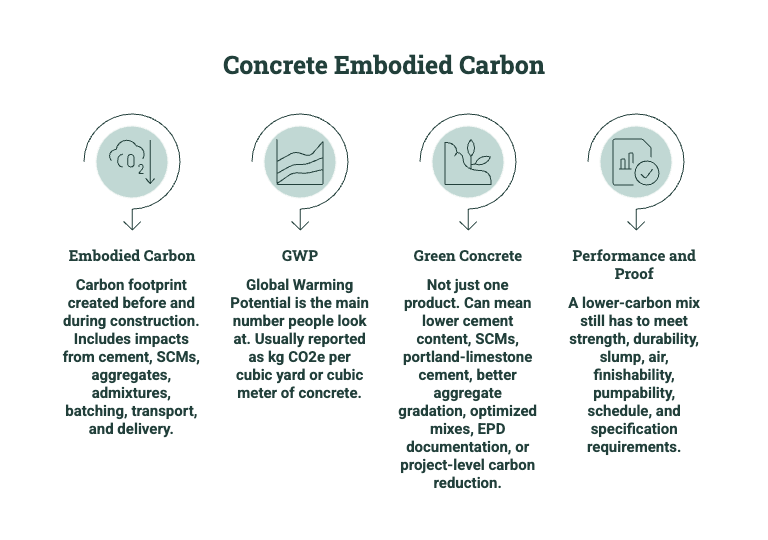
- Embodied carbon in concrete is the carbon footprint created before and during construction. It includes impacts from cement, SCMs, aggregates, admixtures, batching, transport, and sometimes delivery to the jobsite.
- GWP is the main number people look at. Global Warming Potential is usually reported as kg CO2e per cubic yard or cubic meter of concrete.
- Green concrete is not just one product. It can mean lower cement content, SCMs, portland-limestone cement, better aggregate gradation, optimized mixes, EPD documentation, or project-level carbon reduction.
- Ready-mix producers need both performance and proof. A lower-carbon mix still has to meet strength, durability, slump, air, finishability, pumpability, schedule, and specification requirements.
What Is Embodied Carbon in Concrete?
Embodied carbon in concrete is the greenhouse gas emissions connected to making and delivering concrete before the building, road, bridge, or slab is even used. It is different from operational carbon, which comes from energy used after a building is occupied. Embodied carbon is about the materials and construction process itself.
For concrete, the biggest carbon driver is usually cement. Cement production releases CO2 from fuel use and from the chemical process of making clinker. That is why many low-carbon concrete strategies focus on reducing clinker, lowering cement content, using supplementary cementitious materials, or switching to lower-carbon cement types.
Embodied carbon is important because concrete is used in huge volumes. Even a modest reduction per cubic yard or cubic meter can make a large difference on a warehouse, data center, bridge, university building, hospital, or infrastructure project.
Concrete carbon matters because small mix changes become big project impacts when the volume is high.
Green Concrete vs. Sustainable Concrete vs. Low-Carbon Concrete
People often use the terms green concrete, sustainable concrete, and low-carbon concrete as if they mean the same thing. They are related, but they are not exactly the same. For producers, it helps to be precise.
Green concrete is a broad marketing term. It usually means concrete with some environmental benefit, such as reduced cement, recycled materials, SCMs, lower GWP, or improved durability. The problem is that “green” can be vague unless it is backed by data.
Sustainable concrete is broader than carbon. It can include durability, long service life, reduced waste, recycled content, water use, responsible sourcing, local materials, resilience, and carbon reduction. A durable concrete mix that lasts longer can be more sustainable than a weak “green” claim that fails in the field.
Low carbon concrete is more specific. It usually means concrete with lower Global Warming Potential compared with a baseline, benchmark, or project requirement. This is the term most closely tied to EPDs, GWP limits, Buy Clean policies, and carbon reporting.
.png)
How Concrete Carbon Is Measured
Concrete carbon is usually measured through a Life Cycle Assessment, or LCA. The LCA calculates environmental impacts from the materials and processes used to make the concrete. The results can be reported in an Environmental Product Declaration, or EPD.
For ready-mix concrete, the most important EPD number is usually GWP. GWP stands for Global Warming Potential. It is reported as kg CO2e per cubic yard or kg CO2e per cubic meter, depending on the market.
Most concrete EPDs focus on A1-A3 impacts. A1 includes raw materials like cement, SCMs, aggregates, admixtures, and water. A2 includes transportation of raw materials to the plant. A3 includes batching and plant operations. Some project requirements also ask for A4, which is delivery from the plant to the jobsite.
Simple example
If a mix has a GWP of 320 kg CO2e/yd³ and the project uses 5,000 yd³, the concrete package represents: 320 × 5,000 = 1,600,000 kg CO2e
That is why project teams are starting to ask for EPDs by mix and volume. They want to understand not just one mix’s footprint, but the total concrete carbon on the project.
What Drives Embodied Carbon in Ready-Mix Concrete?
The main carbon drivers in ready-mix concrete are cement content, cement type, SCM use, aggregate sourcing, transportation, plant operations, and delivery distance. Not every factor has the same impact. In most mixes, cementitious materials matter the most.
Cement and clinker
Cement is usually the largest source of concrete GWP. Clinker is the most carbon-intensive part of cement. Reducing clinker content, using portland-limestone cement, or using blended cements can help lower GWP.
SCMs
Supplementary cementitious materials can replace a portion of portland cement while supporting performance. Common SCMs include slag, fly ash, silica fume, natural pozzolans, calcined clay, and glass pozzolans. SCMs can reduce GWP, but they must be balanced with strength gain, set time, durability, availability, and project requirements.
Aggregate gradation
Aggregates do not usually carry the same carbon impact as cement, but aggregate gradation affects paste demand. A better-graded aggregate structure can reduce the amount of paste needed for workability. Less paste can mean less cementitious material and lower GWP.
Transportation and plant data
Raw material transportation, plant energy, and delivery distance can affect GWP, especially when A4 delivery is included. These factors usually matter less than cement, but they become more important when projects require detailed carbon reporting.
.png)
How Producers Can Lower Concrete GWP
Ready-mix producers can lower concrete GWP by combining practical mix design strategies. The best strategy depends on the project, local materials, cement supply, SCM availability, standards, and performance needs.
Common low-carbon concrete strategies
- Use portland-limestone cement where accepted.
- Replace some cement with SCMs.
- Optimize aggregate gradation to reduce paste demand.
- Reduce unnecessary cementitious content.
- Use admixtures to maintain workability with lower paste.
- Allow later-age strength when the project schedule allows.
- Use supplier-specific EPD data when available.
- Reduce delivery distance when A4 is counted.
- Match the mix to the actual performance need instead of over-designing.
A 10% reduction may be possible with modest changes such as cement type, SCM adjustment, or mix optimization. A 20% to 30% reduction usually requires a more intentional approach. That may include SCMs, aggregate optimization, lower cementitious content, and performance-based specification flexibility.
The best low-carbon concrete mix is not the lowest number on paper. It is the lowest practical GWP mix that still works on the job.
Why EPDs Matter for Green and Sustainable Concrete
EPDs matter because they turn sustainability claims into comparable data. Without an EPD or verified GWP calculation, a producer may say a mix is green, but the project team cannot easily compare it to another mix. With an EPD, the producer can show the environmental impact in a standardized format.
For ready-mix producers, EPDs are becoming useful in sales, bidding, submittals, and customer conversations. Contractors may ask for them on public projects, LEED projects, DOT work, data centers, universities, warehouses, and large commercial jobs. Agencies may use EPDs to set baselines, check GWP limits, or build low-carbon procurement programs.
An EPD does not automatically mean a mix is low carbon. It means the mix has verified environmental data. The next question is whether the GWP is below the project’s limit, below a baseline, or competitive against other available mixes.
Performance Still Comes First
Green concrete still has to be good concrete. A lower-GWP mix that cracks, sets too slowly, finishes poorly, misses strength, or fails durability requirements is not a win. Producers need to balance carbon reduction with real field performance.
This is where ready-mix expertise matters. A sustainability consultant may focus on the carbon number, but the producer understands the material, the plant, the weather, the aggregate, the cement, the admixtures, the pump, the finishers, and the schedule. Low-carbon concrete works best when producers are involved early.
Performance-based specs can help. Instead of forcing a fixed cement content or limiting SCMs too aggressively, a performance-based spec allows the producer to meet strength, durability, exposure, and GWP requirements with a mix that actually works.
Where Embodied Carbon Requirements Are Showing Up
Embodied carbon requirements are showing up across both public and private construction. Some projects have formal EPD or GWP requirements. Others ask for lower-carbon options because the owner has sustainability goals.
Ready-mix producers may see embodied carbon requests on:
- Federal and public procurement projects
- DOT and infrastructure work
- Buy Clean projects
- LEED and green building projects
- Universities and schools
- Hospitals and healthcare facilities
- Data centers
- Warehouses and logistics facilities
- Corporate campuses
- Large commercial buildings
- Projects using whole-building LCA
The request may not always say “embodied carbon in concrete.” It may say EPD, GWP, low-carbon concrete, sustainable materials, material disclosure, green concrete, whole-building LCA, project carbon report, or low embodied carbon materials.
.png)
What Producers Should Do Now
Ready-mix producers do not need to wait for every project to require EPDs before getting organized. The producers that prepare early will respond faster when customers ask.
Start by identifying your most common and highest-volume mixes. Then organize mix designs, cement data, SCM options, aggregate sources, plant data, supplier EPDs, and current GWP values. Once the data is organized, you can create lower-GWP options by strength class or project type.
Sales and QC teams should also know the basics. They do not need to become LCA experts, but they should understand EPDs, GWP, embodied carbon, and how to talk about lower-carbon mix options without overpromising.
Producer checklist
- Identify high-volume mixes.
- Track GWP for common mixes.
- Generate EPDs for priority products.
- Review cement and SCM options.
- Optimize aggregate gradation and paste demand.
- Create lower-GWP alternates by strength class.
- Train sales, QC, and technical teams.
- Prepare standard EPD and GWP submittal language.
- Review specs for prescriptive limits that block lower-carbon options.
.png)
How Climate Earth Helps Ready-Mix and Cement Producers
Climate Earth helps ready-mix and cement producers generate and manage verified EPDs faster. As EPD requests become more common across public tenders, infrastructure, commercial projects, data centers, and low-carbon procurement, producers need a faster way to turn plant and product data into usable environmental documentation.
Climate Earth supports Type III verified EPD workflows for ready-mix and cement producers, with standards-aligned reporting and expert LCA support. Producers can keep plant, product, and EPD data organized so they are ready when customers, contractors, agencies, or project teams ask for verified environmental product data.
Why producers choose Climate Earth
- Built for ready-mix and cement EPD generation
- Supports Type III verified EPD workflows
- Helps producers respond faster to EPD requests
- Keeps plant and product data organized
- Supports ISO 14025 and EN 15804+A2-aligned reporting
- Helps prepare for evolving low-carbon procurement expectations
- Backed by expert LCA support
Ready to get started? Generate verified EPDs faster with software built for ready-mix and cement producers. Book a demo to see how Climate Earth can help your team manage EPD generation, standards compliance, and environmental product data in one workflow.
FAQ: Embodied Carbon in Concrete
What is embodied carbon in concrete?
Embodied carbon in concrete is the greenhouse gas emissions connected to making and delivering concrete before the building or infrastructure is used. It includes impacts from cement, SCMs, aggregates, batching, transport, and sometimes delivery to site.
What is green concrete?
Green concrete is a broad term for concrete with environmental benefits. It may include lower cement content, SCMs, recycled materials, lower GWP, or an EPD. The term is strongest when backed by verified data.
What is sustainable concrete?
Sustainable concrete considers carbon, durability, waste, water, recycled content, service life, local materials, and performance. It is broader than just carbon reduction.
What is low-carbon concrete?
Low-carbon concrete is concrete with lower GWP compared with a baseline, benchmark, or project requirement. It should still meet strength, durability, workability, and schedule needs.
What does GWP mean in concrete?
GWP stands for Global Warming Potential. It is the carbon footprint number used to compare concrete mixes, usually reported as kg CO2e per cubic yard or cubic meter.
Why is cement the biggest carbon driver?
Cement is carbon intensive because CO2 is released during clinker production from both fuel combustion and chemical reactions. That is why cement reduction, SCMs, and lower-clinker cements are common low-carbon strategies.
Do EPDs prove concrete is sustainable?
Not by themselves. EPDs provide verified environmental data. A project team still needs to compare the GWP to a baseline, threshold, or lower-carbon target.
How can ready-mix producers reduce embodied carbon?
Producers can use SCMs, portland-limestone cement, optimized aggregate gradation, lower cementitious content, admixtures, supplier-specific EPDs, and performance-based specs.
Can low-carbon concrete perform as well as traditional concrete?
Yes, when designed properly. The mix still needs to meet strength, durability, finishability, pumpability, set time, and project requirements.
Why should ready-mix producers care now?
Because EPDs, GWP limits, Buy Clean policies, public procurement rules, and private owner sustainability requirements are becoming more common. Producers with organized carbon data can respond faster and compete better.
Summary
Embodied carbon in concrete is becoming a practical issue for ready-mix producers. Customers are asking for green concrete, sustainable concrete, low-carbon mixes, EPDs, and GWP values. The producers that can explain these terms clearly and support them with verified data will be easier to work with.
The path forward is not about chasing buzzwords. It is about understanding what drives concrete carbon, optimizing mixes intelligently, and documenting performance with EPDs and GWP data. Cement content, SCMs, aggregate gradation, plant data, transport, and specifications all matter.
Ready-mix producers that prepare now will be better positioned for low-carbon projects, public procurement, green building work, and private owner requirements. Sustainable concrete is becoming less about marketing and more about measurable, bid-ready product data.
Related articles

LEED v5 Requirements: What They Mean for Low Carbon Concrete

How to Read a Concrete EPD: Quick, Expert Guide