

U.S. Concrete EPD Requirements: Buy Clean, DOTs, FHWA, GSA, and Private Projects

Concrete Environmental Product Declaration requirements are showing up across the U.S. construction market. They are being driven by federal procurement, GSA low embodied carbon material requirements, FHWA and DOT programs, state Buy Clean laws, city-level policies, LEED projects, universities, data centers, warehouses, and large private owners.
For ready-mix producers, this means EPDs and GWP data are becoming part of bidding, submittals, mix approvals, and project carbon reporting. The most important number in a concrete EPD is usually Global Warming Potential, or GWP. GWP is the carbon footprint number, commonly reported as kg CO2e per cubic yard or kg CO2e per cubic meter of concrete. Project teams use GWP to compare mixes, check compliance with Buy Clean requirements, meet GSA or DOT rules, support LEED documentation, or calculate whole-project embodied carbon.
The practical takeaway is simple: U.S. ready-mix producers need a repeatable way to create, manage, and use EPDs. That means organizing mix data, plant data, supplier data, cement and SCM inputs, transportation assumptions, PCR requirements, third-party verification, and project-specific GWP thresholds before a bid deadline hits.
Key Takeaways
- Concrete EPD requirements are no longer limited to one policy or one state. They are showing up in federal projects, state Buy Clean laws, DOT programs, municipal requirements, LEED projects, and private owner specs.
- Different projects ask for different things. One project may ask for a Type III EPD. Another may ask for a GWP threshold. Another may ask for a 10%, 20%, or 30% reduction below a baseline. Another may ask for total project carbon by mix and volume.
- The current concrete PCR matters. EPDs need to follow the correct Product Category Rule, ISO standards, declared unit, A1-A3 scope, data quality rules, and third-party verification process.
- Private projects are becoming a major driver. Data centers, semiconductor plants, warehouses, universities, hospitals, and corporate campuses may ask for EPDs even when no state law requires them.
.png)
What Are U.S. Concrete EPD Requirements?
Concrete EPD requirements are project, policy, or procurement rules that ask producers to provide verified environmental impact data for concrete. An EPD, or Environmental Product Declaration, reports the environmental footprint of a product based on a Life Cycle Assessment. For ready-mix concrete, the most watched number is usually GWP.
In the U.S., concrete EPD requirements can come from several places. Federal projects may follow GSA low embodied carbon material requirements. State agencies may follow Buy Clean laws. DOTs may collect EPDs through FHWA-supported programs or state transportation requirements. Cities may set their own EPD or GWP rules. Private owners may require EPDs to meet internal carbon goals.
For producers, the requirement usually shows up in a spec, bid form, submittal request, sustainability section, LEED documentation request, or owner carbon reporting template. The wording may change, but the request usually comes down to this: show us the concrete carbon data.
“For ready-mix producers, EPDs are moving from sustainability paperwork into normal project documentation.”
Where Concrete EPDs and GWP Requirements Are Showing Up in the U.S.
U.S. concrete EPD demand is coming from both public and private projects. Some requirements are legal or procurement-based. Others are owner-driven. Some only require EPD submission. Others set maximum GWP limits or ask for a reduction below a baseline.
Concrete producers should watch for EPD or GWP language in:
- GSA federal building projects
- FHWA and state DOT programs
- State Buy Clean laws
- City and municipal public works projects
- Universities and public campuses
- Hospitals and healthcare systems
- LEED and green building projects
- Data centers
- Semiconductor plants
- Warehouses and logistics centers
- Corporate campuses
- Large private developments
- Whole-building LCA requirements
- Owner ESG or carbon reduction programs
A producer may not see the phrase “Buy Clean” in every spec. The requirement may instead appear as “EPD required,” “GWP limit,” “low embodied carbon concrete,” “material disclosure,” “whole-building life cycle assessment,” “carbon footprint report,” or “environmental product declaration.”
.png)
General U.S. Concrete EPD Requirements Producers Should Know
Most U.S. concrete EPD requirements focus on three things: verified documentation, GWP reporting, and comparability. The project team wants to know whether the EPD is credible, whether the GWP meets the project requirement, and whether the mix being compared is functionally similar.
A typical U.S. concrete EPD requirement may ask for:
- A third-party verified Type III EPD
- Mix-specific or plant-specific GWP
- A1-A3 cradle-to-gate impacts
- Optional A4 delivery impacts if the project includes transport to site
- The concrete PCR used
- Program operator and verifier information
- Declared unit, usually cubic yard or cubic meter
- Strength class or specified compressive strength
- Product or mix ID
- Plant location
- Publication date and validity period
- Data year and known data gaps
- Supporting documentation for the bid or submittal
The most important practical detail is that a carbon calculator is not always enough. Many public programs and larger projects want a verified EPD, not just an internal estimate. A calculator can help producers plan, but a verified Type III EPD is usually what the project needs for compliance.
.png)
Federal Drivers: GSA, FHWA, EPA, and Buy Clean
Federal policy has been one of the biggest signals in the U.S. market. Even when federal priorities shift by administration, the broader direction is clear: more agencies and project teams are asking for lower embodied carbon materials and product-level data.
GSA Low Embodied Carbon Material Requirements
GSA requirements matter because they affect federal building projects. GSA’s low embodied carbon material requirements have focused attention on materials such as concrete, asphalt, steel, and glass. For concrete producers, this can mean providing EPDs and GWP data to show whether a mix meets the required low embodied carbon criteria.
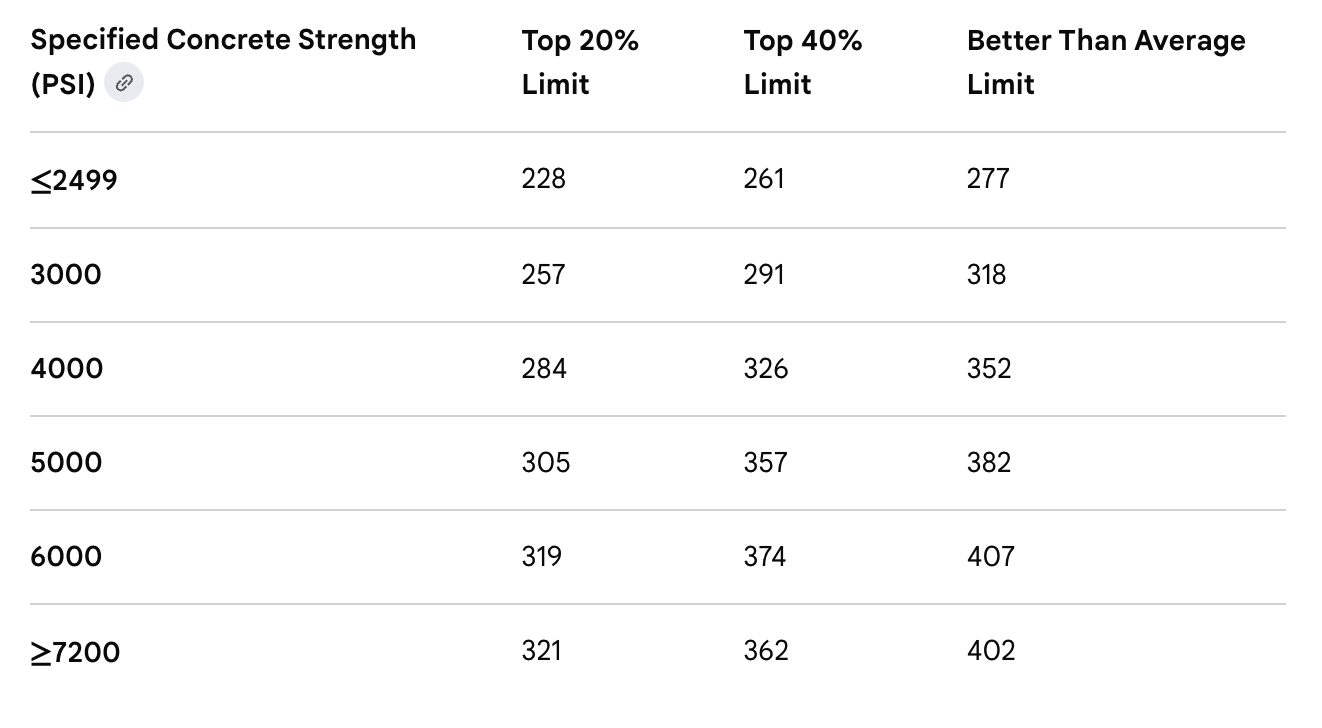
GSA low embodied carbon requirements are important because they often use published GWP limits or threshold categories to determine whether a material qualifies. For concrete producers, the main task is to understand the specific threshold used on the project and whether their mix EPD falls under it.
GSA-style limits may be based on:
- Product category
- Domestic EPD data
- GWP percentiles
- Material type
- Declared unit
- A1-A3 scope
- Project-specific specification language
- Accepted EPD type and program operator
The details matter. A producer should not assume that having an EPD automatically means the mix qualifies. The GWP still has to meet the project’s threshold. The EPD also needs to match the product, plant, mix, and declared unit being submitted.
GSA requirements generally rely on Type III EPDs and GWP limits. The limits are often structured around domestic EPD data and tiered thresholds, such as lower-carbon categories or percentile-based performance. For producers, the practical question is whether a proposed mix’s GWP falls under the accepted threshold for that project.
What producers should ask on GSA-related projects:
- Is a Type III EPD required?
- Is the project using GSA low embodied carbon limits?
- Which concrete category or strength class applies?
- Is the comparison based on A1-A3 only?
- Is A4 delivery included?
- Is the threshold based on a GSA table, project spec, or owner requirement?
- Are industry-average EPDs allowed, or must the EPD be product-specific or facility-specific?
Producer checklist for GSA-related projects
- Confirm whether the project uses GSA low embodied carbon requirements.
- Identify the material category and applicable concrete mix type.
- Confirm the required EPD type.
- Confirm whether A1-A3 only or A1-A4 is required.
- Compare the mix GWP against the GSA threshold.
- Check whether an industry-average EPD is allowed or if a product-specific EPD is required.
- Prepare submittal documentation before the bid deadline.
“An EPD gets you in the conversation. The GWP threshold determines whether the mix qualifies.”
FHWA Low Carbon Transportation Materials Program
FHWA is important because DOTs and transportation agencies are starting to collect and use EPDs for infrastructure materials. The FHWA Every Day Counts EPD initiative has highlighted that EPD use has grown and that several Buy Clean policies require EPDs as part of procurement. For concrete producers serving roads, bridges, sidewalks, tunnels, airports, and public works, this matters.
Some DOT programs are currently collecting EPDs to build data and benchmarks. Others may use EPDs to support low-carbon procurement, incentives, or future GWP limits. The first step is often data collection. The next step is usually benchmarking. After that, agencies can begin setting thresholds or incentives.
For producers, this means DOT requirements may start as “submit an EPD” before becoming “meet this GWP limit.” Producers should prepare early rather than waiting until limits are mandatory.
EPA and Federal Buy Clean Direction
EPA resources continue to point to EPDs as a key tool for measuring and comparing embodied carbon in construction materials. Federal Buy Clean activity has also pushed owners, agencies, contractors, and design teams to pay more attention to product-level carbon data.
The federal landscape can change, but the market signal remains strong. Contractors and owners are learning to ask for EPDs. Large public projects are learning to compare GWP. Producers that can provide verified data quickly will be easier to work with.
“Federal policy may shift, but the market habit is sticking: ask for the EPD, check the GWP, compare against a baseline.”
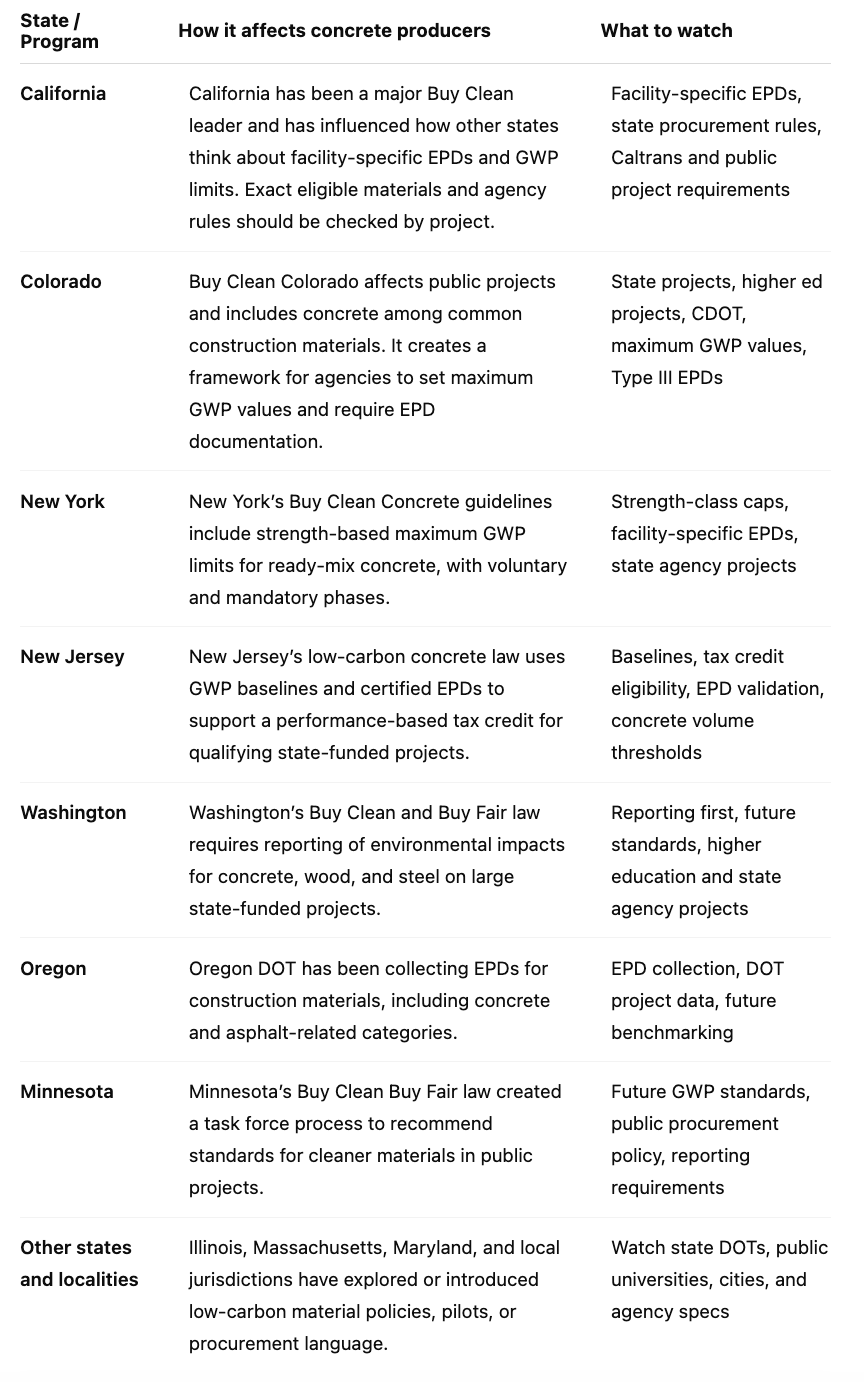
Buy Clean by State: What Producers Should Watch
State Buy Clean programs are not identical. Some require EPDs. Some set GWP caps. Some start with reporting only. Some offer incentives. Some apply to buildings, while others focus on transportation or public infrastructure.
For ready-mix producers, the important thing is to track the states and agencies where they sell concrete. Do not assume one state’s requirement matches another.
DOT Requirements by State: How Transportation Agencies Are Using EPDs
DOTs are one of the most important channels for concrete EPD growth because transportation projects use major volumes of concrete, cement, asphalt, aggregates, and other construction materials. A DOT may start by asking for EPDs, then use the data to build baselines, then eventually set thresholds or incentives.
Oregon DOT
Oregon DOT has been active in environmental product declaration collection for construction materials. For ready-mix producers, this means EPD requests may show up as part of transportation material reporting. Even when there is no immediate GWP cap, data collection is still important because it often comes before future benchmarks.
Colorado DOT
Colorado’s Buy Clean framework is important for producers serving state public projects and transportation work. Producers may be asked for Type III EPDs, GWP values, and documentation showing whether materials meet state requirements. As agency thresholds develop, ready-mix producers will need current EPDs and mix-level carbon data.
New York State Agencies
New York’s concrete requirements are among the clearest examples of strength-based GWP limits. The state has published maximum GWP limits by specified compressive strength. Examples from the published table include:
- 0 – 2,500 psi: 275 kg CO2e/yd³
- 2,501 – 3,000 psi: 302 CO2e/yd³
- 3,001 – 4,000 psi: 360 CO2e/yd³
- 4,001 – 5,000 psi: 434 CO2e/yd³
- 5,001 – 6,000 psi: 458 CO2e/yd³
- 6,001 – 8,000 psi: 541 CO2e/yd³
Illinois, California, Washington, Minnesota, and Others
Some DOTs and state agencies are still in the data collection or policy development stage. That does not mean producers can ignore them. Once agencies collect enough EPD data, they can build state-specific benchmarks and then use those benchmarks for limits, incentives, or procurement preferences.
“For DOT work, EPD collection is often the first step. GWP limits usually come later.”
City and Municipal EPD Requirements
Cities are also driving concrete EPD adoption. In some cases, cities move faster than states because they control their own public works and building requirements.
Portland, Oregon
The City of Portland is one of the clearest examples. Portland has required third-party verified, product-specific EPDs for concrete mixes used on city projects above a volume threshold. It has also moved toward maximum GWP thresholds by strength class. This creates a practical model other cities can copy: first require EPDs, then set GWP thresholds.
New York City and Other Large Municipalities
Large cities may ask for EPDs through capital projects, public works, green building standards, or agency-specific sustainability requirements. Requirements can appear in Division 03 concrete specs, sustainability sections, LEED documentation, or material submittals.
What this means for producers
City requirements can be highly practical and project-specific. A producer may not need a statewide law to start seeing EPD requests. A single city, university system, public works department, or transit agency can create real demand in a local market.
.png)
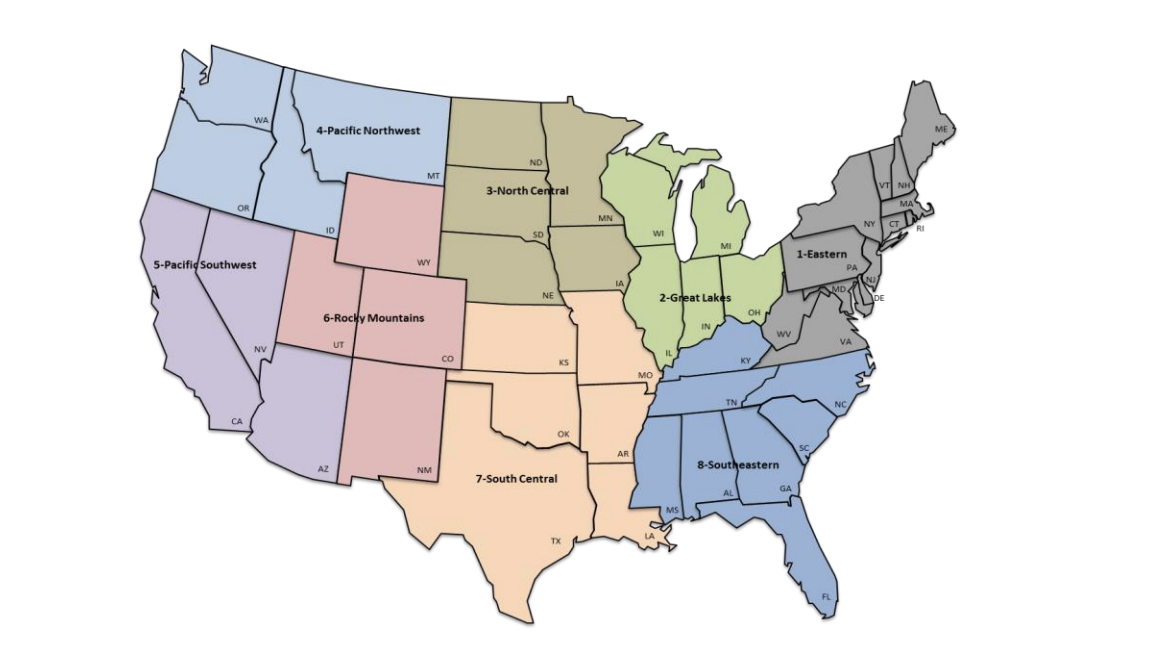
NRMCA Benchmarks and Regional GWP Data: What They Look Like
NRMCA and industry-wide EPD data are often used to understand average GWP values by region, strength, or product category. These benchmarks are useful because they help project teams and agencies decide what is typical and what counts as lower carbon.
A regional benchmark table may include:
- Region
- Strength class
- Air or non-air mix
- Average GWP
- Percentile values
- Declared unit
- PCR version
- EPD data year
- Number of plants or mixes included
- Whether the benchmark is industry-wide or product-specific
How Baselines and Reduction Targets Work
A GWP baseline is the reference point used to determine whether a concrete mix is lower carbon. It answers the question: lower than what?
A baseline may come from:
- NRMCA industry averages
- Regional EPD data
- State agency benchmarks
- DOT-collected EPD data
- A project-specific business-as-usual mix
- A previous mix used on similar work
- A GSA or owner threshold
- A city or municipal GWP cap
The reduction math is simple. Reduction percentage = (Baseline GWP - Proposed Mix GWP) ÷ Baseline GWP × 100
Example: baseline reduction math
If a 4000 psi mix has a baseline of 360 kg CO2e/yd³ and the producer offers a mix at 306 kg CO2e/yd³:
360 - 306 = 54 kg CO2e/yd³ reduction
54 ÷ 360 = 15% reduction
That mix is 15% below the baseline.
Quick reference table
This table is useful because many specs do not just say “provide low-carbon concrete.” They may ask for a percentage reduction, a maximum GWP value, or a comparison against an agency benchmark.
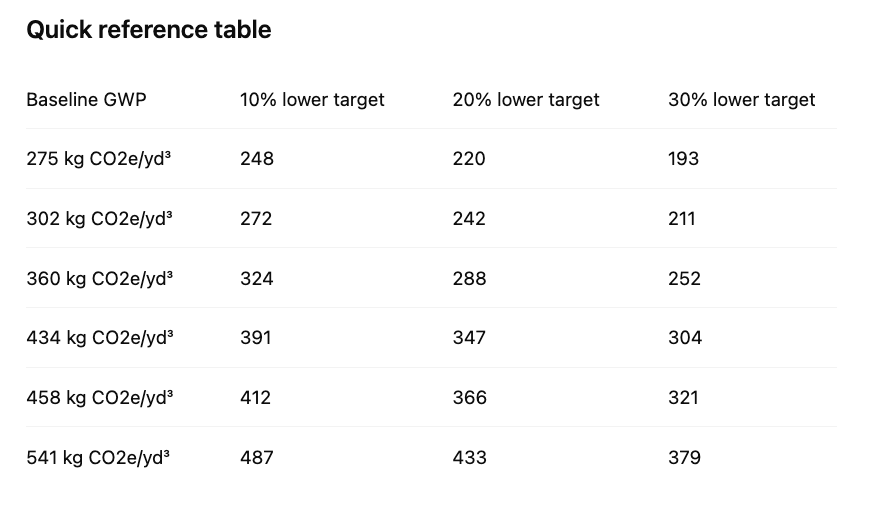
“Low-carbon concrete is never just a claim. It is a number compared against a baseline.”
Whole-Project Carbon Reporting: The Next Step Beyond One EPD
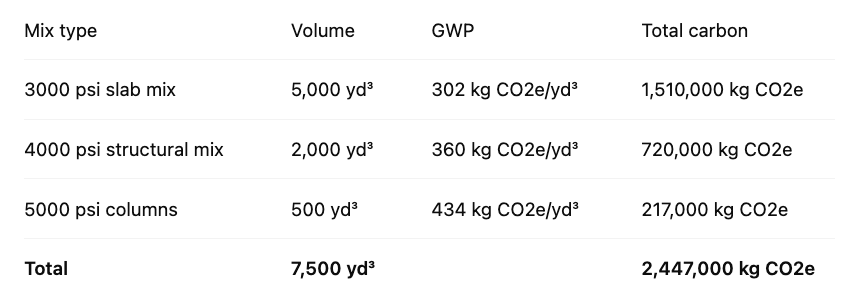
Some projects are moving beyond individual EPDs. Instead of only asking for one mix’s GWP, they may ask for total concrete carbon across the project. This is especially common on large buildings, campuses, universities, data centers, and whole-building LCA projects.
A project-level concrete carbon report may include:
- Mix ID
- Plant
- EPD number
- GWP per cubic yard
- Volume supplied
- Total kg CO2e by mix
- Total concrete package carbon
- Baseline comparison
- Reduction scenario
Example project carbon table
This is where producers can become more valuable. A contractor may not just need an EPD. They may need help understanding which mixes drive the most carbon and where lower-GWP options matter most.
EPD Requirements on Private Projects: Data Centers, Universities, Warehouses, and More
Private projects are now one of the most practical drivers of EPD demand. These requirements may not come from a state law. They may come from the owner, developer, contractor, architect, engineer, LEED consultant, or corporate sustainability team.
Data centers
Data centers can use large volumes of concrete for foundations, slabs, equipment pads, site work, paving, and utility infrastructure. These projects are often tied to corporate climate commitments. Producers may be asked for EPDs, lower-GWP options, and project-level carbon summaries early in bidding.
Semiconductor and advanced manufacturing projects
Semiconductor plants and advanced manufacturing facilities can require major concrete volumes, strict schedules, and high technical requirements. EPDs may be requested as part of owner sustainability goals or federal funding-related reporting.
Warehouses and logistics facilities
Large warehouses and distribution centers often involve big slabs, tilt-up panels, paving, and site concrete. Even when not legally required, owners may ask for lower-carbon concrete to support ESG goals or tenant expectations.
Universities and hospitals
Universities and healthcare systems often have public sustainability goals, LEED targets, or whole-building LCA requirements. These projects may ask for EPDs, GWP values, and lower-carbon mix options during design and procurement.
Corporate campuses and large commercial projects
Corporate owners may have internal embodied carbon goals. They may require EPDs across major materials, including concrete, steel, glass, asphalt, and insulation.
“Private projects can move faster than regulation. If the owner wants carbon data, the producer still has to provide it.”
.png)
What Standards and PCRs Govern U.S. Concrete EPDs?
Concrete EPDs need to be created under recognized standards and the correct Product Category Rule. This is what makes them credible and comparable.
ISO 14025
ISO 14025 covers Type III Environmental Product Declarations. This is the main EPD framework used for third-party verified environmental product data.
ISO 14040 and ISO 14044
ISO 14040 and ISO 14044 are the core Life Cycle Assessment standards. They define the principles, framework, requirements, and guidelines for conducting LCAs.
ISO 21930
ISO 21930 applies to environmental declarations for construction products and services. It is especially important for building and civil engineering product EPDs.
Concrete PCR
The Product Category Rule, or PCR, is the specific rulebook for concrete EPDs. It defines the declared unit, system boundary, life cycle modules, required data, impact categories, reporting requirements, data quality rules, and comparability requirements.
Concrete PCR Version 3
The current concrete PCR update matters because it affects ready-mix EPD workflows. It supports A1-A3 reporting and optional A4, clarifies rules around plant and production data, addresses portable and volumetric production scenarios, and increases the need for clear data quality and documentation.
ASTM, NSF, NRMCA, UL, SCS, and Program Operators
Concrete EPDs may be published or verified through recognized program operators and verification bodies. Producers should confirm which program operators a project accepts. The key is that the EPD must be third-party verified and aligned with the applicable PCR and ISO standards.
.png)
What Producers Need to Track for EPD Compliance
A ready-mix EPD is only as good as the data behind it. Producers should organize the information before the project asks.
Mix data
Track cement, SCMs, aggregates, admixtures, water, air, slump, strength, w/cm, density, exposure class, and typical application.
Plant data
Track plant location, production volume, electricity, fuel, water, returned concrete, material loss, and relevant 12-month production data.
Supplier data
Collect EPDs and data from cement, SCM, aggregate, and admixture suppliers where available. Cement and SCM data can have a major impact on final GWP.
Transportation data
Track raw material transport to plant for A2. Track delivery distance to site if A4 is required.
EPD documentation
Track PCR version, program operator, verifier, EPD ID, publication date, expiration date, declared unit, software, database, data year, and known data gaps.
.png)
Mix Optimization for U.S. Buy Clean and EPD Requirements
Most ready-mix producers will meet lower-GWP requirements through practical mix optimization. The goal is not just to lower cement. The goal is to lower carbon while meeting strength, durability, placement, finishing, schedule, and specification requirements.
Common levers include:
- Reducing unnecessary cementitious content
- Using SCMs such as slag, fly ash, natural pozzolans, calcined clay, or silica fume
- Using portland-limestone cement where available and accepted
- Optimizing aggregate gradation
- Using admixtures to maintain performance with lower paste content
- Allowing later-age strength where schedule allows
- Matching mix design to actual performance need
- Using better supplier-specific EPD data
- Reducing unnecessary transport where possible
RMI-related research suggests that concrete mix optimization can reduce GHG emissions by roughly 14% to 33% in some cases with little to no cost. Producers should treat that as a planning range, not a guarantee. The achievable reduction depends on region, materials, specification flexibility, performance needs, and supplier data.
“The lowest-GWP mix is not always the best mix. The best mix is the lowest practical GWP that still meets the job.”
Three Field Examples: How U.S. EPD Requirements Affect Ready-Mix Producers
Example 1: DOT project starts with EPD collection
A producer bidding on a DOT project is asked to submit EPDs for concrete mixes. There is no maximum GWP limit yet. The DOT is collecting data to understand regional baselines. The producer still needs to take the request seriously. Today’s EPD collection can become tomorrow’s benchmark. If the producer waits until limits are mandatory, they may be behind competitors that already have mix-level GWP data organized.
Producer lesson: EPD collection is not harmless paperwork. It is the first step toward future thresholds.
Example 2: State project has strength-based GWP caps
A state project requires the producer to meet a GWP cap by compressive strength. The producer has a 4000 psi mix with a verified EPD, but the GWP is close to the cap. The producer looks at SCM content, cement type, admixture strategy, and whether the project can accept later-age strength. With small mix optimization, the producer can bring the GWP below the threshold while still meeting performance.
Producer lesson: Having EPDs is not enough. Producers need the ability to adjust mixes and compare GWP before submittal.
Example 3: Private data center asks for project-level carbon
A data center contractor asks for EPDs, GWP by mix, total concrete volume, and total kg CO2e for the concrete package. The producer cannot just email one PDF. They need to connect mix IDs, EPDs, volumes, and project reporting. The producer that can provide a clean project carbon summary becomes easier to work with. The producer that has to manually search spreadsheets may slow down the bid.
Producer lesson: Large private projects may expect carbon reporting that looks more like a project dashboard than a single EPD.
What Producers Should Ask When a U.S. Project Requests EPDs
When a project asks for concrete EPDs or GWP data, producers should clarify the requirement before committing. Ask:
- Is an EPD required, or is an internal GWP estimate acceptable?
Many public projects require verified Type III EPDs. - Which PCR and standards apply?
Confirm the concrete PCR, ISO standards, and accepted program operator. - Is the EPD mix-specific, product-specific, plant-specific, or industry-average?
Some projects may not accept industry averages for final submittal. - What scope is required?
Confirm A1-A3 only or A1-A4. - What declared unit is required?
U.S. projects may use kg CO2e/yd³, while some standards use kg CO2e/m³. - Is there a GWP limit or reduction target?
Ask for the threshold, baseline, or benchmark source. - Does the requirement vary by strength class?
Many concrete limits are strength-based. - Does the spec allow mix optimization?
Watch for minimum cement content, SCM caps, cement type restrictions, and early strength requirements. - Is whole-project carbon reporting required?
If yes, the producer needs mix volumes and total carbon calculations. - What is the submittal deadline?
EPDs take time. Do not wait until the week of bid.
.png)
Getting Started: Climate Earth for Concrete EPDs and GWP Reporting
Getting started with concrete EPDs begins with understanding which projects, plants, mixes, and materials are most likely to face EPD or GWP requirements. From there, producers need to organize mix data, plant data, supplier data, EPDs, GWP values, baselines, and project reporting so they can respond quickly when requirements show up.
Climate Earth helps concrete producers create and manage EPDs, GWP data, baseline comparisons, and low-carbon concrete documentation across plants, mixes, materials, and project requirements. Our platform is built to make concrete carbon data easier to calculate, update, and use in bids, submittals, and project conversations.
Why Choose Climate Earth?
- Built for concrete producers: Designed around mixes, plants, materials, GWP, EPDs, and project requirements.
- Practical GWP visibility: See the carbon impact of mixes and materials so your team can respond with confidence.
- Support for verified EPD workflows: Create and manage EPDs without rebuilding the process from scratch every time a customer asks.
- Baseline comparison tools: Compare mix options against project baselines, GWP thresholds, and reduction targets.
- Useful for bids and submittals: Help sales, QC, and technical teams provide carbon data when contractors, owners, engineers, DOTs, or agencies ask for it.
- Ready for low-carbon requirements: Prepare for Buy Clean policies, GSA requirements, FHWA and DOT programs, LEED projects, data centers, universities, warehouses, and owner-driven carbon specs.
- Scalable across product lines: Support EPD and carbon reporting needs across ready mix, precast, block, pavers, aggregates, asphalt, dry mix, cement, and SCM-related workflows.
Ready to Get Started? Schedule a demo to see how Climate Earth can help your team create, manage, and use concrete EPDs and GWP data across your business.
FAQ: U.S. Concrete EPD Requirements
Do U.S. ready-mix producers need EPDs?
Not for every project, but EPD requests are becoming more common. Producers may need EPDs for GSA projects, DOT work, state Buy Clean programs, LEED projects, municipal projects, data centers, universities, warehouses, and large private owner specs.
What is a concrete EPD?
A concrete EPD is a third-party verified document that reports environmental impact data for a concrete mix or product. It is based on an LCA and follows ISO standards and the applicable concrete PCR.
What is GWP in a concrete EPD?
GWP stands for Global Warming Potential. It is the carbon footprint number, usually reported as kg CO2e per cubic yard or cubic meter of concrete.
What is Buy Clean concrete?
Buy Clean concrete refers to procurement policies that require or encourage lower embodied carbon concrete. These policies often use EPDs and GWP thresholds to compare materials.
Which states have concrete EPD or Buy Clean requirements?
Requirements vary, but producers should watch states such as Colorado, New York, New Jersey, Washington, Oregon, California, and Minnesota, along with local city and agency programs.
What is the difference between EPD collection and GWP limits?
EPD collection means the agency is gathering data. GWP limits mean the project sets a maximum carbon value the mix must meet. Collection often comes before limits.
What standards do U.S. concrete EPDs need to follow?
Concrete EPDs generally follow ISO 14025, ISO 14040/14044, ISO 21930, and the applicable concrete PCR. They also need third-party verification through an accepted program operator or verifier.
What is Concrete PCR Version 3?
Concrete PCR Version 3 is the updated Product Category Rule for ready-mix concrete EPDs. It defines how concrete impacts should be calculated and reported, including A1-A3, optional A4, declared unit, data quality, and performance information.
Is a carbon calculator enough?
A calculator (such as the NRMCA carbon calculator powered by Climate Earth) can help producers estimate GWP, but many public and private projects require verified Type III EPDs. Producers should confirm what the project accepts.
How can producers reduce GWP?
Common strategies include SCMs, Portland-Limestone cement, optimized cementitious content, better aggregate gradation, admixtures, performance-based specs, supplier-specific EPDs, and avoiding over-designed mixes.
What is whole-project carbon reporting?
Whole-project carbon reporting calculates total carbon by multiplying each mix’s GWP by the volume used. Large projects may ask for this to understand total concrete package carbon.
Summary: What U.S. Ready-Mix Producers Should Do Now
U.S. concrete EPD requirements are growing across federal, state, DOT, municipal, and private project markets. GSA, FHWA, Buy Clean laws, DOT EPD collection, city policies, LEED projects, data centers, universities, warehouses, and corporate owners are all increasing demand for verified concrete carbon data.
For ready-mix producers, the most important step is preparation. Organize mix data, plant data, supplier data, cement and SCM information, EPDs, GWP values, baselines, and project reporting workflows before the bid deadline. Producers that can respond quickly with credible data will be easier for contractors, engineers, owners, and agencies to work with.
The market is moving beyond “Do you have an EPD?” toward “Can this mix meet the GWP limit, can you prove it, and can you support the project carbon report?” Producers that can answer those questions clearly will be better positioned as low-carbon concrete requirements continue to spread across the U.S.

Find out how Climate Earth can help you win more big business.
Related articles

Data Center Construction Project Requirements

2026 Ready-Mix Concrete PCR Update: How New Product Category Rules Affect EPDs