

Performance-Based vs. Prescriptive Concrete Specs for Low-Carbon Concrete

Concrete producers are being asked to do two things at once: meet the project’s performance requirements and lower the carbon impact of the mix. That sounds simple, but the way a project specification is written can make that job either easier or much harder. The difference often comes down to whether the concrete spec is performance-based or prescriptive.
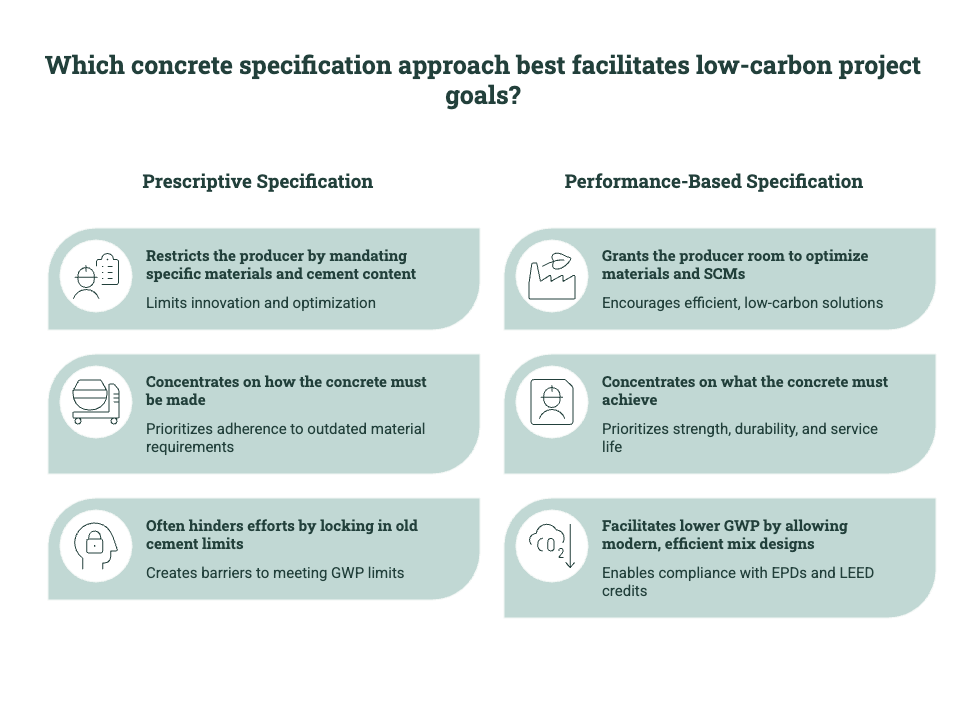
A performance-based concrete specification tells the producer what the concrete needs to achieve. A prescriptive concrete specification tells the producer exactly how the concrete must be made. This difference matters because low-carbon concrete usually requires flexibility in mix design, cementitious materials, curing time, supplier choices, and performance testing.
As more projects ask for EPDs, GWP limits, Buy Clean documentation, LEED credits, and lower embodied carbon, producers need to understand how spec language affects their ability to respond. The best low-carbon outcomes usually happen when specs protect performance while giving producers room to optimize the mix. The worst outcomes happen when specs demand lower carbon but lock producers into old cement limits, SCM caps, material restrictions, or outdated requirements.
Key Takeaways
- Performance-based specs usually give producers more room to lower GWP. They focus on what the concrete must do, such as strength, durability, exposure class, finishability, and service life.
- Prescriptive specs can limit low-carbon options. They may require minimum cement content, restrict SCMs, mandate certain materials, or prevent the producer from using the most efficient mix design.
- Carbon requirements work best when specs connect GWP limits to performance requirements. A lower-carbon mix still needs to meet strength, durability, placement, schedule, and project needs.
What Is a Performance-Based Concrete Specification?
A performance-based concrete specification defines the result the concrete must deliver. It may require a specific compressive strength, exposure class, durability result, permeability limit, shrinkage limit, finishability expectation, or curing performance. Instead of telling the producer exactly how to design the mix, it gives the producer room to meet the performance target using the best available materials and mix strategy.
For example, a performance-based spec might say the concrete must reach 4,000 psi at 56 days, meet a chloride permeability limit, satisfy a freeze-thaw durability requirement, and stay below a project GWP threshold. The producer can then evaluate cement type, SCM content, aggregate gradation, admixtures, water-cementitious ratio, and curing assumptions to meet both performance and carbon goals. This approach gives producers more flexibility to optimize.
Performance-based specs are especially helpful when owners or agencies want lower-carbon concrete. That is because lower-GWP mixes may need different cementitious combinations, longer strength-gain timelines, different SCMs, or optimized aggregate gradations. If the spec allows only one narrow path, the producer has less ability to reduce carbon without risking compliance.
“Performance-based specs ask whether the concrete works. Prescriptive specs often ask whether the concrete was made a certain way.”
What Is a Prescriptive Concrete Specification?
A prescriptive concrete specification tells the producer exactly what the mix must include or exclude. It may set minimum cement content, maximum SCM replacement, required cement type, required aggregate limits, specific admixture restrictions, water-cement ratio limits, curing requirements, or other fixed mix design rules. These requirements may be based on past practice, local preferences, or older risk controls.
Prescriptive specs can be useful when the owner or engineer needs tight control over a known application. They can also help simplify review when the project team wants a very specific material approach. The problem is that prescriptive specs can become a barrier when the same project also asks for lower embodied carbon.
For example, a spec may require a high minimum cement content while also asking the producer to meet a low GWP target. Those two requirements can conflict. The producer may know a lower-carbon mix that performs well, but the spec may not allow it.
.png)
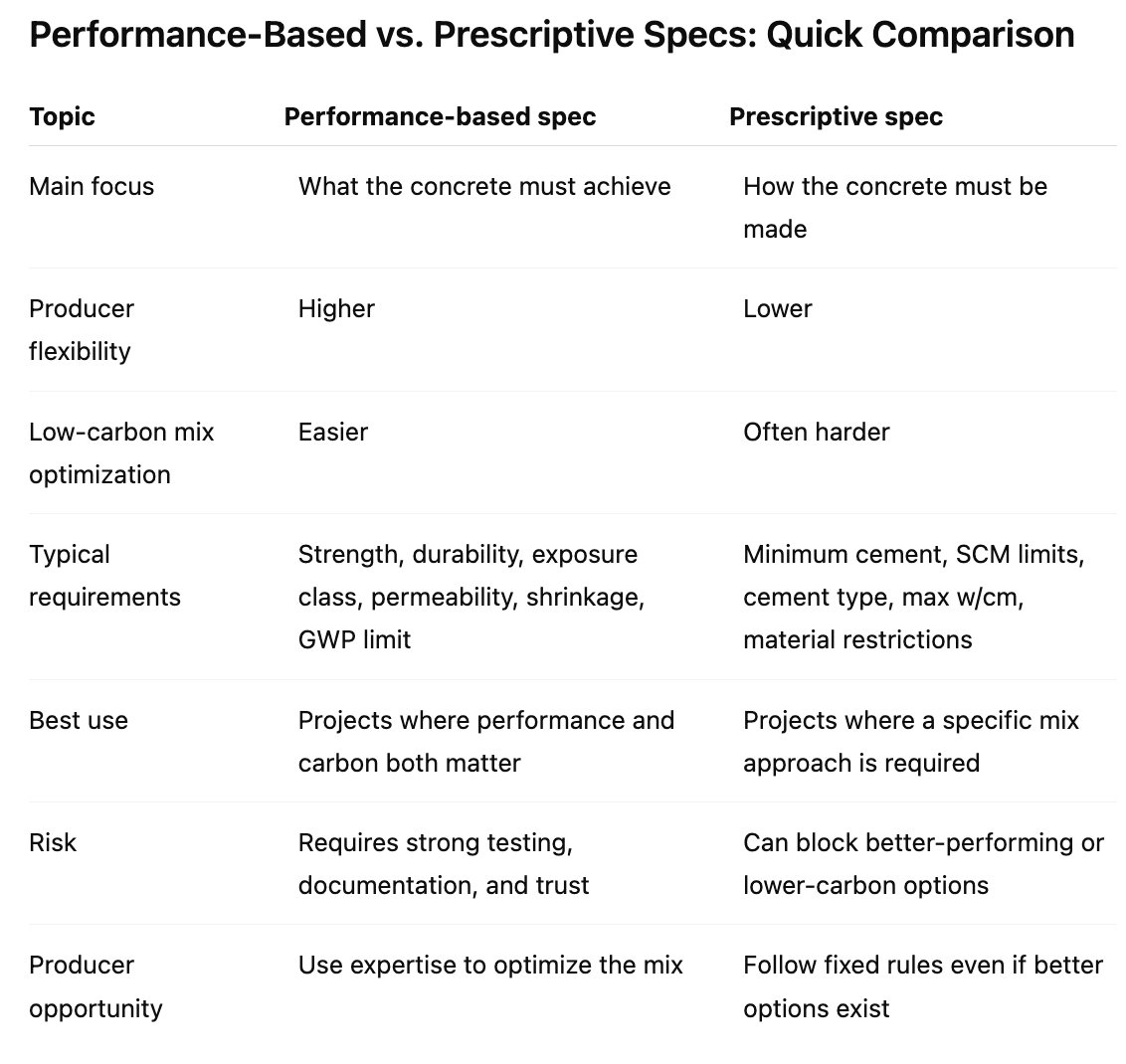
Performance-Based vs. Prescriptive Specs: Quick Comparison
A good specification does not have to be purely performance-based or purely prescriptive. Many real specs include both. The issue is whether the prescriptive parts are necessary or whether they prevent the producer from meeting the project’s performance and carbon goals.
For low-carbon concrete, the most practical approach is often a balanced spec. Keep the performance requirements that protect the project. Remove unnecessary prescriptive limits that make it harder to reduce GWP.
Why This Matters for Low-Carbon Concrete
Low-carbon concrete is not one product. It is usually the result of better mix design, better material choices, better supplier data, and better performance validation. Producers may reduce GWP by optimizing cementitious content, using SCMs, switching cement types, improving aggregate gradation, using admixtures effectively, or selecting lower-carbon upstream materials.
Prescriptive specs can make those strategies harder. If a spec requires a certain cement content, limits SCMs too tightly, or demands early strength when the project does not actually need it, the producer may be forced into a higher-GWP mix. That means the project may pay for carbon reductions on paper while blocking them in practice.
Performance-based specs give producers more room to solve the actual problem. The project still gets concrete that meets the required performance. The producer gets flexibility to find the lowest practical GWP within those performance boundaries.
“You cannot ask for lower-carbon concrete and then write a spec that prevents mix optimization.”
How Specs Affect Concrete EPDs and GWP
Concrete EPDs report the environmental impact of a mix, product, plant, or product group. The most watched number is usually Global Warming Potential, or GWP. GWP is commonly reported as kg CO2e per declared unit, such as one cubic yard or one cubic meter of concrete.
A performance-based spec can make it easier for producers to offer mixes with lower GWP because it allows them to adjust the mix while still meeting project needs. A prescriptive spec may force a higher-GWP mix because the producer has less room to change cement content, SCM content, admixtures, or other inputs. That matters when a project has a GWP threshold or requires EPDs.
Concrete PCR Version 3 also reinforces that EPD comparisons need context. Mixes should be functionally equivalent, use the same declared unit, and consider relevant performance characteristics. In other words, project teams should not only ask for the lowest GWP number. They should ask for the lowest practical GWP mix that still meets the job.
.png)
Common Prescriptive Requirements That Can Increase GWP
Some prescriptive requirements are necessary for safety, durability, or constructability. Others may be outdated, overly conservative, or copied from old specs without review. When low-carbon concrete is a project goal, these requirements should be checked carefully.
Common prescriptive requirements that can limit carbon reduction include:
- Minimum cement content
- Low maximum SCM replacement limits
- Restrictions on slag, fly ash, natural pozzolans, calcined clay, or other SCMs
- Required cement type when alternatives could work
- Early strength requirements that are not needed for the schedule
- Overly conservative water-cementitious ratio requirements
- Aggregate restrictions that prevent optimized gradation
- Prohibitions on admixtures that could improve performance
- Fixed mix designs from old project templates
- Requirements that ignore local material availability
- Requirements that conflict with GWP limits or EPD thresholds
The goal is not to remove all controls. The goal is to remove controls that do not support the actual performance needed. If a requirement does not improve strength, durability, schedule, finishability, or risk management, it may be worth revisiting.
Where Performance-Based Specs Help Producers Most
Performance-based specs are especially useful when producers need to balance carbon with performance. They let producers bring technical expertise into the conversation instead of simply following a fixed recipe. This matters because local materials, cement sources, SCM availability, aggregate properties, plant operations, and weather conditions vary widely.
Performance-based specs help most when:
- The project has a GWP limit.
Producers need flexibility to adjust mix design and material choices to stay under the threshold. - The project allows later-age strength.
Some lower-carbon mixes gain strength more slowly. If the project can accept 56-day strength instead of only 28-day strength, producers may have more options. - SCMs are available locally.
If slag, fly ash, natural pozzolans, calcined clay, or other SCMs are available, performance-based specs can allow producers to use them effectively. - The project requires durability, not just cement content.
Durability is what matters in the final structure. Performance tests can sometimes protect durability better than blanket material limits. - The owner wants carbon reduction without sacrificing constructability.
Producers can evaluate carbon, strength, finishability, pumpability, set time, and placement needs together.
“Low-carbon concrete works best when the spec gives producers room to meet the result, not just follow a recipe.”
How Buy Clean and EPD Requirements Change the Spec Conversation
Buy Clean policies and low embodied carbon procurement programs are increasing the use of EPDs and GWP thresholds. Instead of only asking for strength and durability, specs may ask for a verified EPD, a GWP value below a benchmark, or documentation that the mix meets a project carbon requirement. This changes the role of the producer.
Under older specs, the producer may have mainly focused on meeting technical requirements at the best cost. Under carbon-aware specs, the producer also needs to provide verified environmental data. That means mix design, EPD data, supplier data, and submittals are becoming more connected.
This is where performance-based thinking becomes important. If the spec adds a GWP limit but keeps restrictive material rules, the producer may have fewer paths to comply. If the spec combines performance requirements with carbon targets, the producer can look for the best mix that meets both.
Better low-carbon spec language usually includes:
- Required performance criteria
- Required EPD or GWP documentation
- Clear declared unit
- Project-specific GWP threshold or benchmark
- Accepted EPD types and program operators
- Rules for comparing functionally equivalent mixes
- Flexibility for SCMs and approved low-carbon materials
- Allowance for later-age strength where appropriate
- Submittal requirements that include both performance and carbon data
.png)
Public Projects vs. Private Projects
Public projects often drive EPD demand through federal, state, DOT, or municipal programs. These projects may include highways, bridges, airports, public buildings, universities, water infrastructure, and other agency work. Requirements may reference EPDs, GWP reporting, Buy Clean policies, or low-carbon material programs.
Private projects are also becoming a major driver. Data centers, semiconductor plants, warehouses, distribution centers, manufacturing facilities, corporate campuses, hospitals, and private universities may ask for EPDs or lower-carbon concrete because of internal climate goals or owner sustainability requirements. These projects may move quickly and expect producers to provide documentation early.
The difference is that public requirements may be tied to formal policy, while private requirements may be tied to owner standards. Producers need to be ready for both. A contractor may not care whether the requirement came from a law, a federal program, a LEED credit, or a corporate carbon goal. They will still need the producer to provide compliant data.
Why Data Centers, Warehouses, and Semiconductor Projects Matter
Large private projects can use enormous amounts of concrete. Slabs, foundations, tilt-up panels, paving, utility work, retaining walls, and site infrastructure can all add up quickly. When owners are tracking embodied carbon, the concrete package becomes a major focus.
Data centers and semiconductor facilities are especially important because they are often high-profile, schedule-driven, and tied to corporate sustainability commitments. These projects may require EPDs, GWP reporting, low-carbon options, or documentation that supports broader carbon accounting. Producers that can respond quickly may be easier for contractors and owners to work with.
Warehouses and distribution centers also matter because they often involve large floor slabs and extensive site paving. Even if the project is not pursuing formal certification, an owner may still ask for lower-carbon materials. This is one reason EPD readiness is becoming useful beyond public work.
Practical Example: Same Carbon Goal, Two Different Specs
Imagine a project asks for a concrete mix with lower GWP. The producer can meet the strength and durability requirements with a mix that uses optimized cementitious content and SCMs. The mix performs well, but it reaches final strength at 56 days instead of 28 days.
In a performance-based spec, the engineer may allow 56-day strength if it does not affect the schedule or structural requirements. The producer can submit the mix, EPD data, and performance documentation. The project gets lower-carbon concrete that still meets the actual need.
In a prescriptive spec, the project may require a minimum cement content, cap SCM replacement, and require 28-day strength even when the schedule does not require it. The producer may be forced to submit a higher-GWP mix. The project may still claim it wants low-carbon concrete, but the spec prevents the best available option.
“The carbon requirement is only as good as the spec language behind it.”
Practical Example: DOT Mixes
DOT projects often need consistency, durability, and proven performance. That does not mean low-carbon concrete is impossible. It means the spec needs to define the required performance clearly and allow producers to meet it using approved materials and validated mix designs.
A DOT spec that only allows narrow material options may limit producer flexibility. A DOT spec that defines performance, durability, test methods, EPD requirements, and acceptable material pathways can create more room for innovation. This is especially important as transportation agencies explore low-carbon concrete and asphalt programs.
For producers serving DOT work, the best approach is to understand both the technical spec and the carbon documentation requirement. The producer should know which mixes are commonly used, which EPDs are available, which materials drive GWP, and where performance-based alternatives could be proposed.
Practical Example: Data Center Slabs
A data center may require large volumes of concrete for slabs, foundations, equipment pads, and site work. The owner may have aggressive sustainability goals and ask the contractor to reduce embodied carbon. The producer may be asked for EPDs and lower-GWP mix options early in the process.
If the slab spec includes unnecessary cement minimums or early strength requirements, the producer may have limited room to reduce GWP. If the spec allows performance-based alternatives, the producer may be able to optimize cementitious content, SCMs, admixtures, and curing timelines. The result can be a lower-carbon mix that still meets placement, finishing, flatness, durability, and schedule needs.
This is why producers should get involved early. By the time the mix is submitted, the project may already be locked into spec language that makes carbon reduction harder. Earlier conversations can help align carbon goals with practical concrete performance.
What Producers Should Ask When Reviewing a Carbon-Aware Spec
Producers should not treat a carbon requirement as a separate sustainability line item. It affects the mix design, material sourcing, EPD documentation, and submittal process. Before bidding or submitting, producers should review the spec carefully.
Ask these questions:
- Is the spec performance-based, prescriptive, or mixed?
Identify which parts define outcomes and which parts restrict the mix design. - Is there a GWP limit or benchmark?
Confirm the unit, scope, and whether the limit applies to A1-A3 or another boundary. - Is an EPD required?
Check whether the spec requires product-specific, plant-specific, industry-average, or project-specific EPD data. - Are the performance requirements clear?
Look for strength, age, exposure class, durability, slump, air, finishability, and placement needs. - Are there cement or SCM restrictions?
Check whether the spec limits the very materials needed to reduce GWP. - Can later-age strength be used?
If the schedule allows it, later-age strength can create more low-carbon options. - Are alternative mixes allowed?
Look for substitution, variance, or performance alternative language. - Who approves carbon-related mix changes?
Confirm whether the engineer, owner, contractor, agency, or sustainability consultant needs to review the mix. - What documentation is required?
Identify whether the project needs EPDs, mix design reports, test data, GWP summaries, or supplier documentation. - Does the spec allow local material realities?
Carbon reduction depends on what cement, SCMs, aggregates, admixtures, and transportation options are actually available.
.png)
How Producers Can Work With Engineers and Spec Writers
Producers should not wait until the submittal stage to discuss low-carbon concrete. By then, the spec may already be too restrictive. The best time to influence the outcome is during design, pre-bid, or early project planning.
When talking with engineers or spec writers, producers should bring both performance and carbon data. Do not only say “we can lower the GWP.” Show how the proposed mix meets strength, durability, schedule, placement, and finishability requirements. Then show the EPD or GWP data that supports the carbon reduction.
Helpful conversation points include:
- “Can the project allow performance-based alternatives?”
- “Is the minimum cement content necessary for this application?”
- “Can later-age strength be accepted if the schedule allows it?”
- “Can SCM limits be adjusted if durability and performance are demonstrated?”
- “Which EPD type will be accepted?”
- “Should the GWP threshold be tied to strength or application category?”
- “Can we submit multiple mix options with different carbon and performance profiles?”
“Engineers are more likely to accept lower-carbon mixes when producers bring test data, not just carbon claims.”
How Producers Can Prepare Internally
Meeting performance and carbon requirements requires coordination across sales, technical, QC, operations, and procurement. If those teams are not aligned, the producer may struggle to respond quickly. Low-carbon concrete is not just a sustainability task.
Sales teams need to understand which projects are asking for EPDs and GWP limits. Technical teams need to know which mixes can meet performance requirements. Operations teams need accurate plant and production data. Procurement teams need supplier data for cement, SCMs, aggregates, and admixtures.
The best producers will build repeatable workflows. Instead of creating a one-off response every time a project asks for carbon data, they will maintain an organized system of mix designs, EPDs, GWP results, supplier data, and performance documentation.
Producer readiness checklist
- Identify common mixes likely to face carbon requirements
- Review EPD availability by plant and mix
- Organize GWP data by strength and application
- Track cement, SCM, aggregate, and admixture suppliers
- Ask suppliers for current EPDs
- Identify mixes where prescriptive specs limit carbon reduction
- Develop lower-GWP alternatives with performance data
- Prepare standard language for engineers and contractors
- Train sales and QC teams on EPD and GWP basics
- Create a process for responding to project carbon requirements
.png)
How Climate Earth Helps Producers Respond to Carbon Requirements
Getting started with concrete EPDs begins with understanding which products, plants, mixes, or materials are most likely to be requested in bids, specs, or customer conversations. From there, producers need to organize the right mix, material, supplier, plant, and production data so EPDs can be created, verified, published, and used when projects ask for them.
Climate Earth helps concrete producers create and manage EPDs across ready mix, block, pavers, precast, cement, aggregates, asphalt, dry mix, and SCMs. Our platform is built to make concrete carbon data easier to calculate, update, and use across bids, submittals, and low-carbon project requirements.
Why Choose Climate Earth?
- Built for concrete and construction materials: Climate Earth is designed around the way concrete producers actually manage mixes, plants, materials, and project requirements.
- Faster EPD workflows: Create and manage EPDs without rebuilding the process from scratch every time a customer asks for carbon data.
- Practical GWP visibility: See the carbon impact of mixes, materials, and product options so your team can respond with confidence.
- Support for bids and submittals: Make it easier for sales, technical, and QC teams to provide verified EPD data when owners, contractors, DOTs, or agencies ask for it.
- Ready for low-carbon requirements: Prepare for Buy Clean policies, LEED projects, DOT programs, data centers, universities, warehouses, and owner-driven carbon specs.
- Scalable across product lines: Support EPD needs across ready mix, precast, block, pavers, cementitious products, aggregates, asphalt, dry mix, and SCM-related workflows.
Ready to Get Started? Schedule a demo to see how easy it can be to create, manage, and use concrete EPDs across your business.
Common Questions About Performance-Based and Prescriptive Concrete Specs
What is a performance-based concrete specification?
A performance-based concrete specification defines what the concrete must achieve instead of exactly how it must be made. It may include strength, durability, exposure class, permeability, shrinkage, finishability, schedule, and carbon requirements. This gives producers more flexibility to design mixes that meet project goals.
What is a prescriptive concrete specification?
A prescriptive concrete specification tells the producer what materials or mix limits must be used. It may include minimum cement content, maximum SCM replacement, required cement type, water-cement ratio limits, or other fixed requirements. These specs can be useful but may limit low-carbon mix optimization.
Which type of spec is better for low-carbon concrete?
Performance-based specs are usually better for low-carbon concrete because they give producers more flexibility. The producer can adjust the mix design while still meeting strength, durability, and project requirements. Prescriptive specs can make carbon reduction harder if they restrict cementitious materials or require unnecessary cement content.
Can a spec be both performance-based and prescriptive?
Yes. Many specs include both performance and prescriptive requirements. The key is making sure the prescriptive requirements do not block the project’s carbon goals. A balanced spec should protect performance while allowing reasonable mix optimization.
How do EPDs fit into performance-based specs?
EPDs provide verified environmental data, usually including GWP. A performance-based spec can require the concrete to meet both technical performance requirements and a GWP threshold documented by an EPD. This connects carbon data to actual project performance.
Why do prescriptive specs make Buy Clean compliance harder?
Buy Clean and low-carbon procurement programs often focus on GWP or EPD documentation. If a prescriptive spec forces high cement content or limits SCMs, the producer may have fewer ways to reduce GWP. This can make compliance harder even when lower-carbon mixes are technically possible.
What should producers do when a spec conflicts with carbon goals?
Producers should document the conflict and propose a performance-based alternative. The proposal should include mix performance data, EPD or GWP data, and a clear explanation of how the alternative meets project requirements. Producers should involve the engineer, contractor, owner, and sustainability team as early as possible.
Summary: Why Spec Language Matters for Low-Carbon Concrete
Performance-based and prescriptive concrete specs affect how easily producers can meet carbon requirements. Performance-based specs usually give producers more room to optimize mixes, use appropriate SCMs, adjust cementitious content, and document lower GWP. Prescriptive specs can still be useful, but they may block lower-carbon options if they are too rigid.
As EPDs, Buy Clean programs, DOT requirements, LEED credits, data centers, universities, warehouses, and owner-driven carbon specs become more common, producers need to pay closer attention to spec language. The question is not only whether a mix can meet a GWP target. The question is whether the specification allows the producer to design a mix that meets both performance and carbon goals.
The best outcomes happen when owners, engineers, contractors, and producers work together early. A strong low-carbon concrete spec should define the performance the project needs, require credible EPD or GWP documentation, and give producers enough flexibility to reach the lowest practical carbon impact without sacrificing safety, durability, or constructability.

Find out how Climate Earth can help you win more big business.
Related articles

Data Center Construction Project Requirements

2026 Ready-Mix Concrete PCR Update: How New Product Category Rules Affect EPDs