


Industry Average vs. Product Specific Concrete EPDs: What New Benchmarks Mean for Producers

Concrete EPDs are becoming more important in bids, submittals, Buy Clean programs, DOT projects, GSA requirements, data centers, universities, and private owner specs. But not all EPDs are the same. A project team may ask for an industry average EPD, a product-specific EPD, a plant-specific EPD, or a mix-specific GWP value.
For ready mix producers, the difference matters. Industry average EPDs can help establish a baseline, but they may not reflect the actual concrete being supplied to a job. Product-specific EPDs give project teams a more accurate view of the mix, plant, materials, and carbon footprint behind the concrete they are buying.
As new concrete benchmarks, GWP limits, and PCR updates reshape the market, producers need to understand how EPD data will be compared. The producer with better product-specific data can often respond faster, prove lower-carbon performance more clearly, and compete more effectively on projects where GWP matters.
Key Takeaways
- Industry average EPDs show what is typical. They are useful for benchmarks, baselines, early planning, and understanding average GWP by region or product category.
- Product-specific EPDs show what your concrete actually does. They are more useful when a contractor, owner, DOT, or agency needs to evaluate the mix being supplied to a real project.
- New benchmarks make the difference more important. As agencies and owners compare mixes against GWP limits, regional averages, and percent reductions, producers need accurate EPD data tied to their own plants and products.
- Better data can become a competitive advantage. If your mix performs better than the industry average, a product-specific EPD helps prove it.
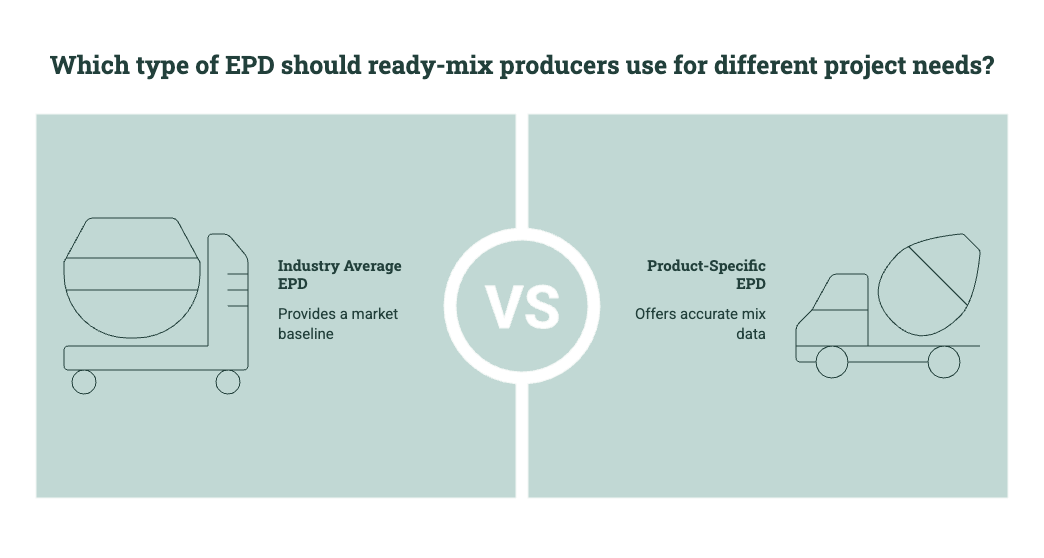
What Is an Industry Average Concrete EPD?
An industry average concrete EPD reports environmental impact data based on an average of data from multiple producers, plants, or mixes. It is designed to represent what is typical across a product category, region, or market. For ready-mix concrete, industry average EPDs may be grouped by strength class, region, air content, or other mix categories.
Industry average EPDs are useful because they give the market a starting point. Agencies, owners, engineers, and contractors can use them to understand typical GWP values and build early benchmarks. They are also helpful when product-specific data is not yet available.
But industry average EPDs have a limit. They do not prove the carbon footprint of the exact mix a producer will supply to a specific project. If your concrete is better than the average, an industry average EPD may hide that advantage.
Industry average EPDs tell the market what is typical. Product-specific EPDs tell the project what you are actually supplying.
What Is a Product-Specific Concrete EPD?
A product-specific concrete EPD reports environmental impact data for a specific producer’s product, mix, plant, or product family. It is based on the actual materials, plant data, mix designs, and production information used by that producer. For ready-mix producers, this can make the EPD much more useful in project bidding.
A product-specific EPD can show the GWP of a specific mix or group of similar mixes. It may reflect the cement type, SCM content, aggregate sources, plant operations, and supplier data behind the actual product. That makes it stronger when the project team wants to compare real options.
For producers, product-specific EPDs are especially valuable when a mix is lower than the benchmark. If your optimized 4,000 psi mix has a lower GWP than the industry average, a product-specific EPD helps document that difference.
.png)
Why New Benchmarks Matter
Benchmarks are changing how concrete EPDs are used. In the past, an EPD might have been requested mainly for transparency or LEED documentation. Now, more projects are using EPDs to compare GWP values, set limits, calculate reductions, and decide whether a mix qualifies.
A benchmark may come from an industry average EPD, a regional database, a DOT program, a GSA threshold, a city requirement, or a project-specific baseline. Once that benchmark exists, the project team can ask whether the proposed mix is above it, below it, or lower by a certain percentage.
This creates a practical shift for ready-mix producers. The EPD is no longer just a document to attach to a submittal. It becomes evidence that the mix meets the carbon requirement.
Common ways benchmarks show up
- Maximum GWP limits by strength class
- Percent reduction below a regional average
- GWP thresholds for public procurement
- DOT EPD data collection and future limits
- GSA low embodied carbon material requirements
- City or municipal concrete carbon caps
- Private owner baseline comparisons
- Whole-project carbon reporting by mix and volume
.png)
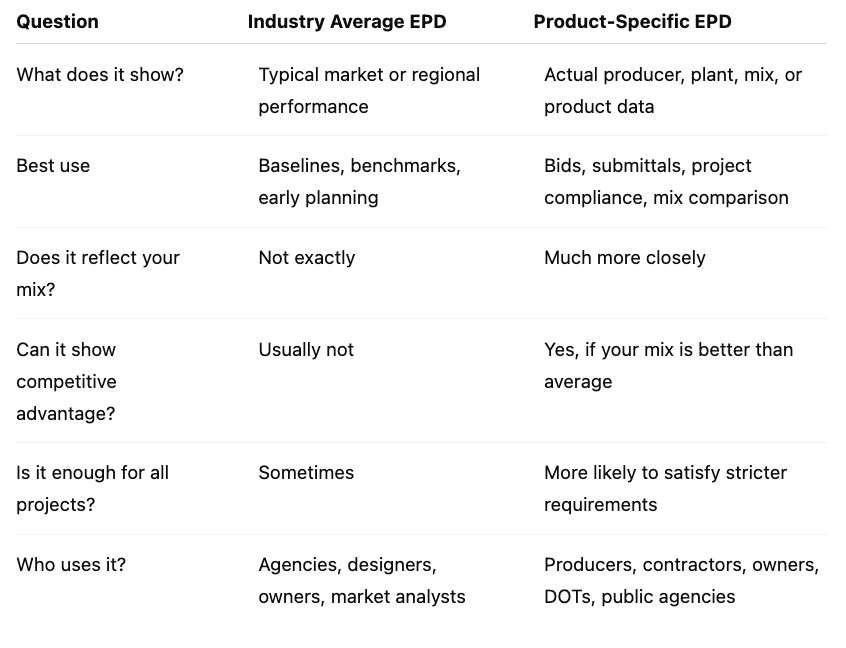
Industry Average vs. Product-Specific EPDs
The simplest way to think about it is this: industry average EPDs are useful for setting the playing field. Product-specific EPDs help you compete on that field.
How This Affects Ready-Mix Producers in Bids
When a project asks for an EPD, the producer needs to know what kind of EPD is acceptable. Some projects may allow an industry average EPD during early design. Others may require a product-specific or plant-specific EPD for final submittal. Some may require mix-specific GWP values tied to the actual concrete being delivered.
This matters during bidding because GWP requirements can affect whether a mix qualifies. If a project sets a maximum GWP value, a producer needs to know whether the submitted EPD is below that limit. If a project requires a 10%, 20%, or 30% reduction below baseline, the producer needs product-specific data to prove the reduction.
A producer that only has industry average data may be at a disadvantage if competitors can show verified lower-GWP mixes. On the other hand, a producer with product-specific EPDs can support the bid with clearer documentation.
When the spec starts comparing GWP, average data is not always enough.
Example: How Benchmarks Change the Conversation
A project sets a benchmark of 360 kg CO2e/yd³ for a 4,000 psi concrete mix. The contractor asks producers to submit a mix at least 10% below the benchmark.
The target is: 360 × 0.90 = 324 kg CO2e/yd³
Producer A submits an industry average EPD showing the general market value. That may help the project team understand the baseline, but it does not clearly prove that Producer A’s actual mix is below 324.
Producer B submits a product-specific EPD showing that its actual 4,000 psi mix is 310 kg CO2e/yd³. That mix is below the target and can be documented clearly.
In this situation, the product-specific EPD gives the contractor and owner more confidence. It shows the actual mix can meet the GWP requirement.
What Producers Should Track
Product-specific EPDs require better data. Producers should start organizing the information behind their most important mixes before a project asks for it.
Track:
- Mix ID
- Plant location
- Strength class
- Air content
- Exposure class
- Cement type
- Cement quantity
- SCM type and percentage
- Aggregate sources
- Admixtures
- Water content
- Plant energy and production data
- Supplier EPDs where available
- A1-A3 GWP
- Optional A4 delivery data where needed
- EPD publication and expiration dates
- PCR version and program operator
The goal is not to create paperwork for its own sake. The goal is to make EPD generation and project response faster when customers ask.
.png)
What New Benchmarks Mean Strategically
New benchmarks will make it easier for agencies and owners to compare concrete carbon performance. That can be good or bad for producers, depending on how prepared they are. If your mix data is organized and your GWP is competitive, benchmarks help you prove value. If your data is messy or outdated, benchmarks can make the bid process harder.
Producers should start by identifying the mixes that matter most. These are usually high-volume mixes, commonly specified strength classes, mixes used on public projects, and mixes that are likely to face EPD or GWP requirements. Once those mixes are documented, producers can build lower-GWP alternates and compare them against common baselines.
The biggest opportunity is not just compliance. Product-specific EPDs can help producers have better technical conversations with contractors, engineers, owners, and sustainability teams. Instead of saying, “We have an EPD,” producers can say, “Here is the GWP of this mix, how it compares to the benchmark, and what lower-carbon options are available.”
.png)
How Climate Earth Helps Producers Manage EPDs and Benchmarks
Climate Earth helps ready-mix and cement producers generate and manage verified EPDs faster. As new benchmarks, GWP limits, and low-carbon concrete requirements become more common, producers need a repeatable way to turn plant and product data into usable environmental documentation.
Climate Earth supports Type III verified EPD workflows for ready-mix and cement producers, with standards-aligned reporting and expert LCA support. Producers can keep plant, product, and EPD data organized so they are ready when contractors, owners, agencies, or project teams ask for verified environmental product data.
Why producers choose Climate Earth
- Built for ready-mix and cement EPD generation
- Supports Type III verified EPD workflows
- Helps producers respond faster to EPD requests
- Keeps plant and product data organized
- Supports ISO 14025 and EN 15804+A2-aligned reporting
- Helps producers compare product data against benchmarks
- Backed by expert LCA support
Ready to get started? Generate verified EPDs faster with software built for ready-mix and cement producers. Book a demo to see how Climate Earth can help your team manage EPD generation, standards compliance, and environmental product data in one workflow.
FAQ: Industry Average vs. Product-Specific Concrete EPDs
What is an industry average concrete EPD?
An industry average concrete EPD reports average environmental impact data across multiple producers, plants, or mixes. It is useful for baselines and benchmarks, but it may not reflect the exact concrete supplied to a project.
What is a product-specific concrete EPD?
A product-specific concrete EPD reports environmental impact data for a specific producer’s product, plant, mix, or product family. It is usually more useful for project bids and submittals.
Is an industry average EPD enough?
Sometimes. It may be enough for early planning or general benchmarking. Stricter projects may require product-specific, plant-specific, or mix-specific EPDs.
Why do benchmarks matter?
Benchmarks give project teams a reference point for comparing GWP. A mix may need to be below a maximum GWP value or a certain percentage lower than a baseline.
Can product-specific EPDs help producers win work?
Yes. If a producer’s mix has a lower GWP than the benchmark or competitor options, a product-specific EPD helps prove that advantage.
What is the main number in a concrete EPD?
The main number most project teams look at is GWP, or Global Warming Potential. It is the carbon footprint of the mix, usually reported as kg CO2e per cubic yard or cubic meter.
Do new benchmarks replace EPDs?
No. Benchmarks are used to compare performance. EPDs provide the verified data needed to show where a product sits against the benchmark.
Summary
Industry average EPDs and product-specific EPDs both matter, but they serve different purposes. Industry average EPDs help define the baseline. Product-specific EPDs help prove what a producer can actually supply.
As new concrete benchmarks, GWP limits, Buy Clean policies, DOT programs, and private owner requirements become more common, ready-mix producers will need better data. The producers that can generate product-specific EPDs, compare mixes against benchmarks, and respond quickly to project requirements will be better positioned.
The market is moving from “Do you have an EPD?” to “How does your mix compare?” Product-specific EPDs help producers answer that question clearly.
Related articles

LEED v5 Requirements: What They Mean for Low Carbon Concrete

How to Read a Concrete EPD: Quick, Expert Guide