


Canada Ready Mix Low-Carbon Concrete Requirements: EPDs, GWP Baselines, and Federal Procurement

Canadian ready-mix producers are being asked for more than concrete mix designs. On federal, institutional, infrastructure, and large private projects, producers may now need to provide Environmental Product Declarations, GWP values, baseline comparisons, and project-level carbon documentation. In practice, carbon data is becoming part of bidding, submittals, mix approvals, and owner conversations.
In Canada, low-carbon concrete requirements are tied to federal procurement, embodied carbon standards, CSA concrete requirements, GUL cement, supplementary cementitious materials, regional material availability, and GWP baselines. A producer may be asked to show the GWP of a 25 MPa, 30 MPa, 35 MPa, or 40 MPa mix, compare it against a regional benchmark, or prove a percentage reduction against a baseline.
This guide explains where low-carbon concrete requirements are showing up in Canada, which projects are asking for EPDs, what standards EPDs need to meet, how baselines and reductions are used, how mix optimization works in the Canadian market, and what ready-mix producers should do next.
Key Takeaways
- Low-carbon concrete requirements in Canada are showing up in federal procurement, public infrastructure, institutional projects, green building work, and owner-driven specs. Producers may see requests for EPDs, GWP values, baseline comparisons, or project-level carbon summaries.
- EPDs need to follow recognized standards and product category rules. For Canadian ready-mix producers, this usually means ISO 14025, ISO 21930, ISO 14040/14044, the concrete PCR, CSA A23.1/A23.2, and CSA A3001 where concrete and cementitious materials are involved.
- Baselines matter because “low carbon” is always relative. A mix is only lower carbon compared with something else: a regional average, industry average, business-as-usual mix, or project-specific benchmark.
.png)
Where Low-Carbon Concrete, EPDs, and GWP Are Showing Up in Canada
Low-carbon concrete requirements are not showing up in one single way across Canada. They are appearing through a mix of federal procurement rules, public project requirements, institutional owner standards, green building programs, and private owner carbon goals. For ready-mix producers, the important thing is not just the policy name. It is how the requirement shows up in the spec.
A project may ask for an EPD. Another may ask for a GWP value. Another may ask for a concrete mix to be 10% below a baseline. Another may ask for total embodied carbon by mix and volume. These are different requests, but they all require the same basic readiness: accurate mix data, plant data, supplier data, and carbon documentation.
In Canada, producers should watch for low-carbon concrete requirements in:
- Federal construction projects
- Public Services and Procurement Canada projects
- Infrastructure projects with public funding
- Provincial and municipal buildings
- Transit and transportation projects
- Universities and colleges
- Hospitals and healthcare facilities
- LEED and zero-carbon building projects
- Data centers and industrial projects
- Warehouses, logistics, and distribution facilities
- Large private developments with ESG or carbon goals
The practical reality is that carbon requirements may not always say “low-carbon concrete” in the title. They may appear under “embodied carbon,” “sustainable materials,” “EPD requirements,” “whole-building LCA,” “GWP limits,” “material disclosure,” or “procurement documentation.”
“For producers, the requirement usually shows up as a document request: provide the EPD, provide the GWP, show the baseline, or summarize the project carbon.”
Canada-Specific Legislation and Procurement Drivers
Canada’s low-carbon concrete market is being shaped by federal embodied carbon policy and public procurement. The federal government has been moving toward disclosure and reduction of embodied carbon in construction materials, with ready-mix concrete as a key material category. That matters because public procurement often influences how contractors, consultants, and owners write future project requirements.
Government of Canada Standard on Embodied Carbon in Construction
The most important federal driver is the Government of Canada’s Standard on Embodied Carbon in Construction. For ready-mix producers, the practical takeaway is that applicable federal projects may require the embodied carbon of ready-mixed concrete to be disclosed and reduced against a baseline.
The number producers hear most often in relation to this standard is a 10% reduction from a regional baseline for ready-mixed concrete. The exact requirements should always be confirmed in the project documents, but the direction is clear: federal procurement is pushing concrete toward measurable GWP reductions, not vague sustainability claims.
For a producer, this means the project team may ask:
- What is the GWP of the proposed mix?
- What baseline is it being compared against?
- Is the mix at least 10% lower than the baseline?
- Is the data supported by an EPD or accepted documentation?
- Does the mix still meet CSA and project performance requirements?
.png)
Greening Government Strategy
Canada’s Greening Government direction also supports lower-carbon construction. Even when a project does not directly quote the embodied carbon standard, federal sustainability goals can influence project requirements. This is especially true for federal buildings, public assets, and projects delivered through major contractors and consultants.
For producers, this may show up as a request for EPDs, lower-GWP mix options, whole-building LCA support, or documentation that helps the project meet internal government carbon goals.
Public Services and Procurement Canada
Public Services and Procurement Canada, or PSPC, matters because it manages federal real property and construction procurement. When PSPC-related projects include embodied carbon language, contractors may need ready-mix suppliers that can provide EPDs, GWP values, and baseline comparisons.
This can affect producers even if they are not directly contracted by the federal government. The requirement may come through the general contractor, design team, sustainability consultant, or submittal package.
Infrastructure Canada and Public Funding
Infrastructure Canada and public infrastructure funding can also shape material expectations. Concrete is heavily used in transit, bridges, water systems, civic buildings, and public works. As public infrastructure projects pay more attention to embodied carbon, ready-mix producers may see more requests for EPDs and project-level GWP reporting.
Provincial, Municipal, and Institutional Requirements
Provinces, municipalities, universities, hospitals, and transit agencies may write their own carbon requirements. Some may follow federal language. Others may use LEED, zero-carbon building frameworks, whole-building LCA requirements, or owner-specific standards.
This means producers need to read each spec carefully. A project in Ontario may not ask for the same documentation as a project in British Columbia, Alberta, Quebec, or Atlantic Canada.
.png)
What Projects in Canada May Require EPDs?
Not every Canadian concrete project requires an EPD. But EPD requests are becoming more common on projects where carbon reporting, public procurement, or sustainability documentation matters.
Projects most likely to ask for EPDs or GWP data
Federal buildings and public assets
Federal construction projects are one of the clearest places producers may see concrete embodied carbon requirements. These projects may ask for EPDs, GWP values, and evidence that ready-mix concrete meets a reduction target.
Universities and colleges
Higher education projects often have sustainability goals, LEED targets, carbon reporting requirements, or owner-driven material standards. These projects may ask for product EPDs and whole-building LCA data.
Hospitals and healthcare facilities
Healthcare projects can involve large concrete volumes and high owner scrutiny. If the owner has carbon or sustainability commitments, concrete EPDs may be requested during design, bidding, or submittals.
Transit and infrastructure projects
Transit stations, bridges, water infrastructure, civic projects, and public works can require carbon documentation, especially when public funding or sustainability standards are involved.
LEED and green building projects
LEED projects may ask for EPDs to support material disclosure or whole-building LCA credits. Concrete can be a major part of the building’s embodied carbon profile.
Data centers and industrial projects
Data centers, semiconductor-related facilities, industrial buildings, and manufacturing projects can use large quantities of concrete. Even when they are private projects, owners may ask for EPDs or GWP data to support corporate carbon goals.
Warehouses and logistics facilities
Large slabs, paving, tilt-up panels, and site concrete can add up quickly. These projects may ask for lower-carbon mixes if the owner is tracking embodied carbon.
“A producer may first see the requirement not from the government, but from the contractor asking: can you send the EPD and GWP for this mix?”
.png)
What Standards Do Concrete EPDs Need to Meet in Canada?
An EPD is not just a marketing document. It is a standardized, third-party verified environmental report based on life cycle assessment. For Canadian ready-mix producers, the standards matter because they affect whether the EPD will be accepted on a project.
ISO 14025
ISO 14025 is the standard for Type III Environmental Product Declarations. This is the main standard behind third-party verified EPDs. It helps define how environmental product information should be reported and verified.
ISO 14040 and ISO 14044
ISO 14040 and ISO 14044 are the core Life Cycle Assessment standards. They define the LCA framework, methodology, requirements, and interpretation process. Since EPDs are based on LCAs, these standards sit behind the EPD process.
ISO 21930
ISO 21930 applies to environmental declarations for construction products and services. It is especially important for construction material EPDs, including concrete. It helps define how building and civil engineering product impacts are reported.
Concrete PCR
The Product Category Rule, or PCR, is the product-specific rulebook for creating the EPD. For ready-mix concrete, the PCR defines the declared unit, system boundary, required data, life cycle stages, performance characteristics, impact categories, and reporting rules.
CSA A23.1 and CSA A23.2
CSA A23.1 and CSA A23.2 are central to concrete materials, methods of construction, and testing in Canada. Low-carbon concrete still needs to meet CSA performance and quality requirements. Carbon reduction does not replace strength, durability, exposure class, air, slump, curing, or testing.
CSA A3001
CSA A3001 covers cementitious materials for use in concrete. This is important for low-carbon concrete because cement type, GUL cement, slag, fly ash, silica fume, natural pozzolans, and other SCMs are major GWP levers.
What this means in practice
A Canadian ready-mix EPD should clearly identify:
- The product or mix covered
- The producer and plant
- The declared unit, usually cubic metre
- The life cycle stages, usually A1-A3
- Whether A4 delivery is included
- The GWP value in kg CO2e/m³
- The PCR used
- The program operator
- The verifier
- The LCA software and database used
- The data year and known data gaps
- Relevant performance characteristics, such as strength and exposure class
.png)
EPD Process for Canadian Ready-Mix Producers
The EPD process can feel technical, but the producer workflow is straightforward. The challenge is usually not the PDF. The challenge is collecting clean data.
Step 1: Identify the mixes and plants
Start with the mixes most likely to be used on federal, institutional, infrastructure, or owner-driven low-carbon projects. These may include 25 MPa, 30 MPa, 35 MPa, and 40 MPa mixes, common slab mixes, foundation mixes, and high-volume structural mixes.
Step 2: Gather mix and material data
Collect cement type, cement quantity, SCM type and quantity, aggregate sources, admixtures, water, air, slump, w/cm, strength, exposure class, and typical application. This is the data that connects the EPD to real concrete performance.
Step 3: Gather plant and supplier data
Plant energy, production volume, fuel, water, transportation distances, and supplier EPDs all matter. Better supplier data can improve the quality of the final EPD.
Step 4: Run the LCA
The LCA calculates environmental impacts, including GWP. For ready-mix concrete, the most important reported result is usually A1-A3 GWP in kg CO2e/m³.
Step 5: Verify and publish the EPD
The EPD needs third-party verification and publication through an accepted program operator. This is what makes it credible for project teams.
Step 6: Use the EPD in bids and submittals
The EPD should not sit in a folder. It should be easy for sales, QC, and technical teams to use when projects ask for GWP, baseline comparisons, or lower-carbon mix options.
.png)
A1-A3 and A4: What Producers Need to Track
Most Canadian concrete carbon requirements focus on A1-A3, also called cradle-to-gate. These are the product stages before the concrete leaves the plant.
A1: Raw materials
A1 includes cement, SCMs, aggregates, admixtures, water, and other inputs. For most ready-mix concrete, cementitious materials are the largest GWP driver.
A2: Transportation to the plant
A2 includes transporting raw materials to the ready-mix plant. In Canada, this can matter because geography, aggregate sources, cement terminals, and SCM availability vary by region.
A3: Plant production
A3 includes batching, plant energy, fuel, water management, and production-related impacts.
A4: Delivery to site
A4 covers delivery from the plant to the jobsite. Some projects may ask for A4 because delivery distance affects project-level carbon. Producers should clarify whether the project wants A1-A3 only or A1-A4.
.png)
How Benchmarks and Baselines Are Used in Low-Carbon Concrete
A GWP baseline is the reference point used to determine whether a mix is lower carbon. It answers the question: lower than what?
Baselines may come from:
- A regional industry average
- An industry-wide EPD
- A provincial benchmark
- A project-specific business-as-usual mix
- A previous mix used on similar work
- A published GWP threshold table
- A whole-building LCA baseline
A good baseline should be realistic for the project location and application. It should be tied to both placement/application and strength, not strength alone. A 25 MPa slab mix, 35 MPa structural mix, and 40 MPa exterior air-entrained mix should not all be judged against the same number.
Example baseline numbers
Use these as examples of how baselines can vary by region and data source:
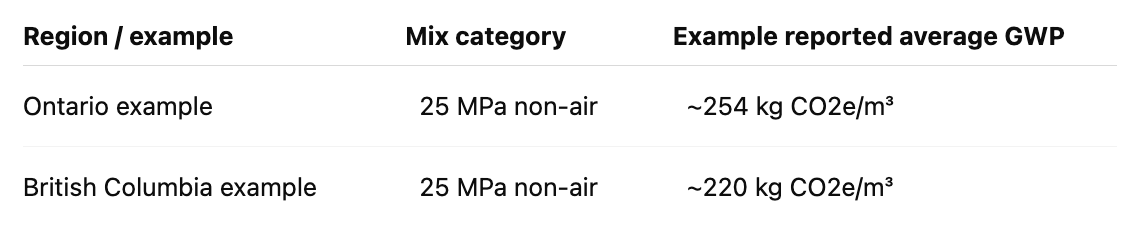
These values should be verified against the final source before publishing. The important lesson is that Canadian baselines are not one-size-fits-all. Regional cement supply, SCM availability, aggregate sources, plant data, and transportation can change the number.
How to Calculate GWP Reductions
The formula is simple:
Reduction percentage = (Baseline GWP - Proposed Mix GWP) ÷ Baseline GWP × 100
Example: 10% reduction
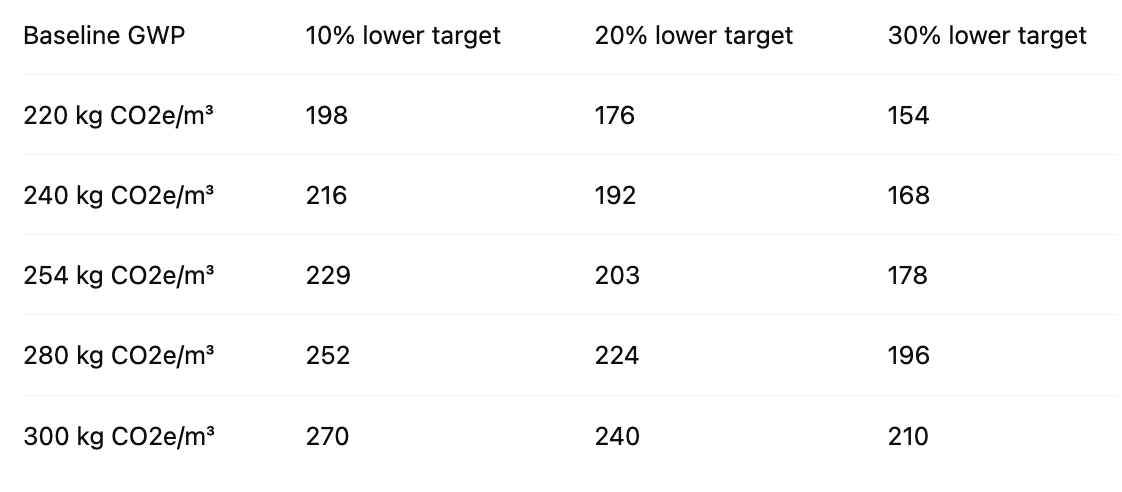
If the baseline is 254 kg CO2e/m³, a 10% reduction target is:
254 × 0.90 = 229 kg CO2e/m³
Example: 20% reduction
If the baseline is 254 kg CO2e/m³, a 20% reduction target is:
254 × 0.80 = 203 kg CO2e/m³
Example: 30% reduction
If the baseline is 254 kg CO2e/m³, a 30% reduction target is:
254 × 0.70 = 178 kg CO2e/m³
Quick reference table
This is the math producers need during bidding. If a spec asks for 10% below baseline, the producer needs the baseline, the target, the proposed mix GWP, and the documentation to support it.
Mix Optimization in Canada: How Producers Lower GWP
Low-carbon concrete in Canada is usually achieved through mix optimization, not one single material swap. Producers need to balance carbon, cost, performance, availability, CSA requirements, and project specifications.
1. GUL cement
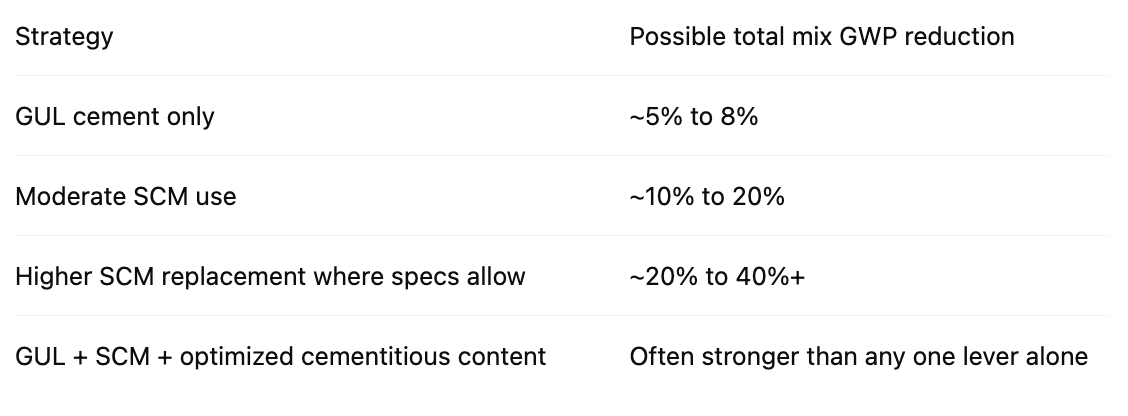
GUL cement, or general use limestone cement, is one of the most practical levers in Canada. It reduces clinker content by using limestone, which can lower cement-related CO2. A common practical estimate is that GUL can reduce cement-related CO2 by about 8% to 10% compared with ordinary portland cement, depending on the cement and data source.
At the concrete mix level, the reduction may be smaller, often around 5% to 8%, because cement is not the only input in the mix.
2. SCMs
Supplementary cementitious materials can reduce GWP by replacing a portion of cementitious material. Common SCMs include slag, fly ash, silica fume, natural pozzolans, and glass pozzolans. Availability varies by region.
Practical planning ranges:
3. Cementitious efficiency
Sometimes the best reduction is using cementitious materials more efficiently. This can include optimizing paste content, improving aggregate gradation, using admixtures effectively, and avoiding over-designed mixes.
4. Performance-based specifications
Performance-based specs are critical. If a project requires high cement minimums, low SCM caps, or unnecessary early strength, producers may not be able to reduce GWP. If the project allows later-age strength or equivalent performance, more low-carbon options become possible.
5. Supplier-specific EPDs
Cement, SCM, and aggregate supplier data can affect the final EPD. Product-specific or facility-specific supplier EPDs can make the concrete EPD more accurate than generic data.
“The lowest practical GWP mix is usually the one that balances cement reduction, SCM use, performance, schedule, and local material availability.”
Practical Field Example 1: Federal Project Asking for 10% Below Baseline
A contractor sends a ready-mix producer a federal project spec asking for concrete to be at least 10% below a regional baseline. The mix is a 25 MPa non-air concrete. The baseline is listed as 254 kg CO2e/m³.
The producer calculates the target: 254 × 0.90 = 229 kg CO2e/m³
The producer checks existing mixes and finds the standard mix is close to the baseline. A GUL cement option brings the mix down to about 238 kg CO2e/m³, which is better but not enough. Adding a moderate SCM adjustment and optimizing cementitious content brings the mix closer to 229 kg CO2e/m³.
The field issue is not just the math. The producer still needs to confirm strength gain, set time, finishability, and CSA requirements. If the spec allows reasonable performance flexibility, the producer can likely meet the requirement. If the spec has unnecessary cement minimums or early strength requirements, the carbon target becomes harder.
Producer lesson: A 10% reduction may be achievable, but only when the producer has the baseline, the mix GWP, the right cementitious options, and enough spec flexibility.
Practical Field Example 2: Institutional Project Asking for Project-Level Carbon Reporting
A university project asks the contractor for embodied carbon documentation across the concrete package. The producer is not just asked for one EPD. They are asked to provide concrete volumes, mix IDs, GWP values, and total kg CO2e by mix.
The producer needs to report something like:
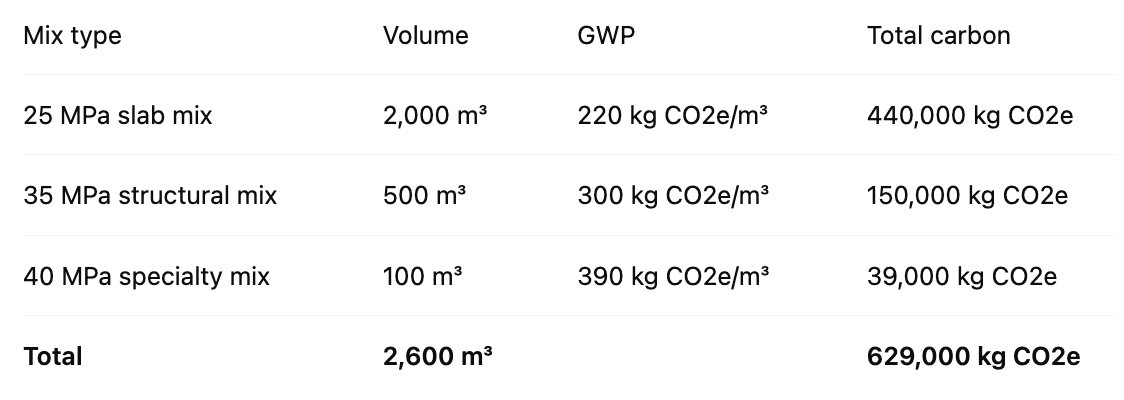
This is where EPD software and organized data become valuable. The producer needs to connect mix designs, volumes, EPDs, and GWP values in a format the contractor can actually use.
Producer lesson: Future requirements may not stop at “send us your EPD.” Producers may be asked to support project-level carbon reporting by mix and volume.
Practical Field Example 3: Low-Carbon Mix Blocked by Prescriptive Spec
A producer has a lower-GWP mix that uses GUL cement and SCMs. The mix performs well and meets the project’s long-term strength requirement. But the spec includes a high minimum cement content, a low SCM cap, and a strict 28-day strength requirement even though the schedule could allow later-age strength.
The result is a conflict. The owner wants low-carbon concrete, but the spec blocks the tools needed to deliver it. The producer may need to request an alternate, provide performance data, or ask the engineer to allow a performance-based option.
Producer lesson: Low-carbon concrete depends on spec flexibility. Carbon requirements and prescriptive mix restrictions need to be reviewed together.
How Ready-Mix Producers Can Get Started
The best time to prepare is before the project asks. If a contractor needs carbon documentation by Friday, it is too late to start collecting plant energy, supplier EPDs, mix records, and baseline data from scratch.
Producer readiness checklist
- Identify the mixes most likely to be requested on low-carbon projects.
- Organize mix design data by plant.
- Track GWP by mix, strength, and application.
- Confirm GUL cement availability.
- Track SCM options by region.
- Ask cement and SCM suppliers for EPDs.
- Organize aggregate source and transportation data.
- Track plant energy and production data.
- Understand which mixes already have EPDs.
- Prepare 10%, 20%, and 30% reduction scenarios for common mixes.
- Review specs for cement minimums, SCM caps, and early strength requirements.
- Train sales, QC, and technical teams on EPD and GWP basics.
- Build a process for project-level carbon reports.
.png)
How Climate Earth Helps Canadian Ready-Mix Producers Prepare
Climate Earth helps concrete producers create and manage EPDs, GWP data, baseline comparisons, and low-carbon concrete documentation across plants, mixes, materials, and project requirements. Our platform is built to make concrete carbon data easier to calculate, update, and use in bids, submittals, and project conversations.
For Canadian producers, that means a practical way to organize mix data, plant data, supplier data, EPDs, GWP baselines, and project carbon reporting. Instead of treating every low-carbon concrete request as a one-off scramble, producers can build a repeatable workflow.
Why Choose Climate Earth?
- Built for concrete producers: Designed around mixes, plants, materials, GWP, EPDs, and project requirements.
- Practical GWP visibility: See the carbon impact of mixes and materials so your team can respond with confidence.
- Support for EPD workflows: Create and manage EPDs without rebuilding the process from scratch every time a customer asks.
- Baseline comparison tools: Compare mix options against project baselines, thresholds, or reduction targets.
- Useful for bids and submittals: Help sales, QC, and technical teams provide carbon data when contractors, owners, engineers, or public agencies ask for it.
- Ready for low-carbon requirements: Prepare for federal procurement, institutional projects, green building requirements, and owner-driven carbon specs.
- Scalable across product lines: Support EPD and carbon reporting needs across ready mix, precast, block, pavers, aggregates, asphalt, dry mix, cement, and SCM-related workflows.
Ready to Get Started? Schedule a demo to see how Climate Earth can help your team create, manage, and use concrete EPDs and GWP data across your business.
FAQ: Canada Ready-Mix Low-Carbon Concrete Requirements
Do Canadian ready-mix producers need EPDs?
Not every project requires an EPD, but EPD requests are becoming more common on federal, institutional, infrastructure, LEED, data center, university, hospital, and owner-driven projects.
Where are low-carbon concrete requirements showing up in Canada?
They are showing up in federal procurement, public infrastructure, provincial and municipal projects, universities, hospitals, green building projects, and private owner specifications.
What is the main federal requirement producers should know?
The main federal signal is Canada’s Standard on Embodied Carbon in Construction, which pushes applicable federal projects toward disclosure and reduction of embodied carbon from ready-mixed concrete.
What is GWP in concrete?
GWP stands for Global Warming Potential. It is the carbon footprint number usually reported as kg CO2e per cubic metre of concrete.
What is a GWP baseline?
A GWP baseline is the reference point used to decide whether a mix is lower carbon. It may be a regional average, industry average, project reference mix, or business-as-usual mix.
What standards do concrete EPDs need to follow?
Concrete EPDs are typically based on ISO 14025, ISO 21930, ISO 14040/14044, and the applicable concrete PCR. Canadian mixes also need to align with CSA concrete and cementitious material requirements such as CSA A23.1/A23.2 and CSA A3001.
How much can GUL cement reduce GWP?
GUL cement can reduce cement-related CO2 by about 8% to 10% in many cases. At the total concrete mix level, the reduction may be lower, often around 5% to 8%, depending on the mix.
How much can SCMs reduce concrete GWP?
Moderate SCM use may reduce total mix GWP by around 10% to 20%. Higher SCM replacement can support 20% to 40% or more reductions where materials, specs, and performance allow.
Why do performance-based specs matter?
Performance-based specs give producers more flexibility to meet carbon and performance goals together. Prescriptive specs with high cement minimums, low SCM caps, or unnecessary early strength requirements can block lower-GWP mix options.
What should producers do first?
Start by organizing mix designs, plant data, cement and SCM information, supplier EPDs, aggregate sources, transportation assumptions, and GWP values for commonly requested mixes.
Summary: What Canadian Ready-Mix Producers Should Know
Low-carbon concrete requirements in Canada are becoming more specific, more data-driven, and more connected to procurement. Producers may be asked for EPDs, GWP values, baseline reductions, project-level carbon summaries, and proof that lower-carbon mixes still meet CSA and project performance requirements.
The most important shift is that carbon is moving into the normal project workflow. It can affect bids, specs, submittals, mix approvals, and contractor conversations. Producers that wait until the request arrives may struggle to respond quickly.
Canadian ready-mix producers should prepare now by organizing EPDs, GWP data, supplier information, mix-level carbon values, and baseline comparison workflows. The producers that can explain carbon and performance clearly will be better positioned as federal procurement, institutional projects, and owner-driven carbon requirements continue to grow.
Related articles

LEED v5 Requirements: What They Mean for Low Carbon Concrete

How to Read a Concrete EPD: Quick, Expert Guide