

CALGreen: A Guide for Ready-Mix Producers and Construction Leaders
CALGreen, part of California’s building standards code, is driving deep changes in the construction industry with mandatory provisions for residential and commercial buildings, encouraging sustainable construction practices and a positive environmental impact across the state. Here’s the essential breakdown for the construction industry.
What is CALGreen?
The California Green Building Standards Code (CALGreen), Part 11 of Title 24 of the California Code of Regulations, is the first mandatory statewide green building code in the United States. It establishes minimum requirements to ensure building sustainability by improving energy efficiency, lowering greenhouse gas emissions, and supporting reductions in embodied carbon across the built environment.
CALgreen mandatory measures apply to most types of construction, covering scope, definitions, building standards, compliance documentation, and enforcement, as well as voluntary Tier 1 and Tier 2 standards that allow projects to exceed minimum code requirements with higher levels of sustainability performance.
CALGreen Timeline
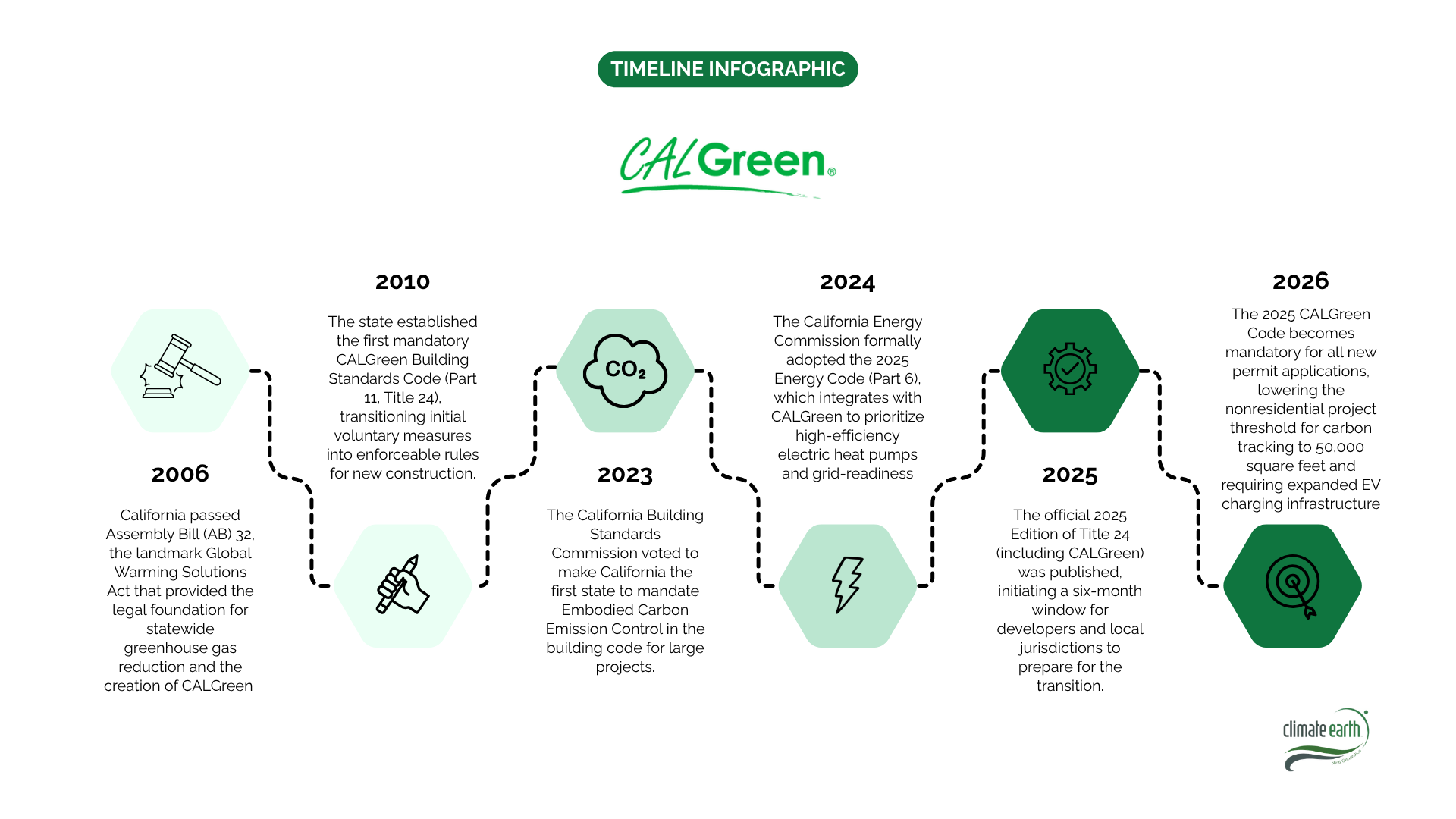
- 2006: California passed Assembly Bill (AB) 32, the landmark Global Warming Solutions Act that provided the legal foundation for statewide greenhouse gas reduction and the creation of CALGreen .
- 2010: The state established the first mandatory CALGreen Building Standards Code (Part 11, Title 24), transitioning initial voluntary measures into enforceable rules for new construction.
- 2023: The California Building Standards Commission voted to make California the first state to mandate Embodied Carbon Emission Control in the building code for large projects.
- October 2023: Governor Newsom signed the Climate Accountability Package (SB 253 and SB 261), requiring large corporations to begin preparing public disclosures of their carbon footprints and climate risks .
- September 2024: The California Energy Commission formally adopted the 2025 Energy Code (Part 6), which integrates with CALGreen to prioritize high-efficiency electric heat pumps and grid-readiness.
- July 1, 2025: The official 2025 Edition of Title 24 (including CALGreen) was published, initiating a six-month window for developers and local jurisdictions to prepare for the transition .
- January 1, 2026: The 2025 CALGreen Code becomes mandatory for all new permit applications, lowering the nonresidential project threshold for carbon tracking to 50,000 square feet and requiring expanded EV charging infrastructure .]
Key Takeaways:
- The California Green Building Standards Code (CALGreen) was first adopted in 2009 and has been updated multiple times, with the latest version effective as of January 1, 2023, focusing on sustainable practices including embodied carbon reduction.
- In July 1, 2024, CALGreen requires non-residential building projects exceeding 100,000 square feet and school projects exceeding 50,000 square feet to address the climate impact of building materials, marking the first statewide embodied carbon building code in the US.
- January 1, 2026: The 2025 CALGreen Code becomes mandatory for all new permit applications.
Which Projects Trigger CALGreen Requirements?
- New construction projects, both residential and non-residential.
- Residential alterations if those expand the building footprint or livable space, since CALGreen provisions may apply to associated structural and site concrete work.
- Larger commercial expansions, spaces exceeding 1,000 square feet, such as retail buildings, warehouses, schools, or industrial facilities.
- Non-residential alterations valued at $200,000 or more, especially where concrete demolition, replacement, or new structural work is involved.

Understanding CALGreen Tier Levels and Applications
CALGreen includes two enhanced sustainability levels, Tier 1 and Tier 2, that are technically voluntary measures at the state level, but often become legally required when adopted by local jurisdictions (cities or counties).
How CALGreen Tiers Affect Concrete & Ready-Mix Producers
For ready-mix producers, projects that use CALGreen Tier requirements, set limits on embodied carbon in concrete can influence whether a mix meets project requirements. According to the American Institute of Architects (AIA), embodied carbon alone accounts for 11% of global annual emissions and is connected to issues of public health and equity, prompting a focus on delivering lower embodied carbon projects as part of CALGreen's new standards.
Example:
Imagine the industry benchmark for a specific concrete mix is set at 100 units of carbon (global warming potential). Think of it like a “carbon ceiling”.
- Mandatory (175% limit): The highest allowable threshold. The ceiling is very high at 175 units, meaning most standard concrete mixes will pass without any changes.
- Tier 1 (115% limit): The ceiling drops to 115 units, so your mix may need moderate adjustments like reducing cement content with materials such as fly ash or slag to stay compliant.
- Tier 2 (100% limit): The strictest threshold. The ceiling drops to the industry average at 100 units, meaning producers need to optimize for a much cleaner, low-carbon mix, or risk not meeting project requirements and potentially losing the bid.
Essentially, California's green building standards code aims to progressively push the market toward a community development that has lower embodied carbon, resource efficiency, material conservation, and higher environmental quality.
CALGreen Requirements by Tier (Mandatory, Tier 1, and Tier 2)
As green building requirements expand across the U.S., builders, designers, and owners increasingly expect suppliers to understand and deliver compliant low-carbon materials. Here are some mandatory measures plus specific tiered prerequisites and electives that projects are required to meet.

Source: Department of General Services (DGS) and Housing and Community Development (HCD)
Key Compliance Requirements for Ready-Mix Producers
Ready-mix producers are essentially "tier-compliant" by providing the following to the builder:
- Type III Environmental Product Declarations (EPDs) for each mix. Without these, the builder cannot prove they met the Tier 1 or Tier 2 requirements .
- Recycled Content Value (RCV) of materials used in the total project, being 10% for Tier 1 and 15% for Tier 2. Producers can meet this by using Supplementary Cementitious Materials (SCMs) like fly ash, slag, or recycled aggregates.
- Low-Carbon Mix Designs, which show how producers are innovating with carbon injection, high-volume SCMs, or alternative cements, to hit Tier 2's aggressive "at industry average" limits.
How CALGreen Impact on Construction Company Operations
CALGreen adds compliance constraints that affect material selection, submittals, and procurement timing. In practice, this often means environmental requirements need to be addressed earlier in preconstruction, especially on projects with Tier requirements or in jurisdictions with stricter enforcement.
For construction teams, this mainly changes the timing of decisions. Materials that were traditionally finalized during procurement may need to be reviewed earlier to confirm compliance with environmental data requirements, such as Environmental Product Declarations (EPDs), particularly for materials like concrete, steel, and assemblies.

It is also important to understand that CALGreen is only one part of California’s broader regulatory framework. HVAC systems, for example, are primarily governed by the California Energy Code (Title 24, Part 6), which focuses on efficiency and performance, while CALGreen addresses construction-related measures such as indoor environmental quality during installation.
Together, CALGreen and the Energy Code operate alongside oversight from state agencies such as the California Energy Commission (CEC) and the California Building Standards Commission (CBSC), which update standards on a regular cycle to align with state climate goals.
Pros and Cons of CALGreen Adoption for the Construction Industry
Pros: CALGreen Creates Competitive Advantage
- CALGreen pushes contractors and suppliers toward innovation in sustainable materials and deconstruction methods, like lower-carbon solutions in concrete mix design, recycled materials, and construction waste reduction strategies.
- Contractors with established compliance processes (EPDs, waste reporting, low-carbon material sourcing) are better positioned during bid evaluation and prequalification with expedited permitting, reduced fees, and even higher property marketability in jurisdictions that enforce higher CALGreen tiers.
Cons: CALGreen Adds Operational Load
- Project teams must coordinate additional documentation, such as Construction Waste Management Plans and, in some cases, Environmental Product Declarations (EPDs) between engineers, estimators, and suppliers.
- Key materials like concrete mixes, steel, and assemblies often need to be confirmed earlier, during preconstruction to meet carbon requirements, reducing flexibility to change materials later in procurement.
- Estimating, procurement, and project management require more cross-team coordination to ensure compliance before bids and submittals are finalized.
- With additional requirements, incomplete or non-compliant documentation can delay submittal approval or trigger revision cycles during review.
- Additional compliance checks and material verification can lengthen permitting and submittal phases, especially on Tier-adopted or public projects.
- If compliant materials are not secured during preconstruction, projects may face substitutions, schedule impacts, or inspection issues later in construction.
How Ready-Mix Producers and Construction Teams Comply with CALGreen
For concrete-heavy scopes, this often centers on confirming that specified mixes meet carbon thresholds and providing supporting data during submittals and approvals. Common compliance approaches include:
- Using concrete mixes with reduced embodied carbon (e.g., SCM-based designs such as fly ash, slag, or calcined clay blends)
- Submitting Environmental Product Declarations (EPDs) when required by project specifications or local jurisdiction
- Tracking and reporting construction waste diversion as part of project closeout requirements
- Coordinating early between ready-mix suppliers, estimators, and project teams to confirm compliant mix availability before submittals
Tools for CALGreen Compliance
[add an image of Climate Earth’s platform in action]
Having the right compliance tools in place helps ready-mix producers and construction teams streamline submittals, reduce rework, and improve coordination, ultimately leading to more efficient project delivery and more predictable results. Climate Earth
- Supports generation and management of EPDs for concrete products
- Helps organize product- and facility-specific emissions data
- Provides third-party verified LCA/EPD documentation for submittals
- Used to streamline reporting of embodied carbon information for project compliance workflows
Book a demo and talk with our experts to see how Climate Earth helps ready-mix producers streamline EPD and carbon data workflows, support compliance requirements, and respond faster to low-carbon project specifications.
Frequently Asked Questions
What is CBSC and why does it matter for CALGreen?
The California Building Standards Commission (CBSC) develops and updates CALGreen and other building codes, often introducing sustainability requirements through public workshops before they become enforceable. This gives contractors and material suppliers early visibility into upcoming changes that can affect design, procurement, and compliance requirements.
What is a Life Cycle Assessment (LCA) and why does it matter in CALGreen?
A Life Cycle Assessment (LCA) measures a building’s environmental impact. In CALGreen, it is used (on qualifying projects) to evaluate and reduce embodied carbon, which directly influences material selection such as concrete mix design and other high-impact building materials.
Which types of construction projects are affected by CALGreen?
CALGreen applies to most new residential and non-residential buildings, as well as many additions and alterations, depending on project size and local enforcement. This means contractors, engineers, and suppliers may be required to meet CALGreen specifications through design, submittals, and material documentation.
How does CALGreen address construction waste?
CALGreen requires that at least 50% of nonhazardous construction and demolition debris be recycled and/or salvaged as part of its sustainability measures. This encourages projects to implement construction waste management practices, which typically include diverting a significant portion of construction and demolition waste away from landfills through reuse, recycling, or salvage strategies supporting material conservation and resource efficiency.
What is a MEP System and how is it affected by CALGreen?
MEP stands for Mechanical, Electrical, and Plumbing systems, which are the main drivers of energy and water use in buildings. CALGreen influences their design by setting efficiency and performance requirements that impact equipment selection, system design, and overall building compliance.
What are CALGreen checklists?
CALGreen checklists are standardized compliance documents used during the building permit process to demonstrate that a project meets the mandatory requirements of the CALGreen code (Title 24, Part 11). They identify applicable green building measures for residential and non-residential projects and must be submitted with permit applications, then verified during construction and final inspection.
Sources
- California Building Standards Commission. CALGreen (Title 24, Part 11).
- International Code Council. 2025 California Green Building Standards Code.
- American Institute of Architects California. CALGreen Checklists.
- Bluebeam blog (Built). California’s ‘CALGreen’ Legislation Spurs Green Building Code.

Descubra cómo Climate Earth puede ayudarle a conseguir más grandes negocios.
Navega por todos los blogs
CALGreen: A Guide for Ready-Mix Producers and Construction Leaders

Net Zero Building Examples: Practical Insights for Concrete Producers
