


The Digital Product Passport Effects in Construction

The Digital Product Passport (DPP) will significantly impact construction material manufacturers by requiring detailed, standardized data on carbon footprint, material composition, and lifecycle performance.
For construction materials, DPPs will rely heavily on Environmental Product Declarations (EPDs), mix design data, and plant-level production metrics. As requirements roll out through 2030, manufacturers that can structure and automate this data will be better positioned for compliance and competitive advantage in low-carbon markets.
Here's what this guide covers:
- Definition and purpose of the Digital Product Passport
- Mandatory nature and implementation timelines of the DPP across sectors
- Sector-specific responsibilities and data requirements for construction
- Step-by-step process for creating and accessing a Digital Product Passport
- Tools and software manufacturers need to navigate DPP compliance effectively
- Frequently asked questions addressing common concerns and clarifications
What Is a Digital Product Passport?
A digital product passports (DPPs) is the collected and shared data about a product and its supply chain across the entire value chain, allowing all stakeholders, including consumers, to gain a deeper understanding of the materials used in products and their associated environmental impacts. Think of it as a comprehensive digital record for product transparency answering every question a regulator, recycler, or buyer might ask about a product.
The core elements of a DPP consist of:
- Unique product identifier compliant with standards like ISO/IEC global trade identification numbers.
- Data carrier (QR code, barcode, NFC, or RFID) linking the physical product to its digital passport.
- Backend data source hosted by the manufacturer or a third-party provider, such as information on substances of concern, user manuals, safety instructions, and guidance on product disposal.
- Access rules defining what information different stakeholders can see.
Typical data include:
- Material composition and origin of key inputs
- Manufacturing site and production date
- Energy consumption and carbon footprint
- Product durability and maintenance information
- Repair and spare parts availability
- Recycling or disposal guidance
Why the Digital Product Passport Matters for Construction Materials?
- It provides a verifiable ID for every component. In 50 years, a contractor can scan a beam and know its load-bearing capacity and chemical safety, allowing it to be reused as a high-value asset rather than discarded.
- It acts as a unified digital locker. One QR code on a pallet of bricks provides the Declaration of Performance, safety data sheets, and carbon footprint simultaneously.
- By tracking the chemical DNA of materials today, future owners can instantly locate and safely remove specific components if regulations change decades from now.
- It turns sustainability data, like EPDs, into machine-readable code. This plugs directly into BIM (Building Information Modeling), allowing architects to calculate the real-time carbon footprint of an entire skyscraper with a click.
What is the difference between a DPP and an EPD?
An Environmental Product Declaration (EPD) is a verified, static report focusing specifically on a product's environmental impact (e.g., carbon footprint), acting as a "nutrition label". A Digital Product Passport (DPP) is a dynamic, digital record containing broader lifecycle, traceability, and circularity data, designed to make EPD data accessible.

Timeline and Key Sectors Affected by the DPP

For concrete producers and construction materials manufacturers, the timeline suggests a 3-5 year lead time before formal requirements take effect. However, unlike a t-shirt, you can't easily scan a QR code on a slab of concrete buried in a building. For these products, the DPP will likely be linked via Building Information Modeling (BIM) or digital building logbooks rather than a physical tag on every cubic meter. So, the Environmental Product Declaration (EPD) is the critical "building block", as your current EPD data will be the primary source for the mandatory environmental fields in your DPP.
Which Evolving Regulations Should Construction Manufacturers Track?
It's important for manufacturers to keep an eye on announcements from US industry bodies and the European Commission to prevent themselves from scrambling while early movers capture competitive advantages in green procurement.
- EU Batteries Regulation (battery passports mandatory from 2026) – relevant for industrial batteries used in construction equipment, ensuring detailed tracking of battery lifecycle and sustainability.
- Right to Repair Directive – promotes product durability and repairability, indirectly impacting construction materials by encouraging longer-lasting products.
- Packaging and Packaging Waste Regulation – affects how construction materials are packaged, aiming to reduce waste and improve recyclability.
- EU Deforestation Regulation (EUDR) – supports responsible sourcing of raw materials, relevant for construction inputs like timber.
- Carbon Border Adjustment Mechanism (CBAM) – targets carbon-intensive imports, influencing construction materials with high embodied carbon.
- EU Construction Products Regulation (updated requirements) – directly governs construction materials, mandating sustainability, transparency, and digital product passport compliance.
Tracking these legislations helps construction manufacturers stay informed about evolving requirements, align their digital product passports with applicable rules, and ensure continued market access while supporting sustainability goals.
Construction Products and Low-Carbon Concrete Under the DPP Framework
Construction products, like cement, concrete, steel, insulation, and glass, have very high embodied carbon and represent a central focus for DPPs over the 2026-2030 period. The construction sector accounts for 37% of EU material use and 11% of emissions, making it impossible to achieve climate goals without addressing these materials.
The construction products regulation is being updated to align with DPP requirements. Manufacturers and importers of construction products will be responsible for creating the DPP, while contractors, designers, and asset owners will use DPP data for regulatory compliance, green building certifications (LEED, BREEAM), and carbon reporting.
Expected key data fields for concrete:
- Cement type and clinker content (target <0.65 for low-carbon)
- Supplementary cementitious materials (SCMs) percentage (up to 60% fly ash/slag)
- Mix design properties and strength class (C20/25 to C50/60)
- Production plant location
- Transport distances and logistics emissions
- Verified EPD/LCA results (GWP, typically 200-500 kg CO2e/m³, energy consumption, water use)
- End-of-life options (crushing for 90% reuse potential)
Construction products DPPs will build heavily on standardized EPDs and mix optimization data. This makes robust carbon accounting and data infrastructure essential for concrete producers. The average concrete has a carbon footprint around 390 kg CO2e/m³, but optimized low-carbon mixes can reduce this by 30% or more.
Early adopters are using EPD-linked QR codes on concrete mixes and prefab elements to share verified carbon and performance data on jobsites. Holcim has piloted QR-EPD systems on concrete products, positioning for ESPR via low-carbon mixes.
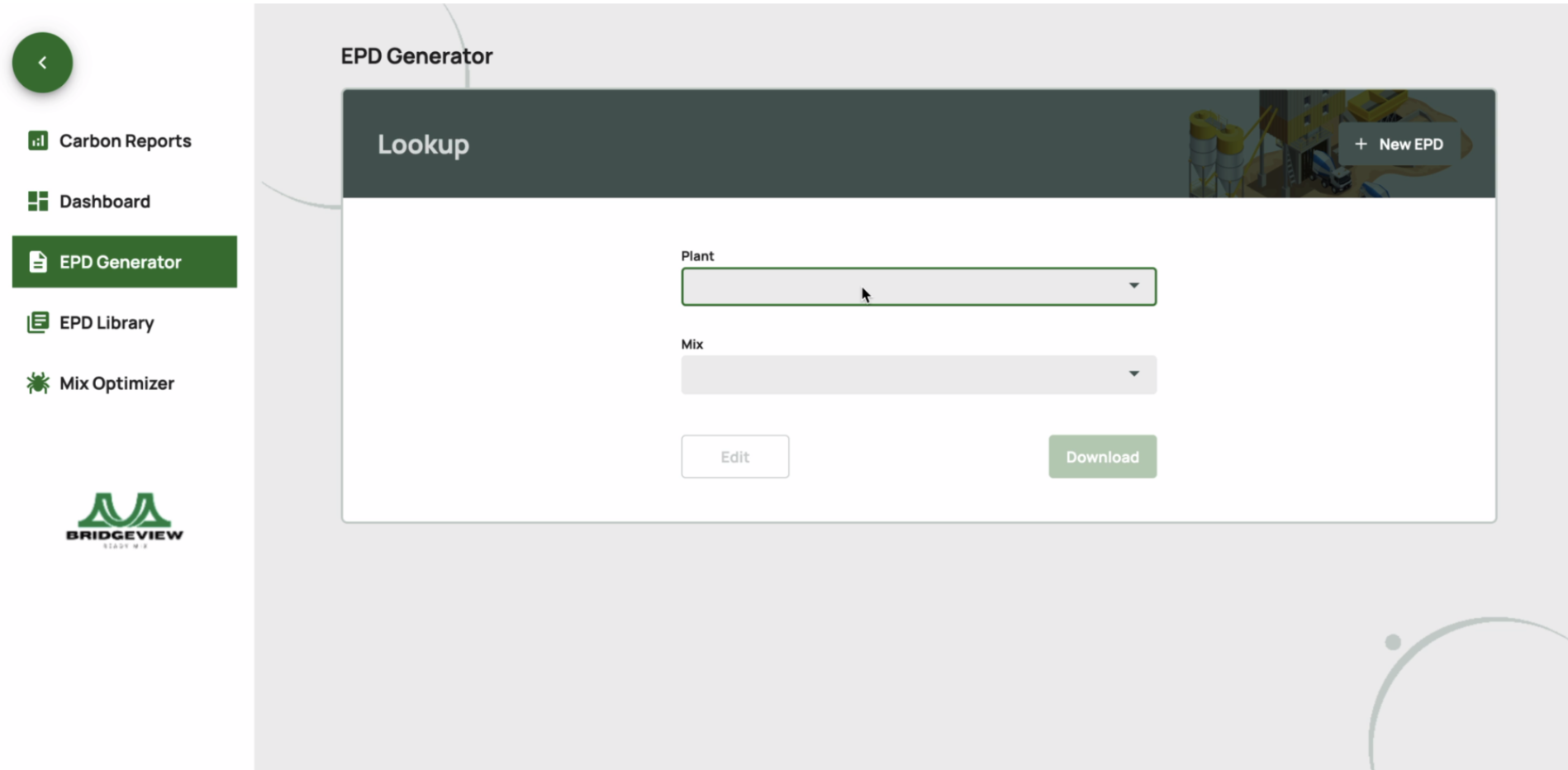
Climate Earth’s EPD generator, mix design optimization, and real-time plant data provide the foundational data engine for DPPs. Producers easily share carbon and materials information without manual rework, directly feeding accurate data into passport schemas.
How to Create a Digital Product Passport (Step-by-Step Guide)
Step 1: Define scope and product hierarchy: Decide whether passports will be at item, batch, or model level. Map your SKUs, variants, and configurations. For concrete, batch-level passports tied to delivery tickets often make the most sense.
Step 2: Identify required data attributes: Review the relevant ESPR Delegated Acts for your sector, industry standards, and customer expectations. For construction products, this includes EPD data, material composition, recycled content, SCM percentages, and strength properties.
Step 3: Map existing data sources: Audit where each required attribute currently lives—ERP, MES, PLM, LCA tools, EPD databases, PIM platforms, supplier portals. Identify gaps. Studies suggest 40-60% of companies find significant data gaps initially.
Step 4: Build or adopt a central data model: Align naming conventions, units, identifiers, and quality rules. Define which data points are public (accessible to any consumer) versus restricted-access (available only to authorized business partners or regulators). Ensure data protection protocols are in place.
Step 5: Select a data carrier and identification scheme: QR codes are most common and work well for construction products. Define printing, engraving, or labeling processes to attach identifiers at the appropriate production stage.
Step 6: Implement automated workflowsSet up data capture, validation, and updating processes. For dynamic data like plant-specific carbon performance, platforms like Climate Earth enable real-time metrics that flow into DPP records without manual intervention.
Step 7: Pilot and test
Start with a limited product line. Validate that regulators, customers, and recyclers can access the right data. Refine access controls, user experience, and governance based on feedback.
How to Access and Use a Digital Product Passport
End-users access a Digital Product Passport (DPP) by scanning a QR code or similar data carrier on the product using a smartphone or scanner. Consumers see public information like material composition, carbon footprint, and recycling guidance to make informed choices. Business users, regulators, and recyclers access additional technical or restricted data through secure portals or APIs, supporting compliance, maintenance, and responsible end-of-life processing.
Example in construction: A project manager scans the QR code on a precast concrete wall panel. The DPP reveals the mix design (C40/50 strength, 45% slag content), verified EPD showing 285 kg CO2e/m³ GWP, production plant location, and instructions for crushing and aggregate reuse at demolition.
Tools and Software Manufacturers Need for DPP Readiness
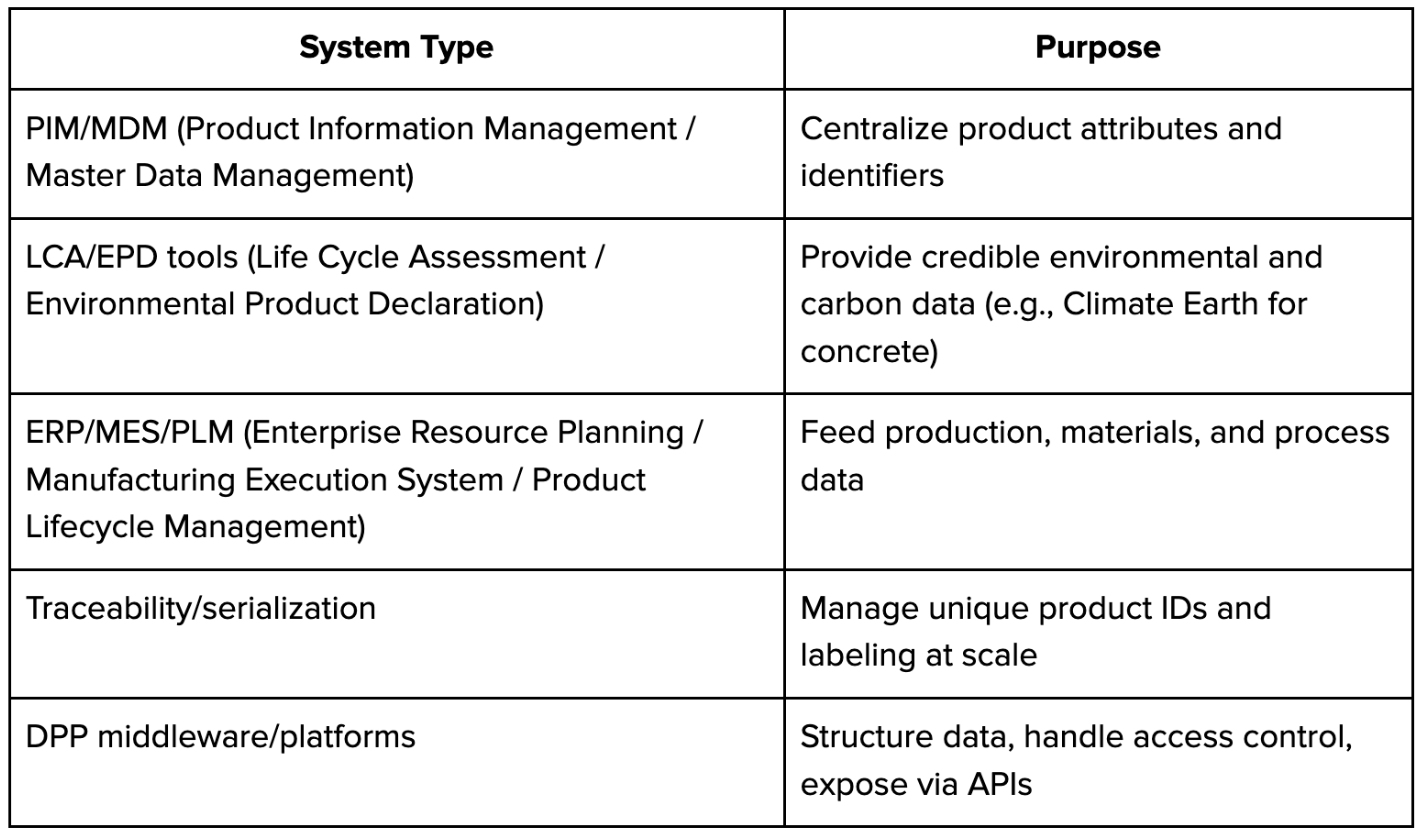
No single system handles everything required for DPP compliance. Manufacturers typically need an ecosystem of tools with clear roles and integrations supporting product lifecycle management to identify bottlenecks, optimize production, reduce waste, and manage inventory more effectively.
Core system categories:
Data governance capabilities to prioritize:
- Data quality rules and validation
- Audit trails for all changes
- User permissions and access tiers
- Change management workflow
Climate Earth’s Role in Enabling Digital Product Passports for Low-Carbon Concrete
Climate Earth’s platform centralizes critical data for digital product passports (DPPs) in concrete. It integrates concrete mix formulations, supplementary cementitious material (SCM) usage, plant- and project-specific Environmental Product Declarations (EPDs), real-time carbon performance metrics, and historical production records.
This comprehensive approach enables construction leaders to automate accurate data feeds into DPP schemas, ensuring compliance with evolving regulations such as ESPR and green building codes. By leveraging AI-powered mix design optimization, Climate Earth helps producers continuously reduce embodied carbon and costs while maintaining performance.
Key benefits for construction leaders include:
- Automated, accurate EPD generation linked directly to product passports
- AI-driven mix design optimization for lower carbon footprints and cost savings
- Streamlined certification compliance to ensure regulatory adherence
- Enhanced transparency and data visibility across the supply chain
- Support for meeting multiple regulations including ESPR and green procurement standards
FAQs About the Digital Product Passport
Is the Digital Product Passport Mandatory?
The Digital Product Passport (DPP) is mandatory in the EU under the Ecodesign for Sustainable Products Regulation (ESPR) since 2024. It requires manufacturers, importers, distributors, and retailers of sectors in scope to provide accessible DPPs containing verified data on materials, carbon footprint, durability, and end-of-life instructions. Non-compliance may lead to penalties, product recalls, or market restrictions.
What is the Circular Economy and Sustainability Initiative?
The circular economy initiative aims to minimize waste and extend the longevity of resources and products by promoting sharing, repairing, reusing, and recycling practices. Under the European Union's Circular Economy Action Plan (CEAP), several industries, including construction, are prioritized for the adoption of digital product passports to enhance sustainability and reduce waste.
What is the EU digital identity regulation?
The EU digital identity regulation, featuring eIDAS 2.0 and the European Digital Identity Wallet, is a key enabler for secure, EU-wide digital identification of people and businesses. Although primarily focused on users rather than products, it intersects with digital product passport implementation by enabling authenticated access, digital signatures, and data security for passport data. This framework enhances data transparency and consumer trust by ensuring clear traceability of who creates or modifies records, supporting compliance with related legislation. By integrating with digital product passports, the regulation facilitates data sharing across the entire value chain, enabling new business models and circular business models while enhancing transparency and product sustainability throughout the entire lifecycle.
Does a DPP replace an EPD or LCA?
No. DPPs do not replace EPDs or LCAs, but reference or embed EPD/LCA results as one part of a broader product data set. Digital product passports (DPPs) are designed to collect and share data about a product and its supply chain across the entire value chain, enhancing supply chain management and traceability. For construction materials, EPDs remain the foundation with DPPs simply make that data more accessible and connect it to additional lifecycle information.
Which Regulations Impacted the Creation of DPP?
The Digital Product Passport is integral to the EU’s sustainability agenda, supporting the European Green Deal’s 2050 climate neutrality goal and the Circular Economy Action Plan’s focus on reducing waste, enhancing product durability, and recyclability. Enforced by the 2024 Ecodesign for Sustainable Products Regulation, it mandates detailed, sector-specific DPP requirements through delegated acts up to 2030.
Next Steps for Manufacturers and Concrete Producers
Digital product passports facilitate better data sharing and collaboration across the industry, which is essential for effective supply chain management and compliance with sustainability regulations. Manufacturers should:
- Track ESPR Delegated Acts relevant to their sector
- Audit and centralize existing product and carbon data (EPDs, LCAs, mix designs, ERP)
- Standardize data using tools like PIM and Climate Earth’s LCA platforms
- Pilot a DPP project on a limited product range to identify gaps
For concrete producers, this is the time to build your data infrastructure and position your operation at the front of digitally connected construction supply chains. Streamline your DPP efforts, avoid duplication, and make your low-carbon and EPD strategies more effective. Book a demo and see Climate Earth’s EPD generator easily build your compliant data foundation and gain a competitive edge in low-carbon markets.

Find out how Climate Earth can help you win more big business.
Browse all blogs

BREEAM: A Guide for Construction & Concrete | Climate Earth
The Digital Product Passport Effects in Construction