

BREEAM: A Guide for Construction & Concrete | Climate Earth

As of 2023, BREEAM has certified over 590,000 buildings worldwide and has registered more than 2.9 million buildings for certification across 103 countries. For construction leaders, complying with BREEAM is essential for securing planning approvals, satisfying investor demands, and optimizing concrete mix designs to achieve higher ratings and a competitive advantage when securing projects.
What is BREEAM?
BREEAM stands for Building Research Establishment Environmental Assessment Method. First published in 1990 by the Building Research Establishment (BRE), it is the longest-established method for assessing the sustainability performance of buildings.
Why BREEAM matters for executives and project teams:
BREEAM certification can reduce operational costs, helping to limit investor and developer risk while making buildings more attractive to let, sell, or retain. It
- Links directly to embodied carbon reduction in construction materials.
- Meets ESG and regulatory reporting requirements (CSRD, SFDR, EU Taxonomy).
- Enables access to sustainability-driven tenders and planning approvals.
- Supports premium valuations; BREEAM-certified buildings have 8-12% higher market values than non-certified ones.
- Aligns with net-zero commitments across the sustainable built environment.
How BREEAM Assessment Works?
A licensed BREEAM assessor evaluates a project against the requirements of the relevant BREEAM scheme and its technical criteria, collecting evidence at design and post-construction stages. Rates range from 'Unclassified' to 'Outstanding'; 'Pass' are usually for scores above 30% and 'Outstanding' for scores that are above 85%. But, those are rare and usually reserved for flagship net-zero pioneers.
Main BREEAM schemes/standards used globally:
- BREEAM New Construction – New non-domestic and residential buildings from design through post-construction.
- BREEAM Refurbishment and Fit Out – Partial and major upgrades to fabric, services, and interiors.
- BREEAM In Use – Operational performance for existing assets (Asset Performance, Building Management, Occupier Management).
- BREEAM Communities – Large-scale masterplans and regeneration at pre-planning stages.
- BREEAM Infrastructure – Civil engineering works including roads, rail, utilities, and bridges.
Core technical categories:
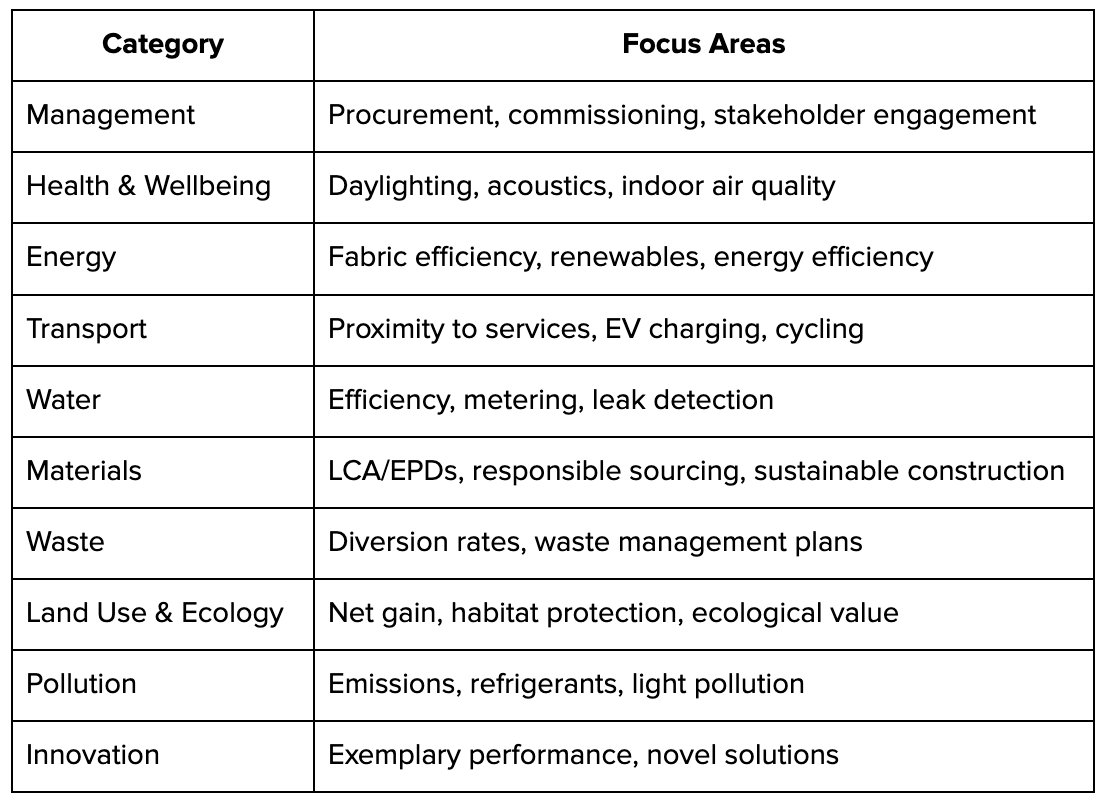
Buildings are rated on a scale from 'Unclassified' to 'Outstanding', with specific percentage thresholds corresponding to each rating level, such as 'Pass' for scores above 30% and 'Outstanding' for scores above 85%, those are rare and usually reserved for flagship net-zero pioneers.
BREEAM rating bands:
- Pass – ≥30% (top 75% of typical sustainability performance)
- Good – ≥45% (intermediate good practice)
- Very Good – ≥55% (advanced good practice)
- Excellent – ≥70% (top 10%)
- Outstanding – ≥85% (top 1%, representing best practice)
BREEAM Applications: How It Affects Different Projects?
BREEAM in New Construction
The BREEAM New Construction standard applies to new commercial buildings, schools, hospitals, logistics facilities, and, in some markets, residential buildings. Concrete producers may earn Materials (MAT) credits for EPD use or responsible sourcing certifications, like BES 6001. They may also get Innovation credits for novel low-carbon binders. The construction technical manual provides detailed guidance on evidence requirements.
Design stage impacts:
- Early sustainability workshops to embed low-carbon materials
- Selection of concrete mixes with high supplementary cementitious materials (SCMs) content
- Energy modelling for operational efficiency
- Orientation and massing decisions for passive solar gain
Construction stage impacts:
- Site logistics planning to reduce transport carbon emissions
- Waste minimisation targeting 95%+ diversion from landfill
- On-site carbon tracking and documentation
- Verified EPDs for concrete, steel, and insulation
BREEAM Refurbishment & Fit Out
Decarbonizing existing buildings is one of the biggest challenges in the green transition. It requires retrofitting millions of unique, older structures, which could cut operational carbon by up to 80%. A significantly lower environmental impact than new constructions have. The BREEAM RFO scheme provides a 'checklist' to help project teams achieve high sustainability ratings through strategic, phased upgrades.
BREEAM Refurbishment & Fit Out:
- Applied to partial and major refurbishments since around 2014
- Covers fabric upgrades, service replacement, and interior fit-out
- Credits for low-disruption measures like prefabricated panels
- Material and Waste credits for recycled content and EPDs
The "Must-Haves" for an Excellent Rating
- Timber: Must be 100% legally sourced (FSC/PEFC).
- Energy: Must install sub-meters for all major systems (heating, lighting, etc.).
- Waste: Must have a formal Waste Management Plan and hit high recycling targets.
- Site Management: Must use a sustainability coordinator and monitor site energy/water use.
- Handover: Must provide a Building User Guide to the tenants.
- Commissioning: Must perform a full professional test of all building systems before move-in.
- CO2 Reduction: Must achieve a score in Ene 01 (Energy Efficiency) to prove the building is "green."
If you miss even one of these, you cannot get an "Excellent" rating, no matter how many other points you have. However, you can pursue reassessment or target a higher rating on future phases.
BREEAM for In Use Properties
The BREEAM In-Use assesses buildings already in operation. It provides a framework for owners and managers to measure, manage, and improve the environmental performance of existing assets. This is the "living" certification that proves a building remains efficient year after year.
- Three-part system: Part 1 (Asset Performance), Part 2 (Building Management), Part 3 (Occupier Management)
- Benchmarks operational data, including energy usage, occupant surveys, and asset audits
- Recertification is required every 3 years.
- Helped improve asset performance across portfolios from hospitals to retail centers
Construction leaders must plan work around occupied buildings. This includes HVAC, lighting, envelope upgrades, but also low-carbon concrete floor slabs, toppings, and structural strengthening. These last ones contribute to Material and Waste credits.
BREEAM Communities and large-scale masterplanning
BREEAM Communities assesses sustainability at large scale. Essentially, new districts, regeneration schemes, and multi-phase developments delivered over 10-20 years. It targets local authorities, master developers, and investors, and has three steps:
- Step 1: Establishing the principle
- Step 2: Determining the layout
- Step 3: Designing the details.
Main focus areas:
- Governance and stakeholder engagement
- Land use and brownfield prioritization
- Transport, connectivity, and active travel infrastructure
- Social and economic well-being
- Climate change resilience and flood modelling
- Resource and infrastructure planning
For concrete producers, this speaks to infrastructure decisions and early specifications, like low-carbon pavements, district energy systems, and materials procurement.
BREEAM for infrastructure and civil engineering
BREEAM Infrastructure, formerly CEEQUAL before being acquired by BRE in 2015, applies to civil engineering projects including highways, rail, utilities, water treatment, and bridges.
Key themes:
- Climate change resilience and adaptation
- Carbon and energy performance with mandatory LCA
- Materials sourcing with EPD requirements
- Resource efficiency and circular economy
- Ecological value and biodiversity impacts
- Community effects, including noise mitigation
Typical scenario: A multi-year highway upgrade from 2023-2030 deploys low-carbon clinker mixes across 100km of road. By using 40-60% GGBS or PFA replacement, verified EPDs, and digital carbon tracking, the project achieves “Excellent” through 25% embodied carbon reduction and biodiversity enhancements.
The BREEAM certification process step by step
While each scheme has specifics, most projects follow a consistent certification process:
- Confirm scheme application and set target rating (“Very Good” or “Excellent”)
- Appoint a licensed BREEAM assessor and/or also a BREEAM Accredited Professional (AP)
- Register with BRE and pay registration fees or the relevant national scheme operators.
- Conduct BREEAM pre-assessment at RIBA Stage 1-2, the early design workshops.
- Submit evidence for interim certification, at the design stage assessment.
- Collect and monitor construction evidence, including waste logs, material certifications, and EPDs
- Conduct a post construction assessment with a final review and certificate issuance.
Early engagement correlates with +10-15% score improvements because fundamental design decisions remain flexible. Typical new-build projects spend 18-36 months from registration to final certification.
How long BREEAM certification lasts and when to recertify
BREEAM certification reflects an individual building’s performance at a point in time, with rules varying by scheme.
- New Construction / Refurbishment – Certificates are perpetual but relevance declines as buildings age or undergo alterations.
- In-Use – Certificates valid for 3 years; reassessment required to maintain rating.
- Infrastructure / Communities – Phase-tied assessments with triggers for major modifications.
Asset managers should plan recertification as part of 5-7 year upgrade cycles to maintain a building’s BREEAM rating and demonstrate continued environmental sustainability.
What BREEAM costs: fees, project overhead and material impacts
BREEAM costs fall into three categories:
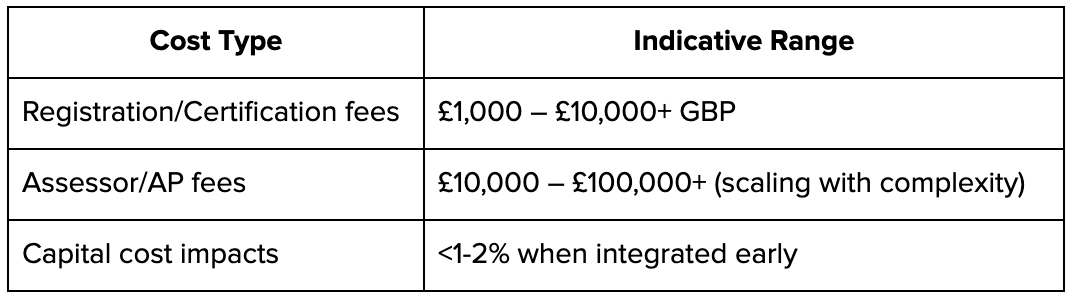
BREEAM measures may add minimal extra capital cost when embedded from project inception, and a higher upfront investment is offset by lower energy usage, reduced maintenance costs, and better compliance positioning.
Benefits and challenges of BREEAM for construction and concrete leaders
BREEAM’s holistic approach creates both opportunity and management complexity.
Key benefits:
- Improved asset value, liquidity, and access to sustainable development finance
- Reduced operational costs (20%+ energy savings common)
- Reduced climate and regulatory risk
- Healthier environments with better indoor air quality for occupants
- Stronger ESG reporting and stakeholder confidence
- Market differentiation on competitive tenders
For concrete producers specifically:
- Earlier involvement in sustainable building design discussions
- Growing demand for low-carbon mixes
- Long-term supply agreements tied to sustainability criteria
Key challenges:
- Documentation burden across project teams
- Need for specialist BREEAM accreditation and expertise
- Managing supply chain data including EPDs and LCA results
- Balancing cost, programme, and sustainability goals
- Adapting to evolving versions (BREEAM International, V7 from 2025)
Frequently asked questions about BREEAM
Is BREEAM mandatory?
BREEAM isn’t legally mandatory, but many UK government projects, local authorities, and private investors require it as a planning or funding condition.
What is the difference between BREEAM and LEED?
BREEAM dominates Europe with a science-led, life cycle approach whereas LEED (Leadership in Energy and Environmental Design) leads in the US with more flexible points-based scoring. Both achieve environmental goals through different frameworks.
Can industrial and logistics buildings be certified?
Yes. Industrial facilities, warehouses, and logistics hubs regularly achieve “Excellent” ratings through low-carbon concrete, efficient lighting, and optimised envelopes.
How does BREEAM V7 change requirements after 2025?
V7 mandates LCA for structural elements exceeding 20% of costs and strengthens biodiversity net gain requirements.
Which BREEAM credits relate most to concrete?
Materials (MAT) credits reward EPDs, low-carbon mixes, and responsible sourcing. Innovation credits recognise novel binders like geopolymers.
What data do concrete suppliers need to provide?
Environmental Product Declarations (EPDs), mix carbon data, and responsible sourcing documentation (e.g., BES 6001 certification).
Can software simplify BREEAM compliance?
Yes. Platforms like Climate Earth automate carbon calculations, EPD generation, and reporting, reducing manual evidence gathering significantly.
Stay Competitive with BREEAM to drive low-carbon construction
BREEAM has become a leading global sustainability standard, helping construction teams improve environmental performance and remain competitive across all stages of a project lifecycle.
With cement and concrete accounting for a significant share of embodied carbon in buildings, producers and project teams are under increasing pressure to deliver verified, transparent carbon data and adopt lower-carbon mix designs.
By aligning with BREEAM requirements, projects can reduce embodied carbon, strengthen ESG performance, and unlock higher asset value and improved market competitiveness.
Book a demo to see how Climate Earth’s EPD generator and concrete mix design tools help you measure embodied carbon accurately, optimize material choices, and support BREEAM-aligned project outcomes.

Find out how Climate Earth can help you win more big business.
Browse all blogs
BREEAM: A Guide for Construction & Concrete | Climate Earth

The Digital Product Passport Effects in Construction